Gini Beatrice, Thomas Nicholas, Blakely Collin M
Department of Medicine, University of California, San Francisco, California, USA.
Helen Diller Family Comprehensive Cancer Center, University of California, San Francisco, California, USA.
J Thorac Dis. 2020 May;12(5):2883-2895. doi: 10.21037/jtd.2020.03.78.
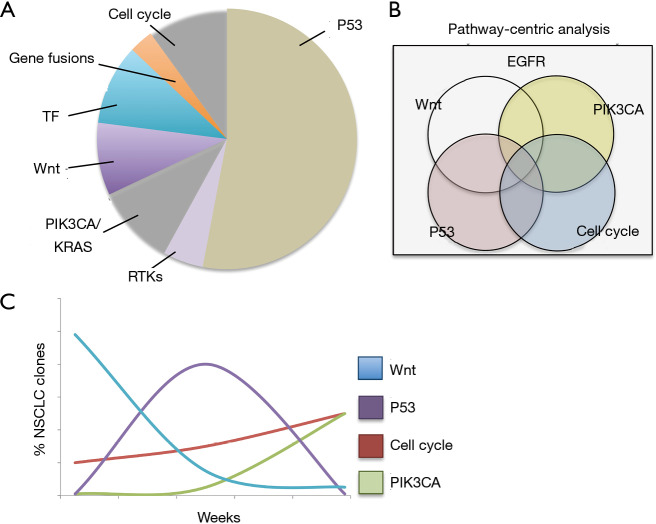
Comprehensive characterization of the genomic landscape of epidermal growth factor receptor ()-mutated lung cancers have identified patterns of secondary mutations beyond the primary oncogenic mutation. These include concurrent pathogenic alterations affecting p53 (60-65%), RTKs (5-10%), PIK3CA/KRAS (3-23%), Wnt (5-10%), and cell cycle (7-25%) pathways as well as transcription factors such as MYC and NKX2-1 (10-15%). The majority of these co-occurring alterations were detected or enriched in samples collected from patients at resistance to tyrosine kinase inhibitor (TKI) treatment, indicating a potential functional role in driving resistance to therapy. Of note, these co-occurring tumor genomic alterations are not necessarily mutually exclusive, and evidence suggests that multiple clonal and sub-clonal cancer cell populations can co-exist and contribute to EGFR TKI resistance. Computational tools aimed to classify, track and predict the evolution of cancer clonal populations during therapy are being investigated in pre-clinical models to guide the selection of combination therapy switching strategies that may delay the development of treatment resistance. Here we review the most frequently identified tumor genomic alterations that co-occur with mutated and the evidence that these alterations effect responsiveness to EGFR TKI treatment.
对表皮生长因子受体(EGFR)突变型肺癌基因组格局的全面表征已确定了除原发性致癌EGFR突变之外的继发性突变模式。这些包括同时发生的影响p53(60 - 65%)、受体酪氨酸激酶(RTKs,5 - 10%)、PIK3CA/KRAS(3 - 23%)、Wnt(5 - 10%)和细胞周期(7 - 25%)通路的致病性改变,以及诸如MYC和NKX2 - 1(10 - 15%)等转录因子。这些共发生的改变大多在从对酪氨酸激酶抑制剂(TKI)治疗耐药的患者收集的样本中被检测到或富集,表明其在驱动治疗耐药性方面具有潜在功能作用。值得注意的是,这些共发生的肿瘤基因组改变不一定相互排斥,并且有证据表明多个克隆和亚克隆癌细胞群体可以共存并导致EGFR TKI耐药。旨在对治疗期间癌症克隆群体的进化进行分类、追踪和预测的计算工具正在临床前模型中进行研究,以指导可能延迟治疗耐药性发展的联合治疗转换策略的选择。在此,我们综述了与EGFR突变同时出现的最常见的肿瘤基因组改变,以及这些改变影响对EGFR TKI治疗反应性的证据。