Pal Rimesh, Yadav Urmila
Post Graduate Institute of Medical Education and Research, Chandigarh, India.
J Prim Care Community Health. 2020 Jan-Dec;11:2150132720939402. doi: 10.1177/2150132720939402.
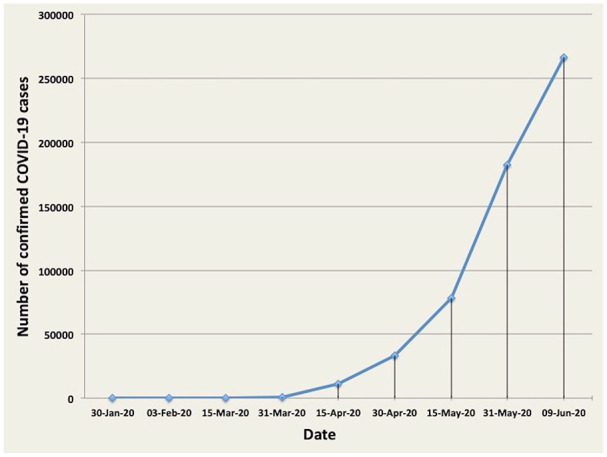
Amid the ongoing COVID-19 pandemic, India has witnessed a massive surge of cases in the past 3 weeks. As of April 30, 33 610 confirmed cases and 1075 deaths have been reported from 32 states/union territories in India. Apart from the nationwide lockdown, India has increased its testing rate and has markedly strengthened the health care sector to combat COVID-19. With India's population of more than 1.3 billion people at a significant population density compared with the rest of the world, the lack of universal access to clean water and overall poor socioeconomic status, all have posed a major challenge to India's fight against COVID-19. Failure to contain the pandemic in India could have disastrous consequences with widespread cases and thousands of deaths that could easily overwhelm the health care infrastructure. Unabated spread of the pandemic could make India the next COVID-19 hotspot; hence the World Health Organization has recently stated that the "future of the pandemic will depend on how India handles it." Here, we have summarized the present scenario of the pandemic in India and the myriad challenges being faced by the country in its fight against COVID-19.
在持续的新冠疫情期间,印度在过去3周内病例数大幅激增。截至4月30日,印度32个邦/中央直辖区已报告33610例确诊病例和1075例死亡病例。除了全国范围的封锁措施外,印度提高了检测率,并显著加强了医疗保健部门以抗击新冠疫情。印度拥有超过13亿人口,与世界其他地区相比人口密度很大,缺乏普遍的清洁水供应以及整体社会经济状况不佳,所有这些都给印度抗击新冠疫情带来了重大挑战。若无法在印度控制疫情,可能会造成灾难性后果,病例广泛传播,数千人死亡,这很容易使医疗保健基础设施不堪重负。疫情的持续蔓延可能会使印度成为下一个新冠疫情热点地区;因此,世界卫生组织最近表示,“疫情的未来将取决于印度如何应对”。在此,我们总结了印度当前的疫情形势以及该国在抗击新冠疫情中面临的众多挑战。