Kolyvushko Oleksandr, Kelch Maximilian A, Osterrieder Nikolaus, Azab Walid
Institut für Virologie, Robert von Ostertag-Haus, Zentrum für Infektionsmedizin, Freie Universität Berlin, Robert-von-Ostertag-Str. 7-13, 14163 Berlin, Germany.
Microorganisms. 2020 Jul 7;8(7):1013. doi: 10.3390/microorganisms8071013.
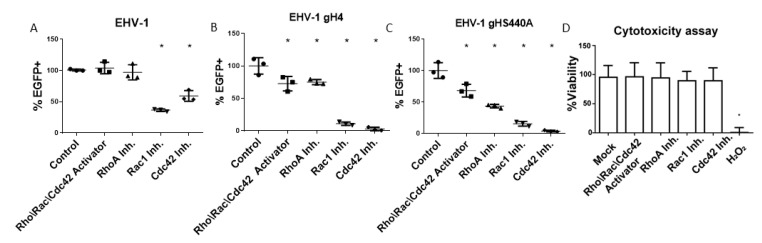
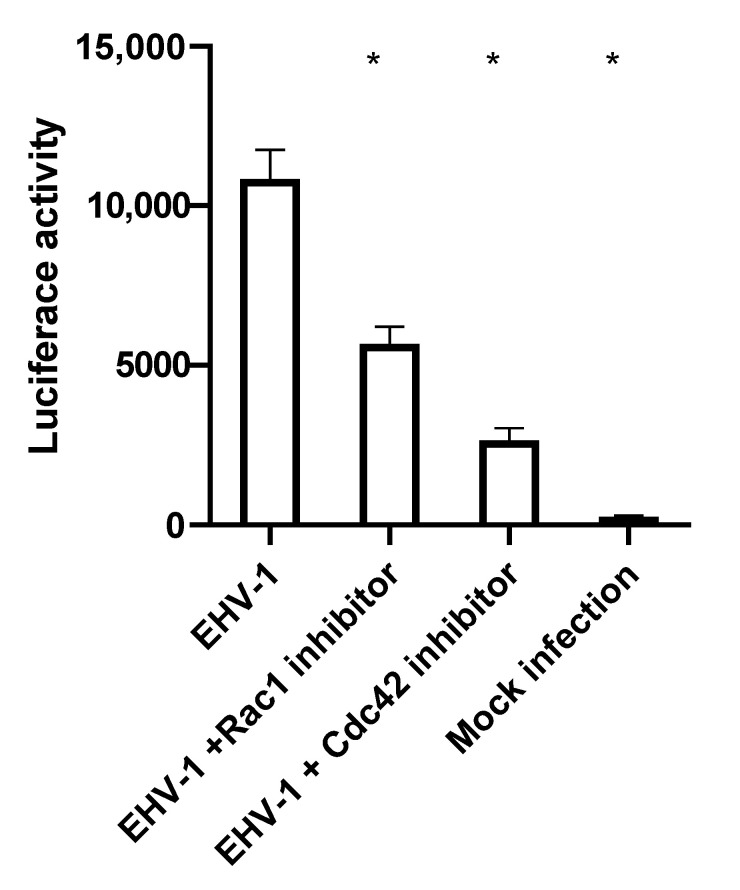
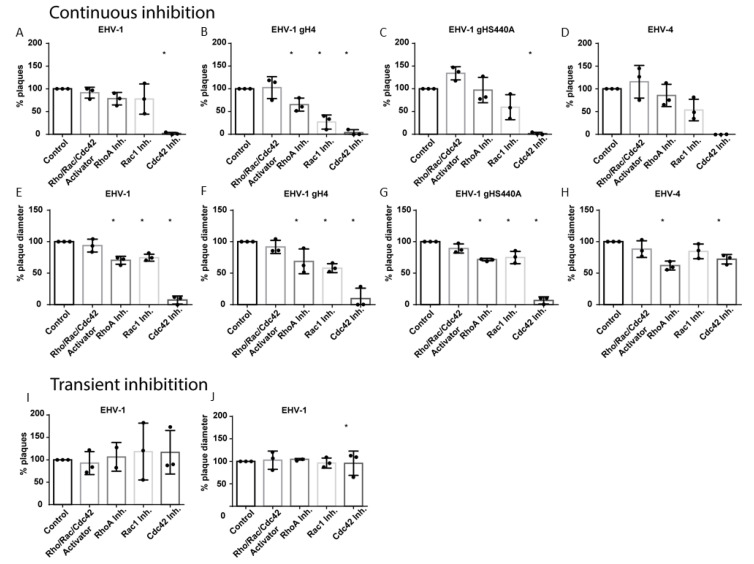
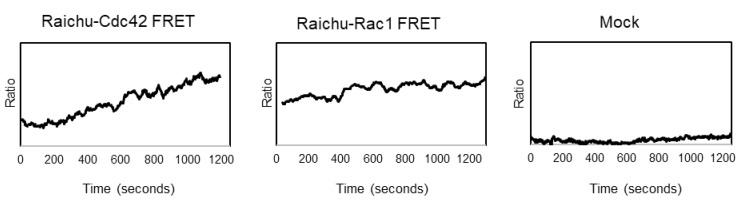
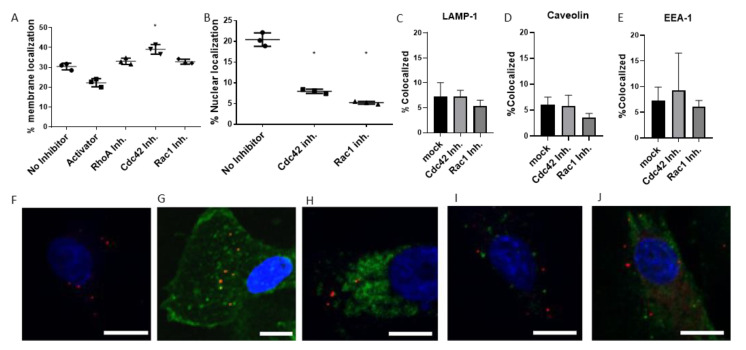
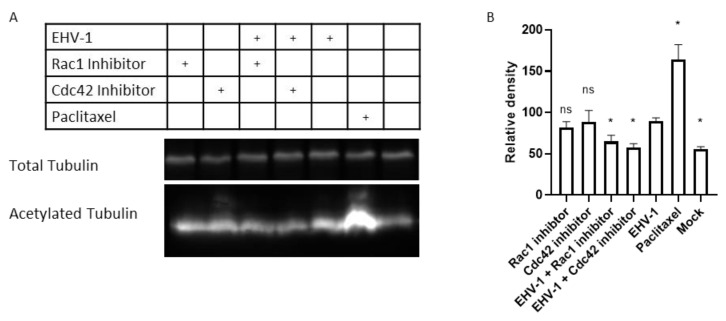
Viruses utilize host cell signaling to facilitate productive infection. Equine herpesvirus type 1 (EHV-1) has been shown to activate Ca2+ release and phospholipase C upon contact with α4β1 integrins on the cell surface. Signaling molecules, including small GTPases, have been shown to be activated downstream of Ca2+ release, and modulate virus entry, membrane remodeling and intracellular transport. In this study, we show that EHV-1 activates the small GTPases Rac1 and Cdc42 during infection. The activation of Rac1 and Cdc42 is necessary for virus-induced acetylation of tubulin, effective viral transport to the nucleus, and cell-to-cell spread. We also show that inhibitors of Rac1 and Cdc42 did not block virus entry, but inhibited overall virus infection. The Rac1 and Cdc42 signaling is presumably orthogonal to Ca2+ release, since Rac1 and Cdc42 inhibitors affected the infection of both EHV-1 and EHV-4, which do not bind to integrins.
病毒利用宿主细胞信号传导来促进有效感染。1型马疱疹病毒(EHV-1)已被证明在与细胞表面的α4β1整合素接触时会激活Ca2+释放和磷脂酶C。包括小GTP酶在内的信号分子已被证明在Ca2+释放的下游被激活,并调节病毒进入、膜重塑和细胞内运输。在本研究中,我们表明EHV-1在感染过程中激活小GTP酶Rac1和Cdc42。Rac1和Cdc42的激活对于病毒诱导的微管蛋白乙酰化、病毒有效转运至细胞核以及细胞间传播是必要的。我们还表明,Rac1和Cdc42的抑制剂不会阻断病毒进入,但会抑制整体病毒感染。Rac1和Cdc42信号传导可能与Ca2+释放正交,因为Rac1和Cdc42抑制剂会影响EHV-1和EHV-4的感染,而这两种病毒并不与整合素结合。