Department of Internal Medicine, Seoul National University Bundang Hospital, Seoul National University College of Medicine, Seongnam, Korea.
Department of Radiology, Seoul National University Bundang Hospital, Seoul National University College of Medicine, Seongnam, Korea.
Clin Mol Hepatol. 2020 Oct;26(4):492-505. doi: 10.3350/cmh.2020.0005. Epub 2020 Jul 10.
BACKGROUND/AIMS: The role of serum myokine levels in sarcopenia and the outcome of hepatocellular carcinoma (HCC) patients are not clear. This study investigated the serum levels of myostatin, follistatin, and interleukin-6 (IL-6) in HCC patients and their association with sarcopenia and survival.
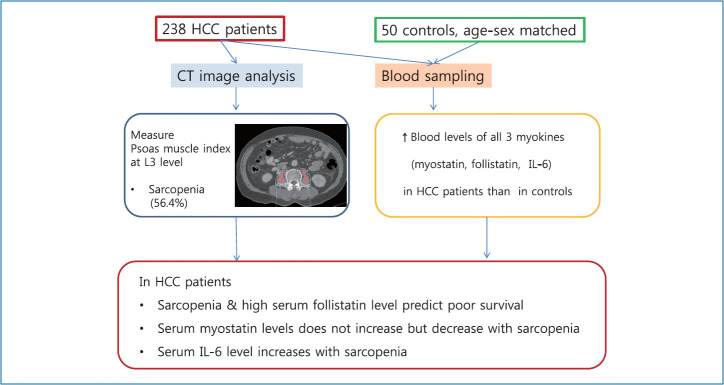
Using prospectively collected pretreatment samples from 238 HCC patients in a hospital from 2012 to 2015, the serum levels of 3 myokines were determined and compared to 50 samples from age and sex-matched healthy controls. Sarcopenia was evaluated using the psoas muscle index (PMI) measured at the third lumbar level in the computed tomography, and clinical data were collected until 2017.
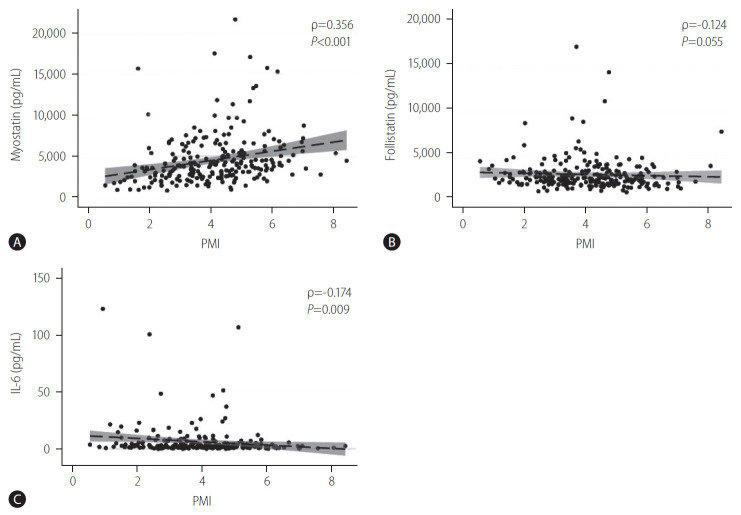
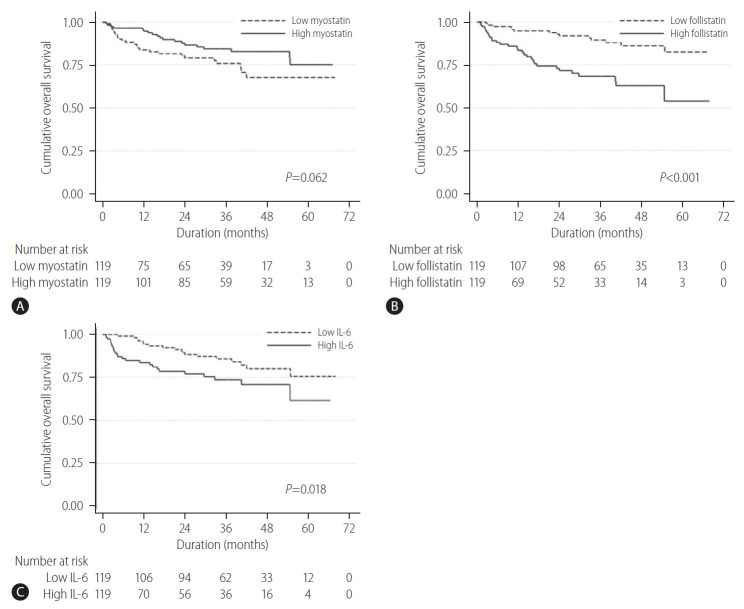
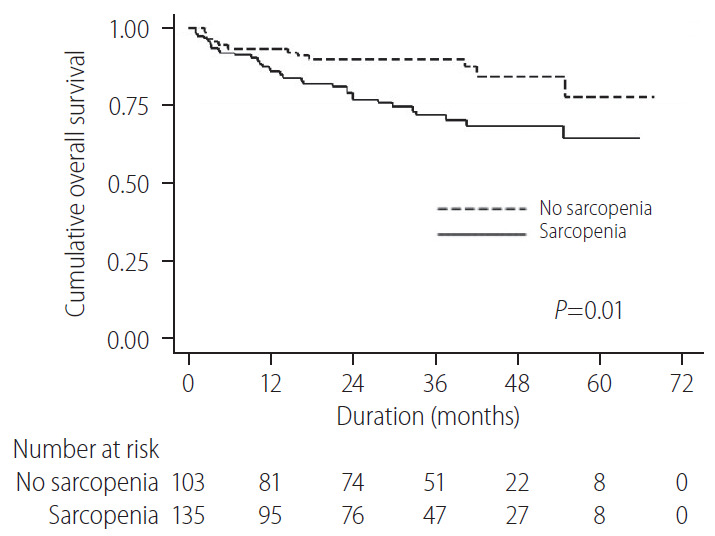
The median levels of the 3 myokines for the male and female HCC patients were as follow: myostatin (3,979.3 and 2,976.3 pg/mL), follistatin (2,118.5 and 2,174.6 pg/mL), and IL-6 (2.5 and 2.7 pg/mL), respectively. Those in the HCC patients were all significantly higher than in the healthy controls. In the HCC patient, the median PMI was 4.43 (males) and 2.17 cm2/m2 (females) with a sarcopenic prevalence of 56.4%. The serum levels of myostatin, IL-6 and follistatin in the HCC patients showed a positive, negative, and no correlation with PMI, respectively. The serum follistatin level was an independent factor for poor survival in HCC patients.
The serum levels of myostatin, follistatin, and IL-6 and their correlation with sarcopenia and survival were presented in HCC patients for the first time. The role of the serum follistatin level as a poor prognostic biomarker warrants further study.
背景/目的:血清肌因子水平在肌肉减少症和肝细胞癌(HCC)患者预后中的作用尚不清楚。本研究检测了 HCC 患者血清中肌肉生长抑制素、卵泡抑素和白细胞介素 6(IL-6)的水平,并探讨了其与肌肉减少症和生存的关系。
收集 2012 年至 2015 年期间在一家医院接受治疗的 238 例 HCC 患者的前瞻性预处理样本,并与 50 例年龄和性别匹配的健康对照者的血清样本进行比较。采用 CT 第 3 腰椎水平测量的竖脊肌指数(PMI)评估肌肉减少症,收集临床资料至 2017 年。
男性和女性 HCC 患者的 3 种肌因子的中位数水平分别为:肌肉生长抑制素(3979.3 和 2976.3 pg/ml)、卵泡抑素(2118.5 和 2174.6 pg/ml)和白细胞介素 6(2.5 和 2.7 pg/ml),均显著高于健康对照组。HCC 患者中,PMI 的中位数分别为男性 4.43cm2/m2 和女性 2.17cm2/m2,肌肉减少症的患病率为 56.4%。HCC 患者的血清肌肉生长抑制素、IL-6 和卵泡抑素水平与 PMI 呈正相关、负相关和无相关性。血清卵泡抑素水平是 HCC 患者不良生存的独立因素。
本研究首次报道了 HCC 患者血清中肌肉生长抑制素、卵泡抑素和白细胞介素 6 水平及其与肌肉减少症和生存的关系。血清卵泡抑素水平作为不良预后生物标志物的作用有待进一步研究。