Hayashibara Co. Ltd., 675 Fujisaki, Naka-ku, Okayama, 702-8006, Japan.
Nutr J. 2020 Jul 9;19(1):68. doi: 10.1186/s12937-020-00586-0.
Trehalose is a natural disaccharide that is widely distributed. A previous study has shown that daily consumption of 10 g of trehalose improves glucose tolerance in individuals with signs of metabolic syndrome. In the present study, we determined whether a lower dose (3.3 g/day) of trehalose improves glucose tolerance in healthy Japanese volunteers.
This was a randomized, double-blind, placebo-controlled study of healthy Japanese participants (n = 50). Each consumed 3.3 g of trehalose (n = 25) or sucrose (n = 25) daily for 78 days. Their body compositions were assessed following 0, 4, 8, and 12 weeks; and serum biochemical parameters were assayed and oral 75-g glucose tolerance tests were performed at baseline and after 12 weeks.
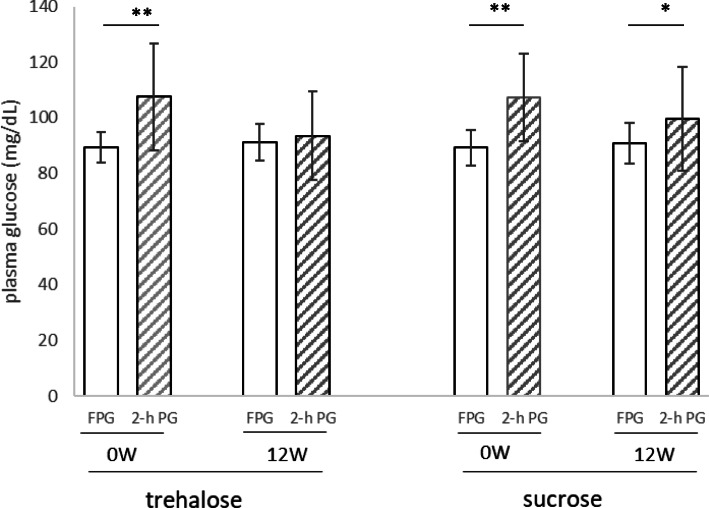
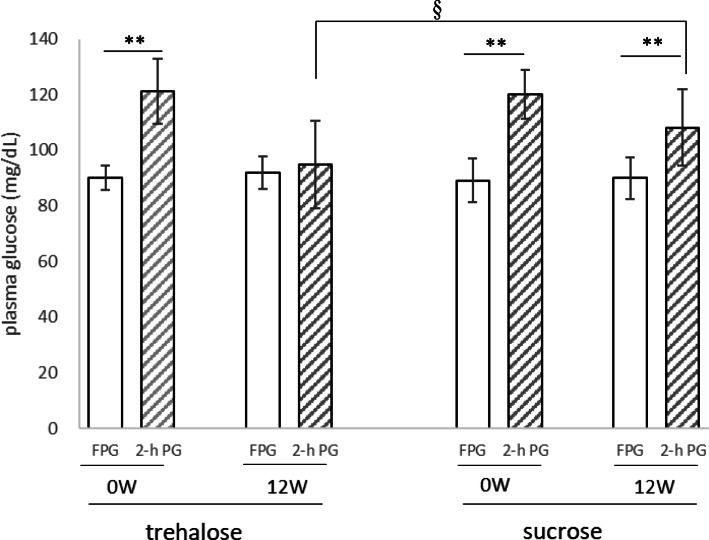
There were similar changes in body composition and serum biochemistry consistent with established seasonal variations in both groups, but there were no differences in any of these parameters between the two groups. However, whereas after 12 weeks of sucrose consumption, the plasma glucose concentration 2 h after a 75-g glucose load was significantly higher than the fasting concentration, after 12 weeks of trehalose consumption the fasting and 2-h plasma glucose concentrations were similar. Furthermore, an analysis of the participants with relatively high postprandial blood glucose showed that the plasma glucose concentration 2 h after a 75-g glucose load was significantly lower in the trehalose group than in the sucrose group.
Our findings suggest that trehalose helps lower postprandial blood glucose in healthy humans with higher postprandial glucose levels within the normal range, and may therefore contribute to the prevention of pathologies that are predisposed to by postprandial hyperglycemia,, even if the daily intake of trehalose is only 3.3 g, an amount that is easily incorporated into a meal.
UMIN, UMIN000033536 . Registered 27 July 2018.
海藻糖是一种广泛分布的天然二糖。先前的研究表明,每天食用 10 克海藻糖可改善代谢综合征患者的葡萄糖耐量。在本研究中,我们确定较低剂量(3.3 克/天)的海藻糖是否可改善健康的日本志愿者的葡萄糖耐量。
这是一项随机、双盲、安慰剂对照的研究,纳入了健康的日本参与者(n=50)。每名参与者每天分别服用 3.3 克海藻糖(n=25)或蔗糖(n=25),共 78 天。在第 0、4、8 和 12 周后评估他们的身体成分;在基线和 12 周后检测血清生化参数并进行口服 75 克葡萄糖耐量试验。
两组的身体成分和血清生化指标均发生了相似的变化,与既定的季节性变化一致,但两组间这些参数无差异。然而,在 12 周的蔗糖摄入后,75 克葡萄糖负荷后 2 小时的血浆葡萄糖浓度明显高于空腹浓度,而在 12 周的海藻糖摄入后,空腹和 2 小时的血浆葡萄糖浓度相似。此外,对餐后血糖较高的参与者进行分析发现,75 克葡萄糖负荷后 2 小时的血浆葡萄糖浓度在海藻糖组显著低于蔗糖组。
我们的发现表明,海藻糖可帮助血糖正常范围内餐后血糖较高的健康人群降低餐后血糖,因此,即使每日摄入海藻糖仅 3.3 克,这一容易融入膳食的量,也可能有助于预防餐后高血糖易患的病理状态。
UMIN,UMIN000033536。注册于 2018 年 7 月 27 日。