Department of Orthopedics, Wuhan Hanyang Hospital, Wuhan University of Science and Technology, Wuhan, 430050, China.
Department of Orthopedic Surgery, CR & WISCO General Hospital, Wuhan University of Science and Technology, Wuhan, China.
J Orthop Surg Res. 2020 Jul 9;15(1):250. doi: 10.1186/s13018-020-01774-8.
In recent years, percutaneous vertebroplasty (PVP) has provided a new option for the treatment of Kümmell's disease (KD). This retrospective study aimed to investigate the differences in clinical characteristics, clinical efficacy, and related complications between two types of bone cement distribution patterns in the PVP treatment of KD.
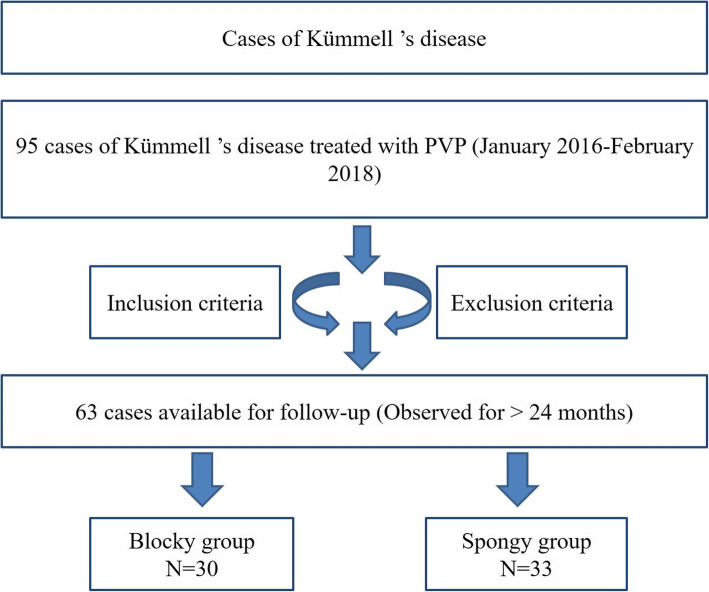
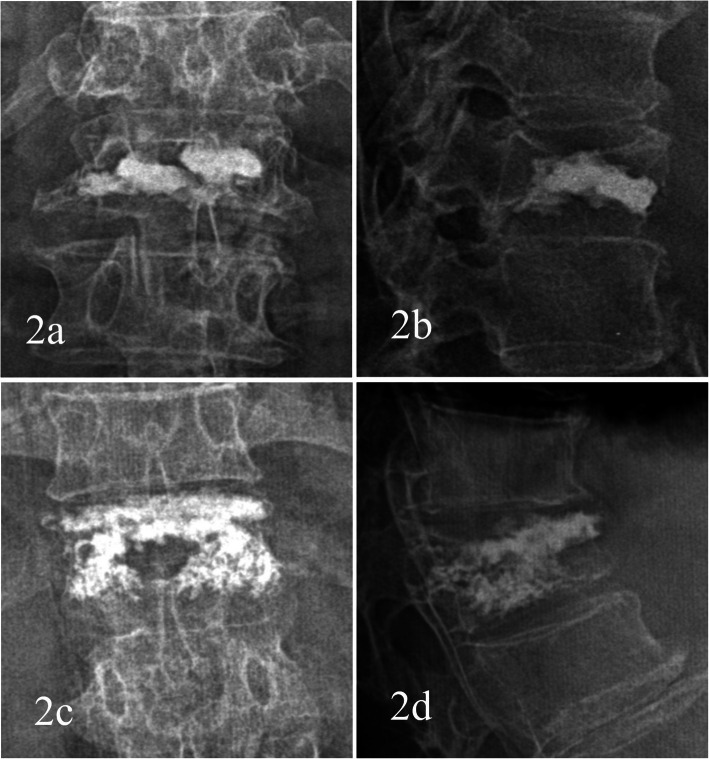
A total of 63 patients with KD from January 2016 to February 2018 who received PVP treatment were examined at least 24 months. According to X-ray distribution modes of bone cement after PVP treatment, they were divided into 2 groups: blocky group (30 cases) and spongy group (33 cases). Clinical features and disease severity preoperatively, and clinical efficacy and related complications postoperatively were statistically compared between the two groups.
The two groups were followed for at least 24 months. The duration of disease, age, Cobb angle, and vertebral compression rate preoperatively were significantly higher in the blocky group than in the spongy group (P < 0.05, respectively). The height of vertebral anterior margin and BMD were significantly lower in the blocky group than in the spongy group (P < 0.05, respectively). The amount of bone cement injected was significantly greater in the blocky group than in the spongy group (P = 0.000). VAS and ODI of the two groups were significantly reduced at the first day, the first year, and the last follow-up postoperatively (all P = 0.000) and were maintained at the last follow-up. VAS and ODI postoperatively decreased significantly in the spongy group compared with the blocky group (P = 0.000). The correction degrees of kyphosis and vertebral compression postoperatively in the two groups were significantly corrected, but gradually decreased over time (P < 0.05), and these correction degrees were significantly higher in the blocky group than in the spongy group, and the postoperative losses were also more serious.
The disease was more serious in the blocky group than in the spongy group. The amount of bone cement, correction degrees of postoperative kyphosis and vertebral compression were significantly higher in the blocky group than in the spongy group, but its postoperative losses of the correction degrees of kyphosis and vertebral compression were also more serious. However, for pain relief and functional recovery, the spongy group was superior to the blocky group. Therefore, the spongy distribution pattern should be formed during the injection of bone cement to obtain better therapeutic effect.
近年来,经皮椎体成形术(PVP)为 Kümmell 病(KD)的治疗提供了新的选择。本回顾性研究旨在探讨两种骨水泥分布模式在 PVP 治疗 KD 中的临床特点、临床疗效及相关并发症的差异。
2016 年 1 月至 2018 年 2 月,对 63 例接受 PVP 治疗的 KD 患者进行了至少 24 个月的检查。根据 PVP 治疗后骨水泥的 X 射线分布模式,将其分为块状组(30 例)和海绵状组(33 例)。统计比较两组患者术前临床特征及疾病严重程度、术后临床疗效及相关并发症。
两组均随访至少 24 个月。块状组患者的疾病持续时间、年龄、Cobb 角及椎体压缩率均显著高于海绵状组(P<0.05),椎体前缘高度及骨密度均显著低于海绵状组(P<0.05),骨水泥注射量显著大于海绵状组(P=0.000)。两组患者术后第 1 天、第 1 年及第末次随访时的 VAS 和 ODI 均显著降低(均 P=0.000),末次随访时仍维持在较低水平。海绵状组术后 VAS 和 ODI 显著低于块状组(P=0.000)。两组患者术后后凸畸形及椎体压缩的矫正程度均显著矫正,但随时间推移逐渐降低(P<0.05),块状组矫正程度显著高于海绵状组,术后丢失程度也更严重。
块状组患者病情较海绵状组严重。块状组患者骨水泥注射量、术后后凸畸形及椎体压缩矫正程度均显著高于海绵状组,但术后后凸畸形及椎体压缩矫正程度丢失也更严重。然而,在缓解疼痛和功能恢复方面,海绵状组优于块状组。因此,在注射骨水泥时应形成海绵状分布模式,以获得更好的治疗效果。