Upadhaya Nawaraj, Jordans Mark J D, Adhikari Ramesh P, Gurung Dristy, Petrus Ruwayda, Petersen Inge, Komproe Ivan H
Transcultural Psychosocial Organization Nepal, Kathmandu, Nepal.
Department of Research and Development, War Child, Amsterdam, the Netherlands.
BMC Health Serv Res. 2020 Jul 9;20(1):632. doi: 10.1186/s12913-020-05491-0.
Despite many important developments in the global mental health arena in the past decade, many people with mental health problems still do not have access to good quality mental health care. The aim of this study was to evaluate the perceived impact of a mental health care package (MHCP) in integrating chronic care elements in primary health care for people with mental illness.
A controlled pre-post study design was used in 20 primary health care facilities in Chitwan, Nepal. We compared 10 health facilities that had implemented a MHCP (intervention group), with 10 health facilities that had not implemented the MHCP (comparative control group) but provided regular physical health services. We administered the Assessment of Chronic Illness Care (ACIC) tool on a group basis within all 20 health facilities among 37 health workers. Data was collected at three time points; at baseline, midline (at 13 months from baseline) and end line (at 25 months from baseline).
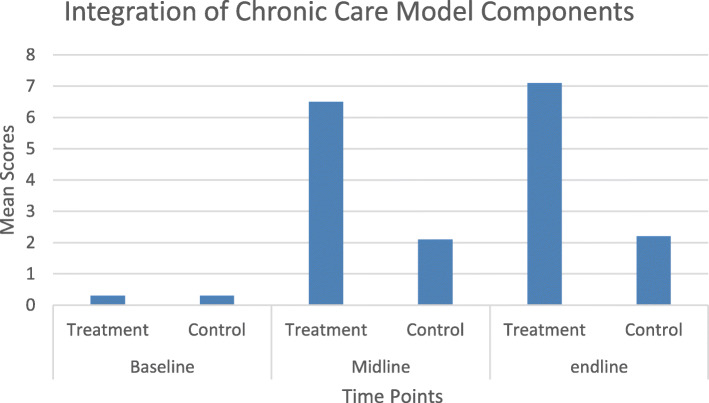
From baseline to end line, we see a notable shift in the level of support reported by the intervention health facilities compared to those in the comparative control group. While at baseline 10% of the intervention health facilities had basic support for the implementation of chronic illness care, at the end line, 90% of the intervention group reported having reasonable support with the remaining 10% of the intervention facilities reporting that they had full support. In contrast, 20% of the health facilities in the comparative control group at end line still reported having limited support for the implementation of chronic illness care, with the remaining 80% only managing to shift to the next level which is basic support.
These findings suggest that training and supervision of primary health care workers in the implementation of MHCP interventions can lead to strengthening of the system to better address the needs of patients with chronic mental health problems. However, substantial financial and coordination inputs are needed to implement the MHCP. The comparative control group also demonstrated improvements, possibly due to the administration of the ACIC tool and components of counselling services for family planning and HIV/AIDS services.
尽管在过去十年全球精神卫生领域取得了许多重大进展,但许多有心理健康问题的人仍然无法获得高质量的精神卫生保健。本研究的目的是评估一套精神卫生保健方案(MHCP)在将慢性病护理要素纳入针对精神疾病患者的初级卫生保健中的感知影响。
在尼泊尔奇旺的20个初级卫生保健机构中采用了对照前后研究设计。我们将10个实施了MHCP的卫生机构(干预组)与10个未实施MHCP但提供常规身体健康服务的卫生机构(比较对照组)进行了比较。我们在所有20个卫生机构中的37名卫生工作者群体中实施了慢性病护理评估(ACIC)工具。在三个时间点收集数据;基线、中线(基线后13个月)和终点线(基线后25个月)。
从基线到终点线,与比较对照组相比,我们看到干预卫生机构报告的支持水平有显著变化。虽然在基线时,10%的干预卫生机构对慢性病护理的实施有基本支持,但在终点线时,90%的干预组报告有合理支持,其余10%的干预机构报告有全面支持。相比之下,比较对照组中20%的卫生机构在终点线时仍报告对慢性病护理的实施支持有限,其余80%仅设法提升到下一个水平,即基本支持。
这些发现表明,对初级卫生保健工作者实施MHCP干预进行培训和监督可导致该系统得到加强,从而更好地满足慢性心理健康问题患者的需求。然而,实施MHCP需要大量的资金和协调投入。比较对照组也显示出改善,这可能归因于ACIC工具的应用以及计划生育和艾滋病毒/艾滋病服务咨询服务的组成部分。