Institute of Health Sciences, Collegium Medicum, Jan Kochanowski University, 25-317, Kielce, Poland.
Department of Epidemiology and Cancer Control, Holycross Cancer Centre, 25-734, Kielce, Poland.
Sci Rep. 2020 Jul 9;10(1):11253. doi: 10.1038/s41598-020-68265-y.
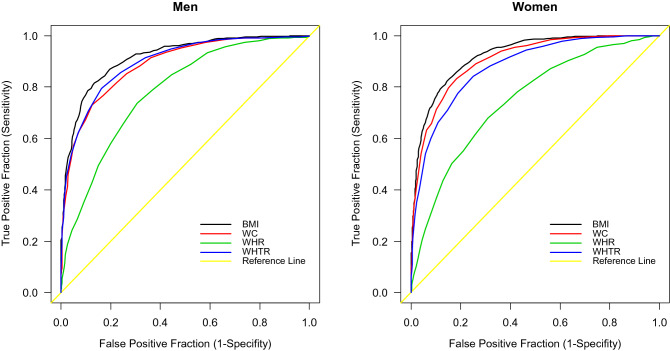
Excessive accumulation of body fat (BF) promotes obesity, whilst posing a significant health hazard. There being no agreed, optimal quantifying methods, application of BF variable in clinical practice is not deemed an effective assessment option. The study, involving 4,735 patients (33.6% men), aged 45-64, aimed to identify optimal cut-off values for anthropometric indicators of obesity to evaluate cardiometabolic risk. A minimum P-value approach was applied to calculate the cut-offs for BF%. Threshold values for body mass index (BMI), waist circumference (WC), waist-to-hip ratio (WHR), and waist-to-height (WHTR) ratio, facilitating optimal differentiation of cardiometabolic risk, were based on BF%, expressed as a binary classifier. The newly estimated cut-off values for predicting cardiometabolic risk, based on BMI, were lower than the referential obesity thresholds, whereas the threshold values of WC, WHR, and WHTR were higher. Apart from dyslipidemia, the odds of cardiometabolic disorders were higher, when the anthropometric indicators under study exceeded the cut-off points in both sexes. The proposed cut-offs proved instrumental in predicting cardiometabolic risk, whilst highlighting diagnostic and clinical potential of BF%, whereas BMI boasted the highest predictive potential. Cardiometabolic risk also proved significantly higher even in the overweight patients.
体脂肪(BF)过度积累会导致肥胖,同时对健康构成重大威胁。由于没有公认的最佳量化方法,BF 变量在临床实践中的应用并不能被视为一种有效的评估选择。本研究涉及 4735 名年龄在 45-64 岁的患者(33.6%为男性),旨在确定肥胖的人体测量指标的最佳截断值,以评估心血管代谢风险。应用最小 P 值法计算 BF%的截断值。BMI、腰围(WC)、腰臀比(WHR)和腰高比(WHTR)的阈值值用于最佳区分心血管代谢风险,基于 BF%作为二进制分类器。基于 BMI 预测心血管代谢风险的新估计截断值低于参考肥胖阈值,而 WC、WHR 和 WHTR 的阈值值较高。除了血脂异常外,当研究中的人体测量指标在两性中超过截断值时,心血管代谢紊乱的几率更高。所提出的截断值有助于预测心血管代谢风险,同时突出了 BF%的诊断和临床潜力,而 BMI 则具有最高的预测潜力。即使在超重患者中,心血管代谢风险也明显更高。