Bhaskar Sukritee, Steer David L, Anand Ruchi, Panjikar Santosh
IITB-Monash Research Academy, Mumbai 400076, Maharashtra, India.
Department of Chemistry, Indian Institute of Technology Bombay, Mumbai 400076, Maharashtra, India.
J Struct Biol X. 2020 Jan 3;4:100018. doi: 10.1016/j.yjsbx.2019.100018. eCollection 2020.
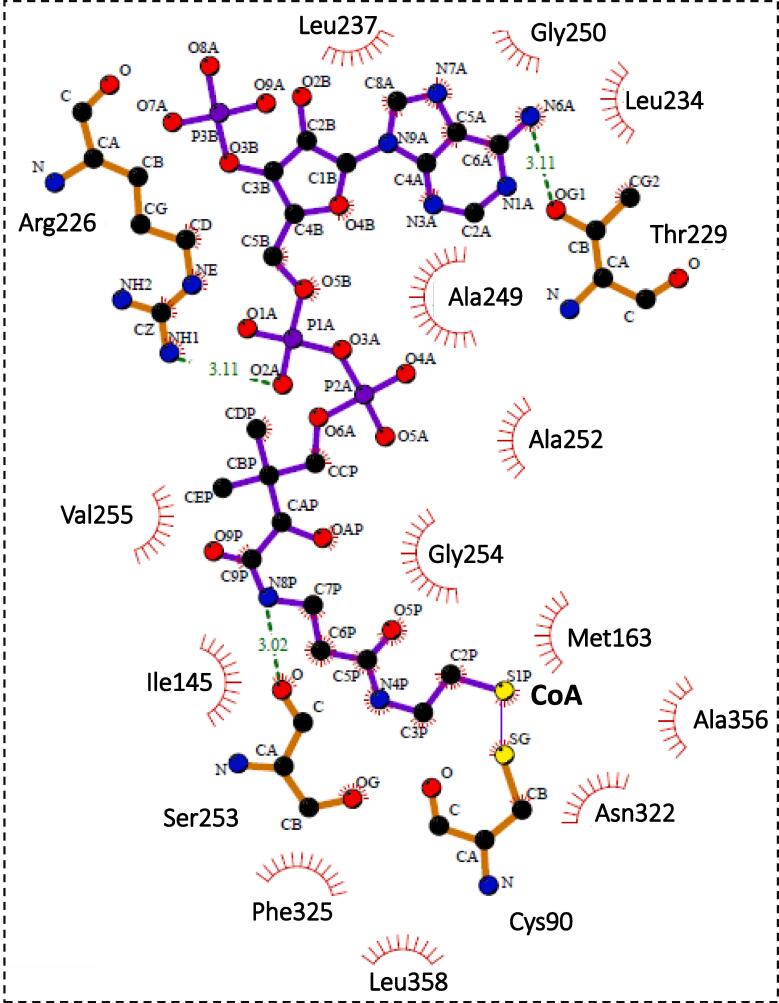
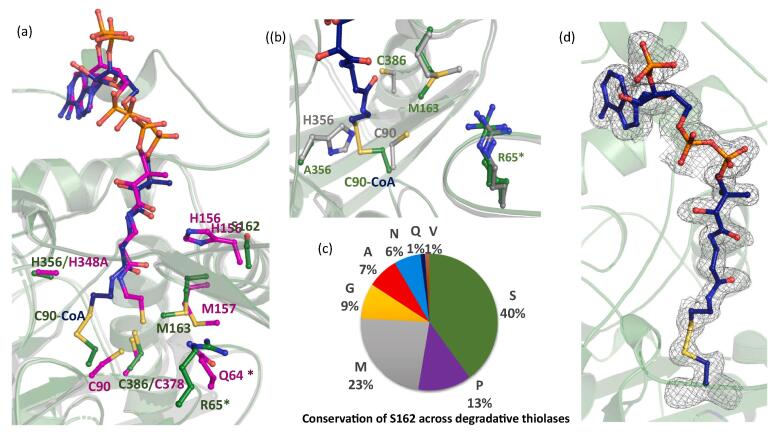
Thiolases are a well characterized family of enzymes with two distinct categories: degradative, β-ketoadipyl-CoA thiolases and biosynthetic, acetoacetyl-CoA thiolases. Both classes share an identical catalytic triad but catalyze reactions in opposite directions. Moreover, it is established that in contrast to the biosynthetic thiolases the degradative thiolases can accept substrates with broad chain lengths. Hitherto, no residue or structural pattern has been recognized that might help to discern the two thiolases, here we exploit, a tetrameric degradative thiolase from KT2440 annotated as PcaF, as a model system to understand features which distinguishes the two classes using structural studies and bioinformatics analyses. Degradative thiolases have different active site architecture when compared to biosynthetic thiolases, demonstrating the dissimilar chemical nature of the active site architecture. Both thiolases deploy different "anchoring residues" to tether the large Coenzyme A (CoA) or CoA derivatives. Interestingly, the H356 of the catalytic triad in PcaF is directly involved in tethering the CoA/CoA derivatives into the active site and we were able to trap a gridlocked thiolase structure of the H356A mutant, where the CoA was found to be covalently linked to the catalytic cysteine residue, inhibiting the overall reaction. Further, X-ray structures with two long chain CoA derivatives, hexanal-CoA and octanal-CoA helped in delineating the long tunnel of 235 Å surface area in PcaF and led to identification of a unique covering loop exclusive to degradative thiolases that plays an active role in determining the tunnel length and the nature of the binding substrate.
硫解酶是一类特征明确的酶家族,分为两个不同的类别:降解型的β-酮己二酰辅酶A硫解酶和生物合成型的乙酰乙酰辅酶A硫解酶。这两类酶都具有相同的催化三联体,但催化的反应方向相反。此外,已确定与生物合成型硫解酶不同,降解型硫解酶可以接受具有广泛链长的底物。迄今为止,尚未识别出有助于区分这两种硫解酶的残基或结构模式,在此我们利用来自KT2440的一种四聚体降解型硫解酶(注释为PcaF)作为模型系统,通过结构研究和生物信息学分析来了解区分这两类酶的特征。与生物合成型硫解酶相比,降解型硫解酶具有不同的活性位点结构,这表明活性位点结构具有不同的化学性质。两种硫解酶都利用不同的“锚定残基”来连接大的辅酶A(CoA)或CoA衍生物。有趣的是,PcaF催化三联体中的H356直接参与将CoA/CoA衍生物连接到活性位点,我们能够捕获H356A突变体的一种锁定硫解酶结构,其中发现CoA与催化性半胱氨酸残基共价连接,从而抑制了整个反应。此外,含有两种长链CoA衍生物己醛-CoA和辛醛-CoA的X射线结构有助于描绘PcaF中表面积为235 Å的长通道,并导致鉴定出一种降解型硫解酶特有的独特覆盖环,该环在确定通道长度和结合底物的性质方面发挥着积极作用。