Institute for Medical Information Science, Biometry and Epidemiology, Ludwig Maximilians University, Munich, Germany.
Pettenkofer School of Public Health, Munich, Germany.
Geroscience. 2020 Oct;42(5):1365-1376. doi: 10.1007/s11357-020-00216-x. Epub 2020 Jul 9.
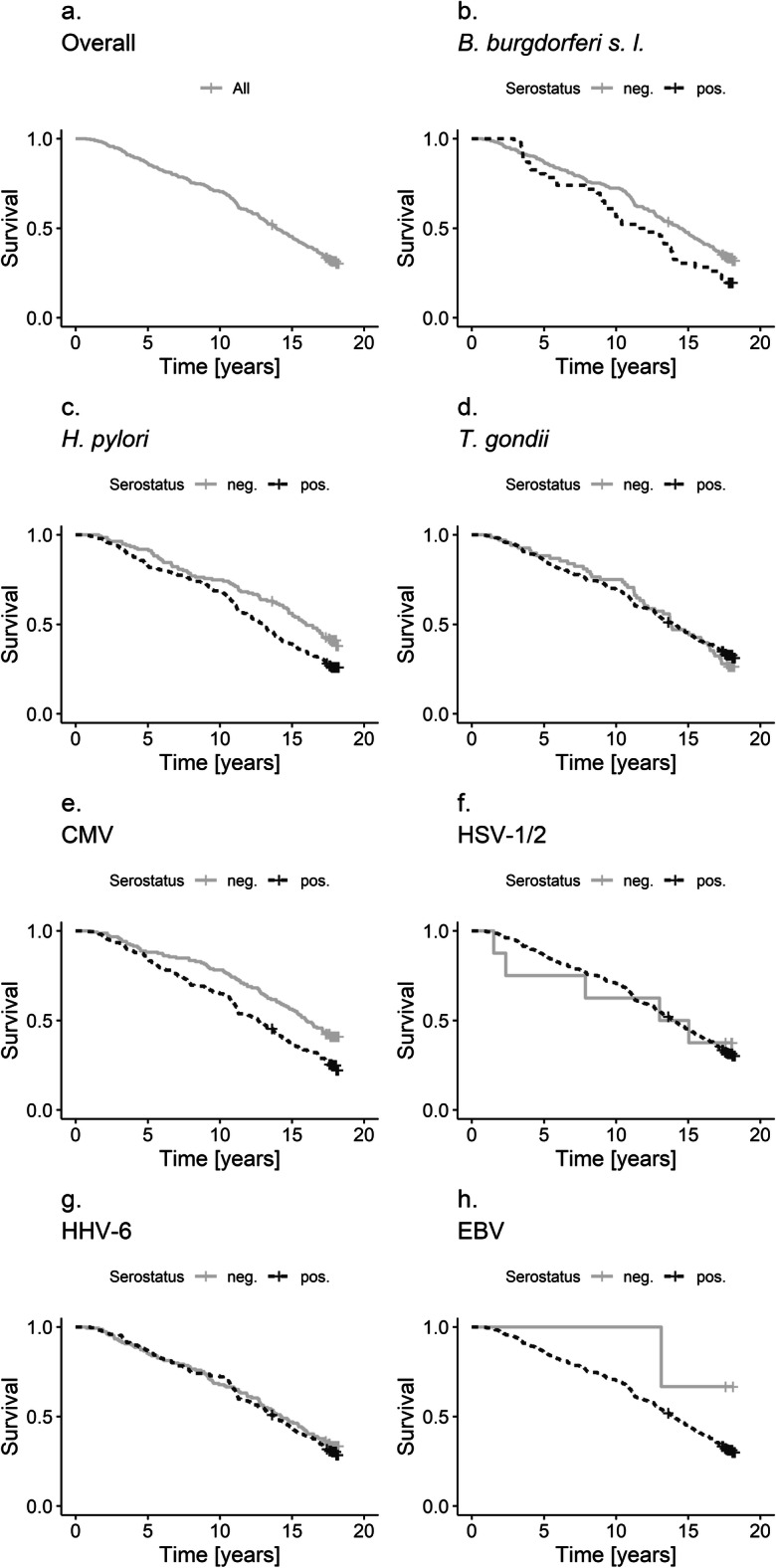
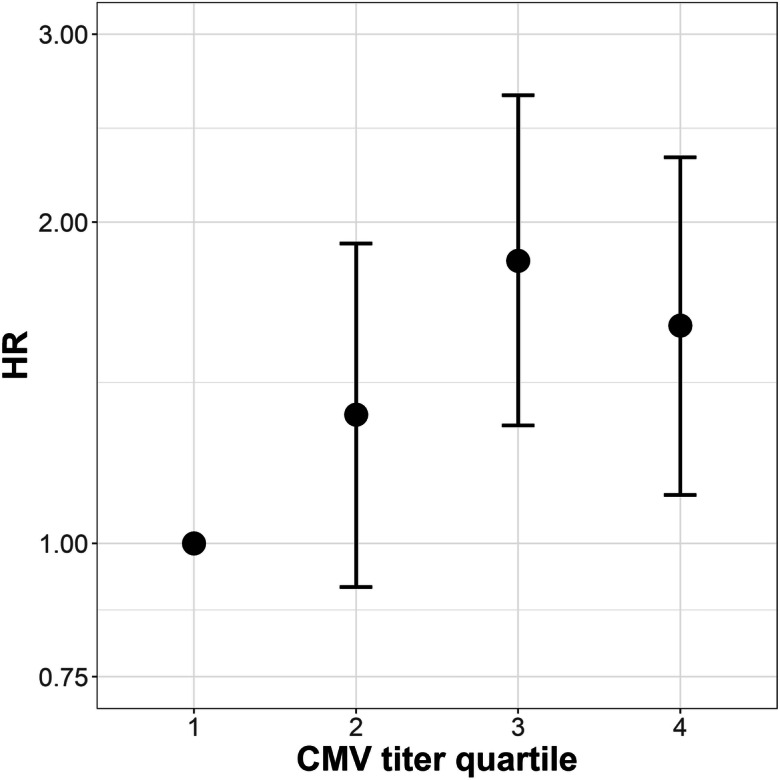
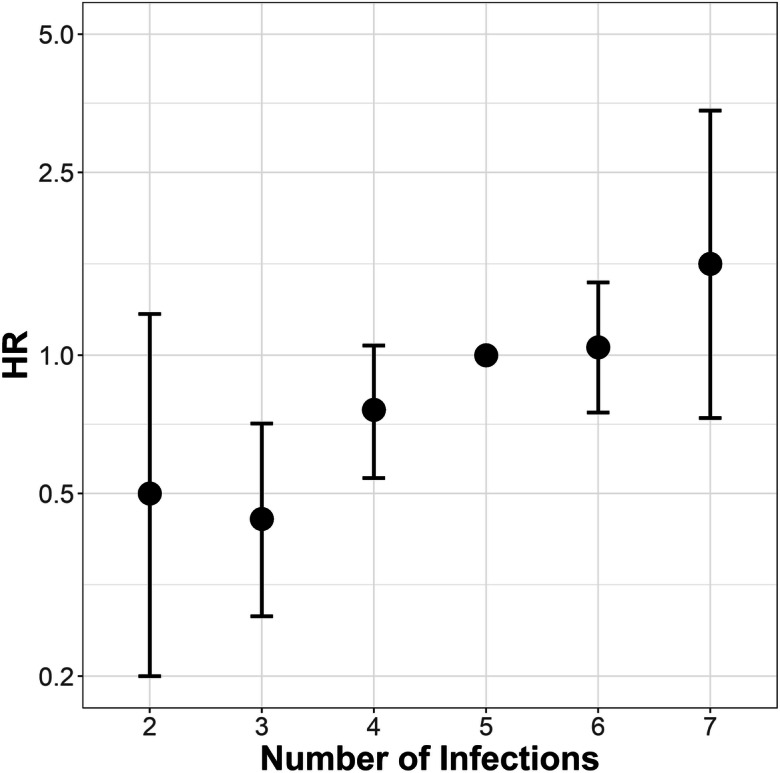
Immunostimulation by chronic infection has been linked to an increased risk for different non-communicable diseases, which in turn are leading causes of death in high- and middle-income countries. Thus, we investigated if a positive serostatus for pathogens responsible for common chronic infections is individually or synergistically related to reduced overall survival in community dwelling elderly. We used data of 365 individuals from the German MEMO (Memory and Morbidity in Augsburg Elderly) cohort study with a median age of 73 years at baseline and a median follow-up of 14 years. We examined the effect of a positive serostatus at baseline for selected pathogens associated with chronic infections (Helicobacter pylori, Borrelia burgdorferi sensu lato, Toxoplasma gondii, cytomegalovirus, Epstein-Barr virus, herpes simplex virus 1/2, and human herpesvirus 6) on all-cause mortality with multivariable parametric survival models. We found a reduced survival time in individuals with a positive serostatus for Helicobacter pylori (accelerated failure time (AFT) - 15.92, 95% CI - 29.96; - 1.88), cytomegalovirus (AFT - 22.81, 95% CI - 36.41; - 9.22) and Borrelia burgdorferi sensu lato (AFT - 25.25, 95% CI - 43.40; - 7.10), after adjusting for potential confounders. The number of infectious agents an individual was seropositive for had a linear effect on all-cause mortality (AFT per additional infection - 12.42 95% CI - 18.55; - 6.30). Our results suggest an effect of seropositivity for Helicobacter pylori, cytomegalovirus, and Borrelia burgdorferi sensu lato on all-cause mortality in older community dwelling individuals. Further research with larger cohorts and additional biomarkers is required, to assess mediators and molecular pathways of this effect.
慢性感染引起的免疫刺激与多种非传染性疾病的风险增加有关,而这些疾病反过来又是高收入和中等收入国家的主要死亡原因。因此,我们调查了负责常见慢性感染的病原体的阳性血清状态是否单独或协同与社区居住的老年人整体存活率降低有关。我们使用了德国 MEMO(奥格斯堡老年人记忆和发病率)队列研究中 365 名个体的数据,这些个体在基线时的中位年龄为 73 岁,中位随访时间为 14 年。我们检查了基线时与慢性感染相关的选定病原体(幽门螺杆菌、伯氏疏螺旋体、刚地弓形虫、巨细胞病毒、爱泼斯坦-巴尔病毒、单纯疱疹病毒 1/2 和人类疱疹病毒 6)的阳性血清状态对全因死亡率的影响,使用多变量参数生存模型。我们发现,幽门螺杆菌阳性血清状态个体的生存时间缩短(加速失效时间(AFT)-15.92,95%CI-29.96;-1.88)、巨细胞病毒(AFT-22.81,95%CI-36.41;-9.22)和伯氏疏螺旋体(AFT-25.25,95%CI-43.40;-7.10),在调整了潜在混杂因素后。个体感染的传染性病原体数量对全因死亡率有线性影响(每增加一种感染的 AFT-12.42,95%CI-18.55;-6.30)。我们的研究结果表明,幽门螺杆菌、巨细胞病毒和伯氏疏螺旋体的阳性血清状态对老年社区居民的全因死亡率有影响。需要进一步研究更大的队列和额外的生物标志物,以评估这种影响的介导因素和分子途径。