Department of Psychology, Jeffrey Cheah School of Medicine and Health Sciences, Monash University Malaysia, Subang Jaya, Malaysia.
Department of Psychology, Kulliyyah of Islamic Revealed Knowledge and Human Sciences, International Islamic University Malaysia, Kuala Lumpur, Malaysia.
Am J Infect Control. 2021 Mar;49(3):286-292. doi: 10.1016/j.ajic.2020.06.214. Epub 2020 Jul 7.
The COVID-19 outbreak has gravely impacted the physical and psychological health of people. As the outbreak is ongoing, it is crucial to equip the emergency healthcare workers (HCWs) to be medically and psychologically prepared.
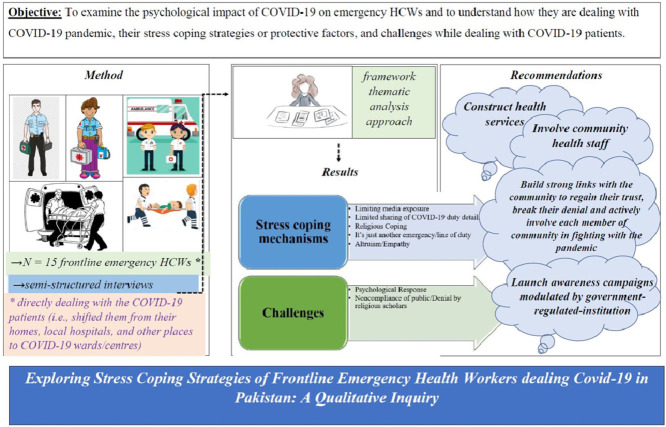
To examine the psychological impact of COVID-19 on emergency HCWs and to understand how they are dealing with COVID-19 pandemic, their stress coping strategies or protective factors, and challenges while dealing with COVID-19 patients.
Using a framework thematic analysis approach, 15 frontline emergency HCWs directly dealing with COVID-19 patients from April 2, 2020 to April 25, 2020. The semi-structured interviews were conducted face-to-face or by telephone. Data were analyzed using thematic analysis.
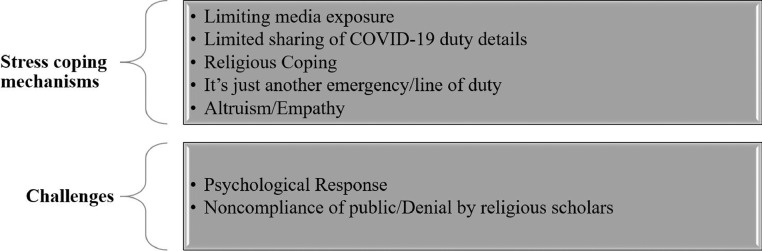
Findings highlighted first major theme of stress coping, including, limiting media exposure, limited sharing of Covid-19 duty details, religious coping, just another emergency approach, altruism, and second major theme of Challenges includes, psychological response and noncompliance of public/denial by religious scholar.
Participants practiced and recommended various coping strategies to deal with stress and anxiety emerging from COVID-19 pandemic. Media was reported to be a principal source of raising stress and anxiety among the public. Religious coping as well as their passion to serve humanity and country were the commonly employed coping strategies.
COVID-19 疫情严重影响了人们的身心健康。由于疫情仍在持续,为应急医护人员配备医学和心理准备至关重要。
调查 COVID-19 对急诊医护人员的心理影响,并了解他们如何应对 COVID-19 大流行,他们的压力应对策略或保护因素,以及在处理 COVID-19 患者时面临的挑战。
采用框架主题分析方法,对 2020 年 4 月 2 日至 4 月 25 日期间直接接触 COVID-19 患者的 15 名一线急诊医护人员进行研究。采用半结构式访谈,通过面对面或电话进行。采用主题分析对数据进行分析。
研究结果突出了压力应对的第一个主要主题,包括限制媒体接触、限制分享 COVID-19 职责细节、宗教应对、只是另一种紧急应对方式、利他主义,以及第二个主要主题的挑战,包括公众的心理反应和不遵守/宗教学者的否认。
参与者练习并推荐了各种应对策略来应对 COVID-19 大流行带来的压力和焦虑。媒体被报道是引起公众压力和焦虑的主要来源。宗教应对以及他们为服务人类和国家的热情是常用的应对策略。