Department of Otorhinolaryngology and Head and Neck Surgery, Erasmus University Medical Center, Rotterdam, the Netherlands; The Generation R Study Group, Erasmus University Medical Center, Rotterdam, the Netherlands.
Department of Otorhinolaryngology and Head and Neck Surgery, Erasmus University Medical Center, Rotterdam, the Netherlands.
Neuroimage Clin. 2020;27:102334. doi: 10.1016/j.nicl.2020.102334. Epub 2020 Jun 29.
Stuttering is a complex speech fluency disorder occurring in childhood. In young children, stuttering has been associated with speech-related auditory and motor areas of the brain. During transition into adolescence, the majority of children who stutter (75-80%) will experience remission of their symptoms. The current study evaluated brain (micro-)structural differences between pre-adolescents who persisted in stuttering, those who recovered, and fluently speaking controls.
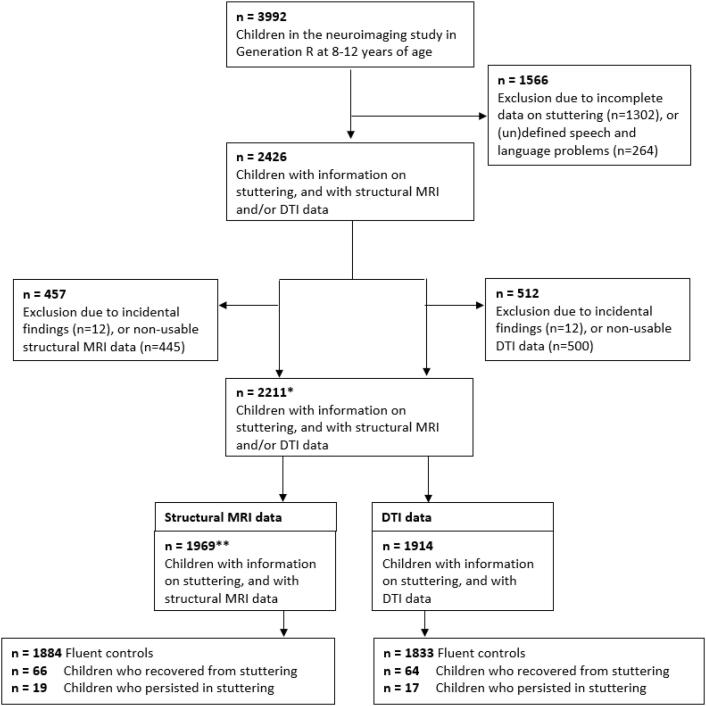
This study was embedded in the Generation R Study, a population-based cohort in the Netherlands of children followed from pregnancy onwards. Neuroimaging was performed in 2211 children (mean age: 10 years, range 8-12), of whom 20 persisted in and 77 recovered from stuttering. Brain structure (e.g., gray matter) and microstructure (e.g., diffusion tensor imaging) differences between groups were tested using multiple linear regression.
Pre-adolescents who persisted in stuttering had marginally lower left superior frontal gray matter volume compared to those with no history of stuttering (β -1344, 95%CI -2407;-280), and those who recovered (β -1825, 95%CI -2999;-650). Pre-adolescents who recovered, compared to those with no history of stuttering, had higher mean diffusivity in the forceps major (β 0.002, 95%CI 0.001;0.004), bilateral superior longitudinal fasciculi (β 0.001, 95%CI 0.000;0.001), left corticospinal tract (β 0.003, 95%CI 0.002;0.004), and right inferior longitudinal fasciculus (β 0.001, 95%CI 0.000;0.001).
Findings suggest that relatively small difference in prefrontal gray matter volume is associated with persistent stuttering, and alterations in white matter tracts are apparent in individuals who recovered. The findings further strengthen the potential relevance of brain (micro-)structure in persistence and recovery from stuttering in pre-adolescents.
口吃是一种发生在儿童时期的复杂言语流畅障碍。在幼儿中,口吃与大脑与言语相关的听觉和运动区域有关。在进入青春期的过渡期间,大多数口吃的儿童(75-80%)将经历症状缓解。本研究评估了持续口吃、已恢复和流利说话的对照组的前青春期儿童之间的大脑(微观)结构差异。
这项研究嵌入了荷兰的一项基于人群的队列研究——生育队列研究,对从怀孕到儿童期的儿童进行随访。对 2211 名儿童(平均年龄:10 岁,范围 8-12 岁)进行了神经影像学检查,其中 20 名持续口吃,77 名已恢复。使用多元线性回归测试了组间大脑结构(如灰质)和微观结构(如扩散张量成像)的差异。
与无口吃史的儿童相比,持续口吃的前青春期儿童左侧额上回灰质体积略低(β-1344,95%CI-2407;-280),与已恢复的儿童相比(β-1825,95%CI-2999;-650)。与无口吃史的儿童相比,已恢复口吃的儿童,在右侧钩束(β 0.002,95%CI 0.001;0.004)、双侧上纵束(β 0.001,95%CI 0.000;0.001)、左侧皮质脊髓束(β 0.003,95%CI 0.002;0.004)和右侧下纵束(β 0.001,95%CI 0.000;0.001)的平均弥散系数较高。
研究结果表明,前额叶灰质体积的相对较小差异与持续性口吃有关,而在已恢复的个体中,白质束的改变是明显的。这些发现进一步加强了大脑(微观)结构在儿童前青春期口吃持续和恢复中的潜在相关性。