Chang Soo-Eun, Erickson Kirk I, Ambrose Nicoline G, Hasegawa-Johnson Mark A, Ludlow Christy L
Laryngeal and Speech Section, National Institute of Neurological Disorders and Stroke, National Institutes of Health, Bethesda, MD 20892, USA.
Neuroimage. 2008 Feb 1;39(3):1333-44. doi: 10.1016/j.neuroimage.2007.09.067. Epub 2007 Oct 13.
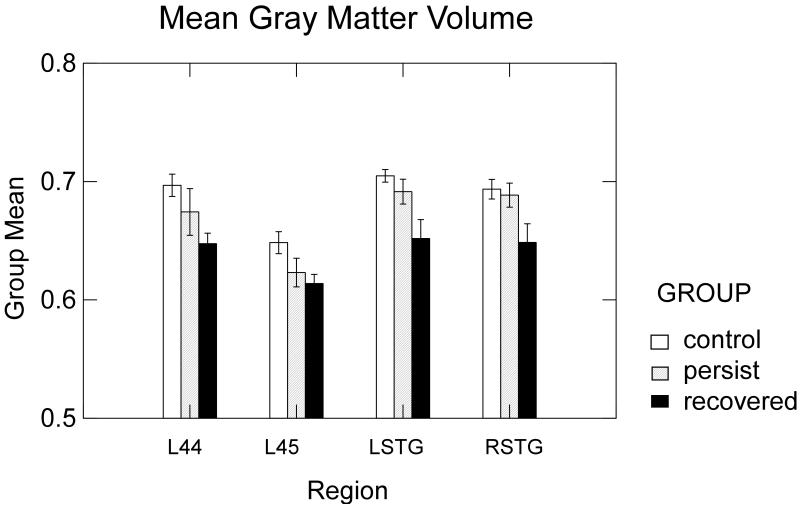
Stuttering is a developmental speech disorder that occurs in 5% of children with spontaneous remission in approximately 70% of cases. Previous imaging studies in adults with persistent stuttering found left white matter deficiencies and reversed right-left asymmetries compared to fluent controls. We hypothesized that similar differences might be present indicating brain development differences in children at risk of stuttering. Optimized voxel-based morphometry compared gray matter volume (GMV) and diffusion tensor imaging measured fractional anisotropy (FA) in white matter tracts in 3 groups: children with persistent stuttering, children recovered from stuttering, and fluent peers. Both the persistent stuttering and recovered groups had reduced GMV from normal in speech-relevant regions: the left inferior frontal gyrus and bilateral temporal regions. Reduced FA was found in the left white matter tracts underlying the motor regions for face and larynx in the persistent stuttering group. Contrary to previous findings in adults who stutter, no increases were found in the right hemisphere speech regions in stuttering or recovered children and no differences in right-left asymmetries. Instead, a risk for childhood stuttering was associated with deficiencies in left gray matter volume while reduced white matter integrity in the left hemisphere speech system was associated with persistent stuttering. Anatomical increases in right hemisphere structures previously found in adults who stutter may have resulted from a lifetime of stuttering. These findings point to the importance of considering the role of neuroplasticity during development when studying persistent forms of developmental disorders in adults.
口吃是一种发育性言语障碍,在5%的儿童中出现,约70%的病例会自发缓解。先前针对持续性口吃成年人的影像学研究发现,与流利对照组相比,他们存在左侧白质缺陷以及左右不对称性反转的情况。我们推测,在有口吃风险的儿童中可能也存在类似差异,这表明大脑发育存在差异。我们采用优化的基于体素的形态测量法,比较了三组儿童的灰质体积(GMV)以及通过扩散张量成像测量的白质束分数各向异性(FA):持续性口吃儿童、已从口吃中恢复的儿童以及流利的同龄人。持续性口吃组和已恢复组在与言语相关的区域,即左侧额下回和双侧颞区,灰质体积均低于正常水平。在持续性口吃组中,面部和喉部运动区域下方的左侧白质束中发现分数各向异性降低。与先前口吃成年人的研究结果相反,口吃儿童或已恢复儿童的右半球言语区域未发现增加,左右不对称性也无差异。相反,儿童口吃风险与左侧灰质体积不足有关,而左侧半球言语系统白质完整性降低与持续性口吃有关。先前在口吃成年人中发现的右半球结构的解剖学增加可能是由于一生口吃所致。这些发现表明,在研究成年人持续性发育障碍时,考虑发育过程中神经可塑性的作用非常重要。