
蛋白质摄入量和来源与糖尿病前期和 2 型糖尿病个体血糖控制相关因素的关系。
The Relationship between Protein Intake and Source on Factors Associated with Glycemic Control in Individuals with Prediabetes and Type 2 Diabetes.
机构信息
Department of Nutrition, Food and Exercise Sciences, Florida State University, Tallahassee, FL 32304, USA.
Center for Advancing Exercise and Nutrition Research on Aging, Florida State University, Tallahassee, FL 32304, USA.
出版信息
Nutrients. 2020 Jul 8;12(7):2031. doi: 10.3390/nu12072031.
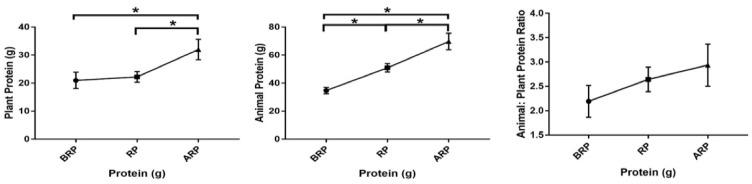
Type 2 diabetes (T2D) is a major contributor to morbidity and mortality largely due to increased cardiovascular disease risk. This study examined the relationships among protein consumption and sources on glycemic control and cardiovascular health in individuals with prediabetes and T2D. Sixty-two overweight or obese participants with prediabetes or T2D, aged 45-75 years were stratified into the following three groups based on protein intake: <0.8 g (gram)/kg (kilogram) body weight (bw), ≥0.8 but <1.0 g/kg bw, and ≥1.0 g/kg bw as below, meeting, and above the recommended levels of protein intake, respectively. Body mass, body mass index (BMI), hip circumference (HC), waist circumference (WC), lean mass, and fat mass (FM) were significantly higher in participants who consumed below the recommended level of protein intake as compared with other groups. Higher animal protein intake was associated with greater insulin secretion and lower triglycerides (TG). Total, low-density, and high-density cholesterol were significantly higher in participants who met the recommended protein intake as compared with the other groups. These data suggest that high protein consumption is associated with lower BMI, HC, WC, and FM, and can improve insulin resistance without affecting lipid profiles in this population. Furthermore, higher intake of animal protein can improve β-cell function and lower plasma TG.
2 型糖尿病(T2D)是导致发病率和死亡率的主要原因,主要是由于心血管疾病风险增加。本研究探讨了蛋白质摄入量和来源与糖尿病前期和 T2D 患者血糖控制和心血管健康之间的关系。62 名超重或肥胖的糖尿病前期或 T2D 患者,年龄在 45-75 岁,根据蛋白质摄入量分为以下三组:<0.8 g(克)/kg(千克)体重(bw)、≥0.8 但<1.0 g/kg bw 和≥1.0 g/kg bw,分别低于、符合和高于推荐的蛋白质摄入量。与其他组相比,摄入低于推荐水平的蛋白质摄入量的参与者的体重、体重指数(BMI)、臀围(HC)、腰围(WC)、瘦体重和脂肪量(FM)显著更高。动物蛋白摄入量较高与胰岛素分泌增加和甘油三酯(TG)降低有关。总胆固醇、低密度脂蛋白胆固醇和高密度脂蛋白胆固醇在符合推荐蛋白质摄入量的参与者中显著高于其他组。这些数据表明,高蛋白摄入与较低的 BMI、HC、WC 和 FM 相关,并可改善该人群的胰岛素抵抗而不影响血脂谱。此外,较高的动物蛋白摄入可以改善β细胞功能并降低血浆 TG。




 Zotero 插件