Department of Infectious Diseases, The Third Affiliated Hospital of Sun Yat-Sen University, Guangzhou, People's Republic of China.
Department of Liver Surgery and Liver Transplantation, The Third Affiliated Hospital of Sun Yat-Sen University, Guangzhou, People's Republic of China.
Stem Cell Res Ther. 2020 Jul 10;11(1):277. doi: 10.1186/s13287-020-01787-4.
Umbilical cord mesenchymal stem cells (UCMSCs) have been demonstrated to have good therapeutic effects in the treatment of HBV-related liver diseases. However, the therapeutic effect of UCMSCs on HBV-related liver failure and liver cirrhosis and the variations in the efficacy of UCMSCs after different treatment courses remain poorly understood. Therefore, this study was designed to answer these two questions.
This was an observational study that retrospectively considered a 3-year period during which 513 patients who received stem cell infusion and met the criteria of hepatic failure and liver cirrhosis were identified from the databases of the Third Affiliated Hospital of Sun Yat-sen University. The eligible patients were categorized into the liver failure group and liver cirrhosis group. The two groups were divided into different subgroups according to the duration of stem cell therapy. In the liver failure group, group A received more than 4 weeks and group B received less than 4 weeks of stem cell therapy. In the liver cirrhosis group, patients who received more than 4 weeks of stem cell therapy belonged to group C, and the patients in group D received less than 4 weeks of stem cell therapy. The patients were followed up for 24 weeks. The demographics, clinical characteristics, biochemical factors, and model for end-stage liver disease (MELD) scores were recorded and compared among different groups.
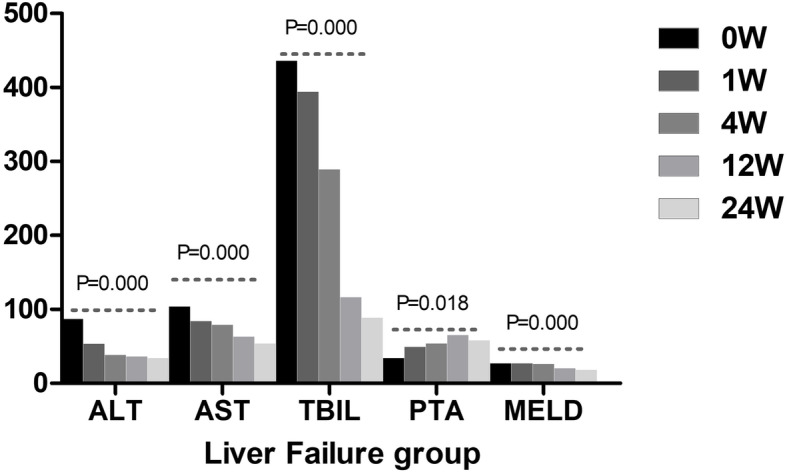
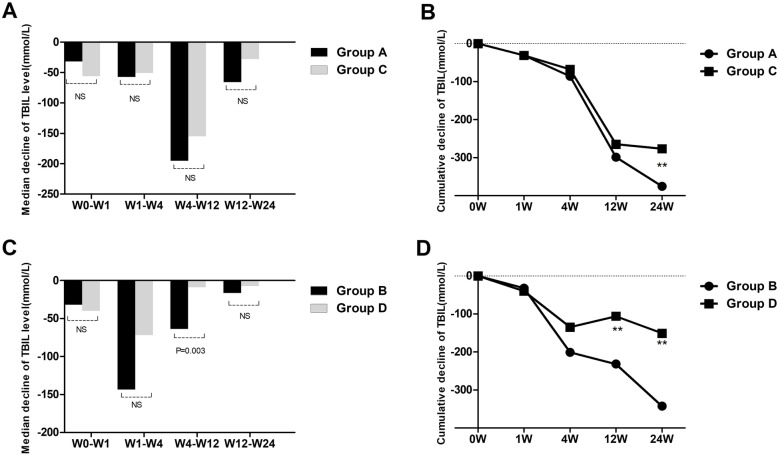
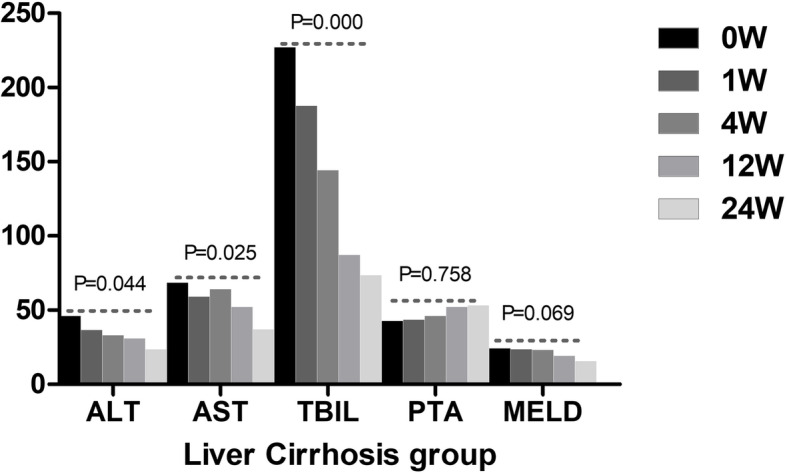
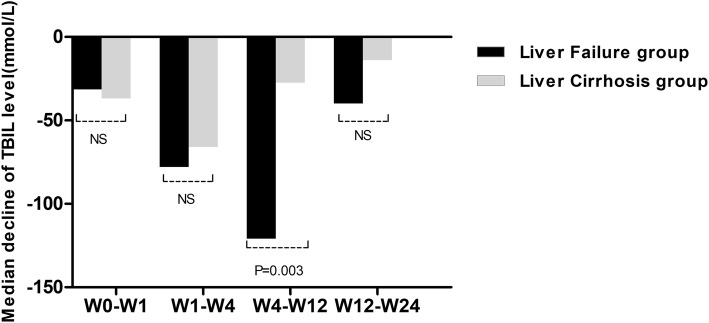
A total of 64 patients met the criteria for liver failure, and 59 patients met the criteria for liver cirrhosis. After UCMSC treatment, the levels of alanine aminotransferase (ALT), glutamic-oxaloacetic transaminase (AST), and total bilirubin (TBIL) at all postbaseline time points were significantly lower than those at baseline in the liver failure group and liver cirrhosis group; the prothrombin activity (PTA) and MELD scores gradually improved in only the liver failure group. Four weeks after UCMSC treatment, patients who received prolonged treatment with UCMSCs had a larger decrease in TBIL levels than patients who terminated treatment with UCMSCs. After more than 4 weeks of UCMSC treatment, there were no statistically significant differences in the changes in ALT, AST, TBIL, and PTA values and MELD scores between patients with liver failure who received prolonged treatment with UCMSCs and patients with liver cirrhosis who received prolonged treatment with UCMSCs at any time point. However, the median decrease and cumulative decrease in the TBIL level of patients with liver failure with a standard 4-week treatment course were larger than those of patients with liver cirrhosis with a standard 4-week treatment course.
Peripheral infusion of UCMSCs showed good therapeutic effects for HBV-related liver failure and liver cirrhosis. Prolonging the treatment course can increase the curative effect of UCMSCs for end-stage liver disease, especially for patients with cirrhosis.
脐带间充质干细胞(UCMSCs)在治疗乙型肝炎相关肝病方面已被证明具有良好的治疗效果。然而,UCMSCs 对乙型肝炎相关肝衰竭和肝硬化的治疗效果以及 UCMSCs 在不同治疗疗程后的疗效变化仍知之甚少。因此,本研究旨在回答这两个问题。
这是一项观察性研究,回顾性分析了中山大学附属第三医院数据库中,3 年内接受干细胞输注且符合肝衰竭和肝硬化标准的 513 例患者。符合条件的患者被分为肝衰竭组和肝硬化组。两组根据干细胞治疗时间的不同分为不同的亚组。在肝衰竭组中,A 组接受 UCMSC 治疗超过 4 周,B 组接受 UCMSC 治疗少于 4 周。在肝硬化组中,接受 UCMSC 治疗超过 4 周的患者属于 C 组,接受 UCMSC 治疗少于 4 周的患者属于 D 组。对患者进行 24 周随访。记录和比较不同组间的人口统计学、临床特征、生化指标和终末期肝病模型(MELD)评分。
共有 64 例患者符合肝衰竭标准,59 例患者符合肝硬化标准。在接受 UCMSC 治疗后,肝衰竭组和肝硬化组患者在所有时间点的丙氨酸氨基转移酶(ALT)、门冬氨酸氨基转移酶(AST)和总胆红素(TBIL)水平均低于基线水平,凝血酶原活动度(PTA)和 MELD 评分仅在肝衰竭组逐渐升高。在接受 UCMSC 治疗 4 周后,接受 UCMSCs 长期治疗的患者 TBIL 水平下降幅度大于终止 UCMSCs 治疗的患者。在接受 UCMSC 治疗超过 4 周后,肝衰竭组接受 UCMSC 长期治疗的患者与肝硬化组接受 UCMSC 长期治疗的患者在任何时间点的 ALT、AST、TBIL、PTA 值和 MELD 评分变化均无统计学差异。然而,标准 4 周治疗疗程的肝衰竭患者的 TBIL 水平中位数下降和累积下降幅度大于标准 4 周治疗疗程的肝硬化患者。
外周输注 UCMSCs 对乙型肝炎相关肝衰竭和肝硬化具有良好的治疗效果。延长治疗疗程可以增加 UCMSCs 对终末期肝病的疗效,尤其是对肝硬化患者。