Department of Bioengineering and Bar-Ilan Institute of Nanotechnology and Advanced Materials, Bar-Ilan University, Ramat Gan, Israel.
The Mina and Everard Goodman Faculty of Life Sciences, Bar-Ilan University, Ramat-Gan, Israel.
J Am Soc Nephrol. 2020 Oct;31(10):2278-2291. doi: 10.1681/ASN.2019080770. Epub 2020 Jul 10.
During mammalian kidney development, nephron progenitors undergo a mesenchymal-to-epithelial transition and eventually differentiate into the various tubular segments of the nephron. Recently, Drop-seq single-cell RNA sequencing technology for measuring gene expression from thousands of individual cells identified the different cell types in the developing kidney. However, that analysis did not include the additional layer of heterogeneity that alternative mRNA splicing creates.
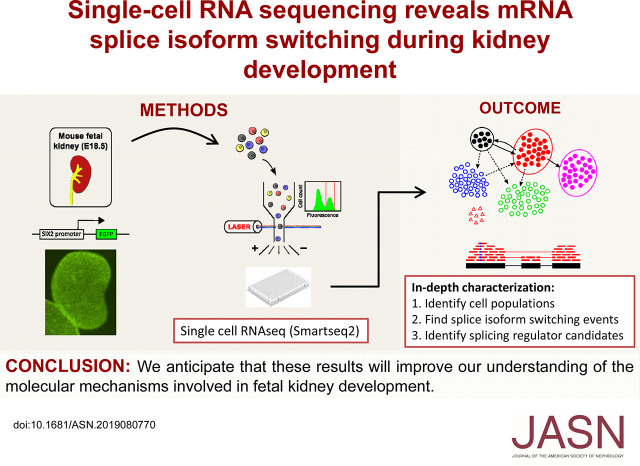
Full transcript length single-cell RNA sequencing characterized the transcriptomes of 544 individual cells from mouse embryonic kidneys.
Gene expression levels measured with full transcript length single-cell RNA sequencing identified each cell type. Further analysis comprehensively characterized splice isoform switching during the transition between mesenchymal and epithelial cellular states, which is a key transitional process in kidney development. The study also identified several putative splicing regulators, including the genes and .
Discovery of the sets of genes that are alternatively spliced as the fetal kidney mesenchyme differentiates into tubular epithelium will improve our understanding of the molecular mechanisms that drive kidney development.
在哺乳动物肾脏发育过程中,肾祖细胞经历间质到上皮的转变,并最终分化为肾单位的各种管状节段。最近,用于测量数千个单个细胞中基因表达的 Drop-seq 单细胞 RNA 测序技术鉴定了发育中肾脏中的不同细胞类型。然而,该分析并未包括可变剪接产生的额外异质性层。
全长转录本单细胞 RNA 测序对来自小鼠胚胎肾脏的 544 个单个细胞的转录组进行了特征描述。
全长转录本单细胞 RNA 测序测量的基因表达水平鉴定了每种细胞类型。进一步的分析全面描述了间充质和上皮细胞状态之间转变过程中的剪接异构体转换,这是肾脏发育的关键过渡过程。该研究还鉴定了几个假定的剪接调节因子,包括基因 和 。
发现胎儿肾脏间充质分化为管状上皮时发生可变剪接的基因集将提高我们对驱动肾脏发育的分子机制的理解。