IRD Global, 15 Beach Road #02-01, Singapore, 189677, Singapore.
IRD Pakistan, 4th Floor Woodcraft Building, Korangi Creek, Karachi, 75190, Pakistan.
BMC Public Health. 2020 Jul 11;20(1):1086. doi: 10.1186/s12889-020-09088-4.
Inability to track children's vaccination history coupled with parents' lack of awareness of vaccination due dates compounds the problem of low immunization coverage and timeliness in developing countries. We evaluated the impact of two types of silicone immunization reminder bracelets for children in improving immunization coverage and timeliness of Pentavalent-3 and the Measles-1 vaccines.
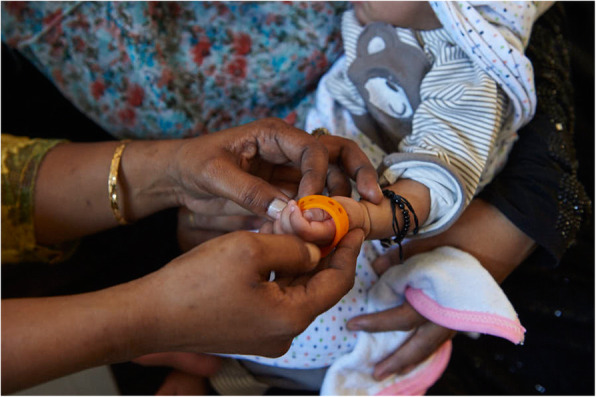
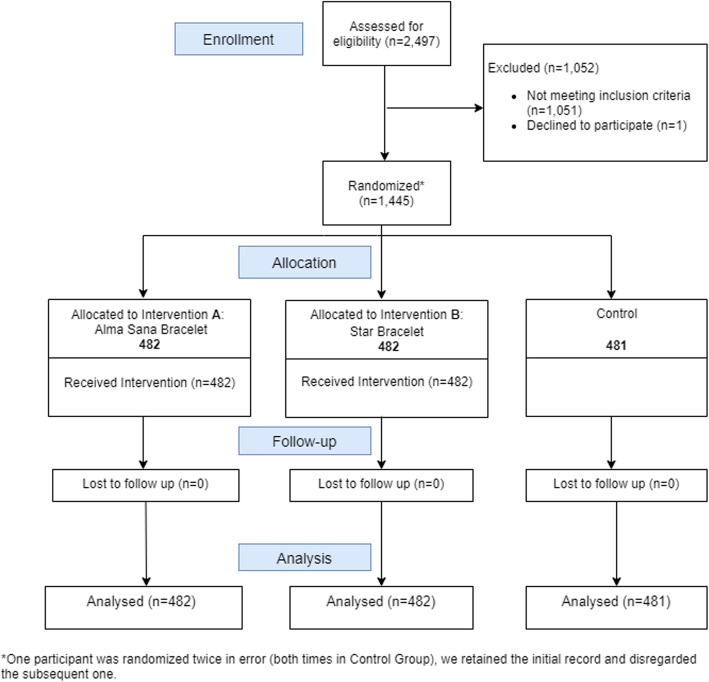
Children < 3 months were enrolled in either of the 2 intervention groups (Alma Sana Bracelet Group and Star Bracelet Group) or the Control group. Children in the intervention groups were provided the two different bracelets at the time of recruitment. Each time the child visited the immunization center, a hole was perforated in the silicone bracelet to denote vaccine administration. Each child was followed up till administration of Measles-1 vaccine or till 12 months of age (if they did not come to the center for vaccination). Data was analyzed using the intention-to-treat population between groups. The unadjusted and adjusted Risk Ratios (RR) and 95% confidence interval (CI) for Pentavalent-3 and Measles-1 coverage at 12 months of age were estimated through bivariate and multivariate analysis. Time-to-Pentavalent-3 and Measles-1 immunization curves were calculated using the Kaplan-Meier method.
A total of 1,445 children were enrolled in the study between July 19, 2017 and October 10, 2017. Baseline characteristics among the three groups were similar. Up-to-date coverage for the Pentavalent-3 /Measles-1 vaccine at 12 months of age was 84.6%/72.0%, 85.4%/70.5% and 83.0%/68.5% in Alma Sana Bracelet group, Star Bracelet group and Control group respectively but the differences were not statistically significant. In the multivariate analysis, neither the Alma Sana bracelet (adjusted RR = 1.01; 95% CI: 0.96-1.06), (adjusted RR: 1.05; 95% CI: 0.97-1.13) nor the Star bracelet (adjusted RR = 1.01; 95% CI: 0.96-1.06) (adjusted RR: 1.03; 95% CI: 0.95-1.11) was significantly associated with Pentavalent-3 vaccination or Measles-1 vaccination.
Although we did not observe any significant impact of the bracelets on improved immunization coverage and timeliness, our findings add to the existing literature on innovative, low cost reminders for health and make several suggestions for enhancing practical implementation of these tools.
ClinicalTrials.gov NCT03310762 . Retrospectively Registered on October 16, 2017.
发展中国家儿童疫苗接种史难以追踪,加之家长对疫苗接种时间缺乏认识,这使得疫苗接种覆盖率和及时性低的问题更加复杂。我们评估了两种类型的硅胶免疫提醒手镯对儿童接种五联疫苗和麻疹-1 疫苗的影响。
<3 个月大的儿童被纳入 2 个干预组(Alma Sana 手镯组和 Star 手镯组)或对照组。在招募时,干预组的儿童会获得两种不同的手镯。每次孩子去免疫中心时,都会在硅胶手镯上打一个孔,表示疫苗接种。每个孩子都会被随访到接种麻疹-1 疫苗或 12 个月(如果他们不来中心接种疫苗)。使用群组间意向治疗人群进行数据分析。通过双变量和多变量分析,估计了 12 个月时五联疫苗和麻疹-1 疫苗覆盖率的未调整和调整风险比(RR)和 95%置信区间(CI)。使用 Kaplan-Meier 方法计算五联疫苗和麻疹-1 疫苗接种时间曲线。
2017 年 7 月 19 日至 2017 年 10 月 10 日期间,共有 1445 名儿童入组研究。三组的基线特征相似。12 个月时,五联疫苗/麻疹-1 疫苗的最新接种率分别为 Alma Sana 手镯组 84.6%/72.0%、Star 手镯组 85.4%/70.5%和对照组 83.0%/68.5%,但差异无统计学意义。在多变量分析中,Alma Sana 手镯(调整 RR=1.01;95%CI:0.96-1.06)和 Star 手镯(调整 RR=1.01;95%CI:0.96-1.06)均与五联疫苗接种或麻疹-1 疫苗接种无显著相关性(调整 RR:1.05;95%CI:0.97-1.13)。
尽管我们没有观察到手镯对提高免疫接种覆盖率和及时性有任何显著影响,但我们的发现增加了关于健康创新、低成本提醒的现有文献,并为增强这些工具的实际实施提出了几点建议。
ClinicalTrials.gov NCT03310762. 2017 年 10 月 16 日回顾性注册。