Lung Biology Group, Regenerative Medicine Institute (REMEDI) at CÚRAM Centre for Research in Medical Devices, Biomedical Sciences Building, National University of Ireland, Galway, Ireland.
Department of Anaesthesia and Intensive Care Medicine, Galway University Hospitals, Galway, Ireland.
Intensive Care Med. 2020 Dec;46(12):2265-2283. doi: 10.1007/s00134-020-06141-z. Epub 2020 Jul 11.
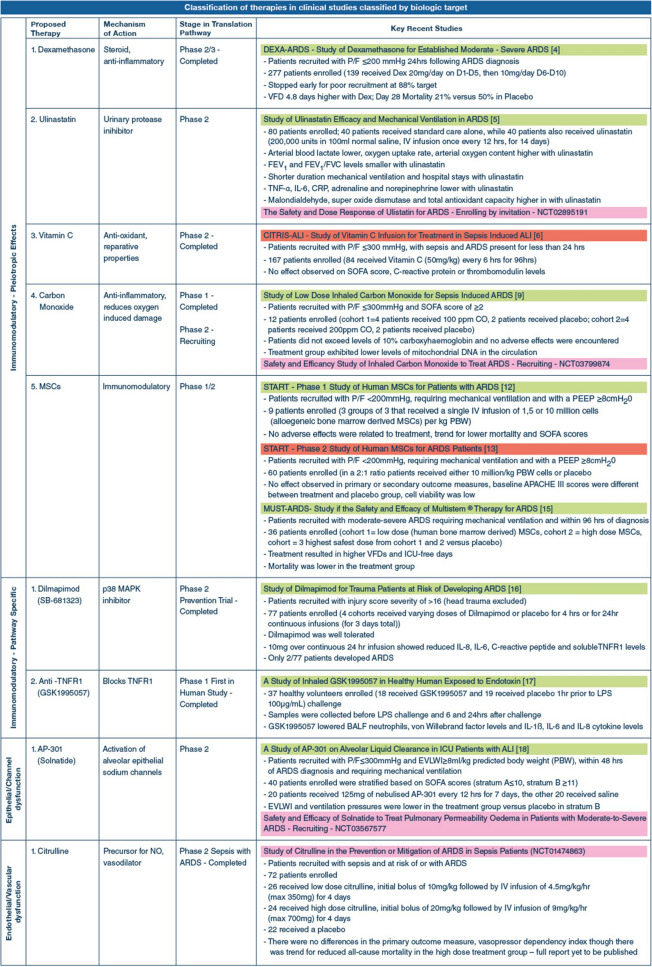
ARDS, first described in 1967, is the commonest form of acute severe hypoxemic respiratory failure. Despite considerable advances in our knowledge regarding the pathophysiology of ARDS, insights into the biologic mechanisms of lung injury and repair, and advances in supportive care, particularly ventilatory management, there remains no effective pharmacological therapy for this syndrome. Hospital mortality at 40% remains unacceptably high underlining the need to continue to develop and test therapies for this devastating clinical condition. The purpose of the review is to critically appraise the current status of promising emerging pharmacological therapies for patients with ARDS and potential impact of these and other emerging therapies for COVID-19-induced ARDS. We focus on drugs that: (1) modulate the immune response, both via pleiotropic mechanisms and via specific pathway blockade effects, (2) modify epithelial and channel function, (3) target endothelial and vascular dysfunction, (4) have anticoagulant effects, and (5) enhance ARDS resolution. We also critically assess drugs that demonstrate potential in emerging reports from clinical studies in patients with COVID-19-induced ARDS. Several therapies show promise in earlier and later phase clinical testing, while a growing pipeline of therapies is in preclinical testing. The history of unsuccessful clinical trials of promising therapies underlines the challenges to successful translation. Given this, attention has been focused on the potential to identify biologically homogenous subtypes within ARDS, to enable us to target more specific therapies 'precision medicines.' It is hoped that the substantial number of studies globally investigating potential therapies for COVID-19 will lead to the rapid identification of effective therapies to reduce the mortality and morbidity of this devastating form of ARDS.
急性呼吸窘迫综合征(ARDS)于 1967 年首次描述,是最常见的急性严重低氧性呼吸衰竭形式。尽管我们在 ARDS 的病理生理学、对肺损伤和修复的生物学机制的认识以及支持性治疗方面,特别是通气管理方面取得了相当大的进展,但对于这种综合征仍然没有有效的药物治疗。40%的住院死亡率仍然高得不可接受,这突显出需要继续为这种破坏性临床状况开发和测试治疗方法。本综述的目的是批判性地评价目前有前途的 ARDS 患者新兴药物治疗的现状,以及这些和其他新兴疗法对 COVID-19 引起的 ARDS 的潜在影响。我们专注于以下几类药物:(1)通过多效机制和特定途径阻断作用调节免疫反应;(2)调节上皮和通道功能;(3)靶向内皮和血管功能障碍;(4)具有抗凝作用;(5)增强 ARDS 的解决。我们还批判性地评估了在 COVID-19 引起的 ARDS 患者的临床研究中新兴报告中显示出潜力的药物。一些疗法在早期和后期临床试验中显示出前景,而越来越多的疗法正在进行临床前测试。有前途的疗法在临床试验中失败的历史突显出成功转化的挑战。有鉴于此,人们一直关注在 ARDS 中识别生物学同质亚群的潜力,以便我们能够针对更具体的疗法进行“精准医学”。希望全球对 COVID-19 潜在治疗方法的大量研究将迅速确定有效的治疗方法,以降低这种破坏性形式的 ARDS 的死亡率和发病率。