Takeda Pharma Vertrieb GmbH & Co. KG, Berlin, Germany.
Health Economics, WifOR, Darmstadt, Germany.
Eur J Health Econ. 2020 Dec;21(9):1351-1361. doi: 10.1007/s10198-020-01219-3. Epub 2020 Jul 11.
In Germany, several triplet therapies for treating relapsed or refractory multiple myeloma (rrMM) patients have recently been approved. While most of them are administered intravenously, ixazomib-based combination is the only orally bioavailable regimen.
To conduct a 1-year and 3-year budget impact analysis (BIA) of different novel triplets to treat patients with rrMM in second or subsequent therapy lines accounting for costs covered by German statutory health insurance (SHI).
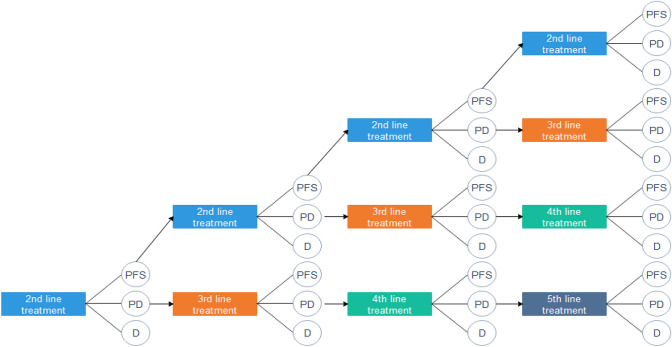
A 3-state partitioned survival model (PSM) was developed to evaluate the budget impact of the following regimens: carfilzomib plus lenalidomide plus dexamethasone (KRd), elotuzumab plus lenalidomide plus dexamethasone (ERd), daratumumab plus lenalidomide plus dexamethasone (DRd), and ixazomib plus lenalidomide plus dexamethasone (IRd). The analysis included direct medical costs such as drug acquisition, comedication and preparation for parenteral solutions, drug administration and other 1-time costs, adverse event management costs and direct non-medical costs, such as transportation costs.
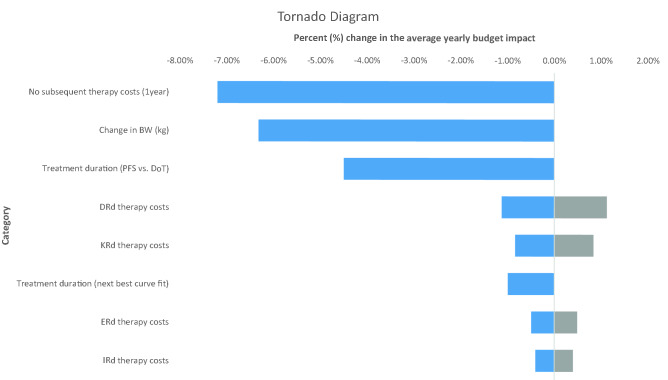
Based on current drug market shares in German healthcare market, the estimated costs after 1 year of treatment was €551 million (KRd), €163 million (ERd), €584 million (DRd), and €95 million (IRd). The total budget impact of €1393 million is mainly driven by drug acquisition and subsequent therapy costs.
Among the regimens of interest, the oral-based therapy regimens offered cost advantages over intravenous-based therapy regimens. The higher overall costs of intravenous therapy regimens were attributed primarily to higher drug acquisition costs.
在德国,最近有几种三联疗法被批准用于治疗复发或难治性多发性骨髓瘤(rrMM)患者。虽然它们大多数都是静脉给药,但基于伊沙佐米的联合用药是唯一口服生物利用的方案。
针对在二线或二线以上治疗中治疗 rrMM 患者的不同新型三联疗法,进行 1 年和 3 年的预算影响分析(BIA),并考虑德国法定健康保险(SHI)涵盖的成本。
开发了一个三状态分区生存模型(PSM),以评估以下方案的预算影响:卡非佐米联合来那度胺联合地塞米松(KRd)、埃罗妥珠单抗联合来那度胺联合地塞米松(ERd)、达雷妥尤单抗联合来那度胺联合地塞米松(DRd)和伊沙佐米联合来那度胺联合地塞米松(IRd)。该分析包括直接医疗成本,如药物获取、合并用药和静脉制剂准备、药物管理和其他一次性成本、不良事件管理成本以及直接非医疗成本,如交通成本。
基于德国医疗保健市场目前的药物市场份额,治疗 1 年后的估计成本为 5.51 亿欧元(KRd)、1.63 亿欧元(ERd)、5.84 亿欧元(DRd)和 9500 万欧元(IRd)。13.93 亿欧元的总预算影响主要由药物获取和后续治疗成本驱动。
在所关注的方案中,口服治疗方案比静脉治疗方案具有成本优势。静脉治疗方案的总体成本较高主要归因于药物获取成本较高。