Institute of Public Policy and Administration, Chung-Ang University, Seoul, South Korea.
School of Economic, Political and Policy Sciences, University of Texas at Dallas, Richardson TX, USA.
Int J Health Policy Manag. 2020 Nov 1;9(11):475-483. doi: 10.34172/ijhpm.2020.118.
Allocation of adequate healthcare facilities is one of the most important factors that public health policymakers consider when preparing for infectious disease outbreaks. Negative pressure isolation rooms (NPIRs) are one of the critical resources for control of infectious respiratory diseases, such as the novel coronavirus disease 2019 (COVID-19) outbreak. However, there is insufficient attention to efficient allocation of NPIR-equipped hospitals.
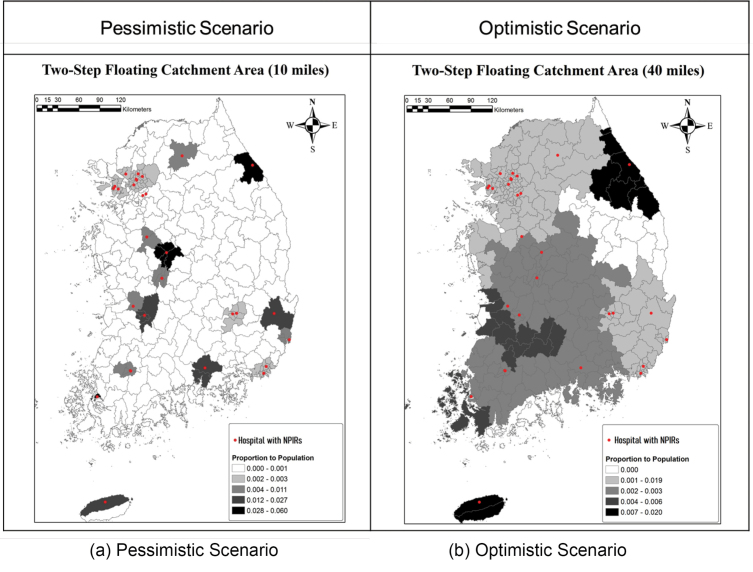
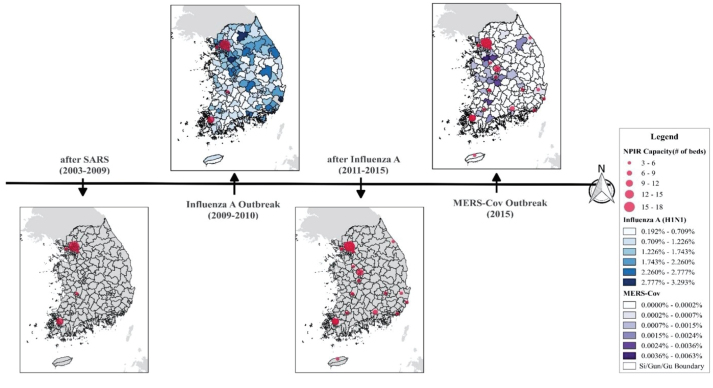
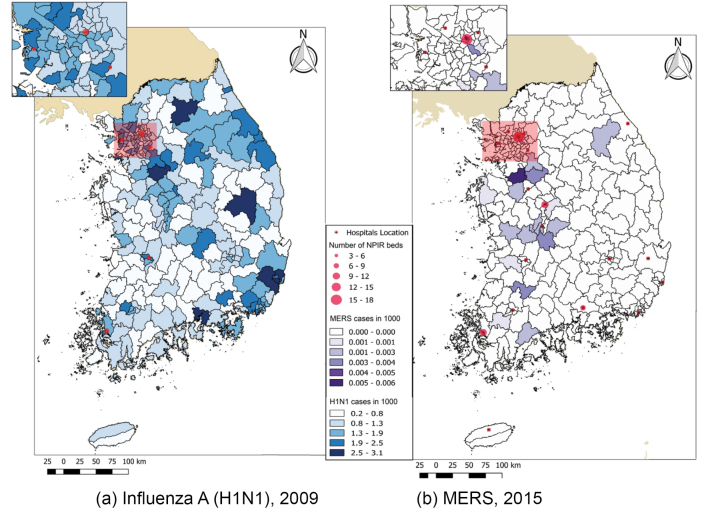
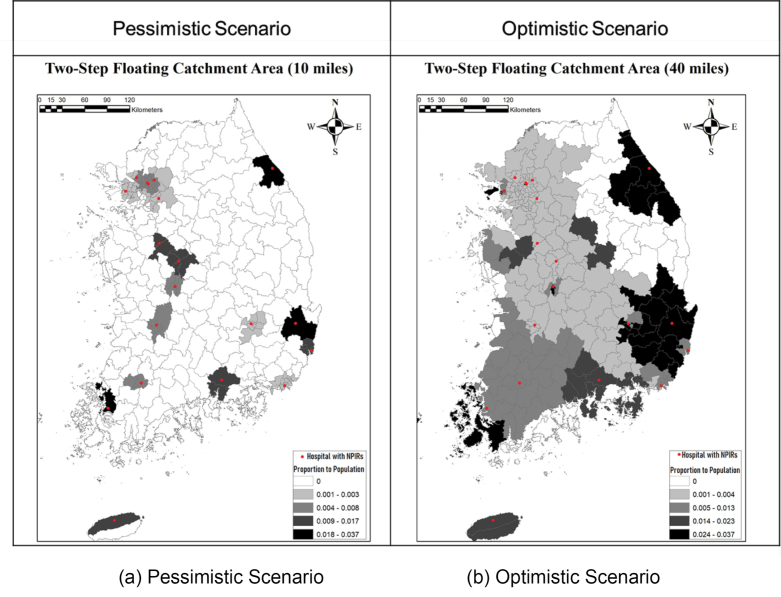
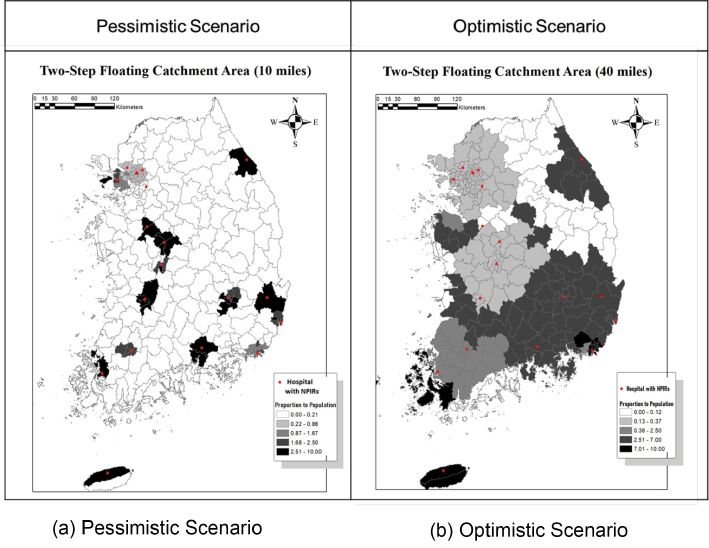
We aim to explore any insufficiency and spatial disparity of NPIRs in South Korea in response to infectious disease outbreaks based on a simple analytic approach. We examined the history of installing NPIRs in South Korea between the severe acute respiratory syndrome (SARS) outbreak in 2003 and the Middle East respiratory syndrome coronavirus (MERS-Cov) in 2015 to evaluate the allocation process and spatial distribution of NPIRs across the country. Then, for two types of infectious diseases (a highly contagious disease like COVID-19 vs. a hospital-based transmission like MERS-Cov), we estimated the level of disparity between NPIR capacity and demand at the sub-regional level in South Korea by applying the two-step floating catchment area (2SFCA) method.
Geospatial information system (GIS) mapping reveals a substantial shortage and misallocation of NPIRs, indicating that the Korean government should consider a simple but evidence-based spatial method to identify the areas that need NPIRs most and allocate funds wisely. The 2SFCA method suggests that, despite the recent addition of NPIRs across the country, there should still be more NPIRs regardless of the spread pattern of the disease. It also illustrates high levels of regional disparity in allocation of those facilities in preparation for an infectious disease, due to the lack of evidence-based approach.
These findings highlight the importance of evidence-based decision-making processes in allocating public health facilities, as misallocation of facilities could impede the responsiveness of the public health system during an epidemic. This study provides some evidence to be used to allocate the resources for NPIRs, the urgency of which is heightened in the face of rapidly evolving threats from the novel COVID-19 outbreak.
在为传染病爆发做准备时,公共卫生政策制定者考虑的最重要因素之一是分配足够的医疗设施。负压隔离室(NPIR)是控制传染性呼吸道疾病(如新型冠状病毒病 2019(COVID-19)爆发)的关键资源之一。然而,对于 NPIR 配备医院的有效分配,关注不足。
我们旨在基于简单的分析方法,探讨韩国在传染病爆发时 NPIR 配置不足和空间差异的问题。我们检查了韩国在 2003 年严重急性呼吸系统综合征(SARS)爆发和 2015 年中东呼吸综合征冠状病毒(MERS-Cov)之间安装 NPIR 的历史,以评估全国范围内 NPIR 的分配过程和空间分布。然后,对于两种类型的传染病(一种高度传染性疾病,如 COVID-19,与一种医院传播疾病,如 MERS-Cov),我们应用两步浮动集水区(2SFCA)方法,在韩国的亚区域水平上估计 NPIR 能力与需求之间的差异程度。
地理信息系统(GIS)制图揭示了 NPIR 严重短缺和配置不当,这表明韩国政府应考虑一种简单但基于证据的空间方法,以确定最需要 NPIR 的地区,并明智地分配资金。2SFCA 方法表明,尽管全国范围内最近增加了 NPIR,但无论疾病传播模式如何,仍需要更多的 NPIR。它还说明了在为传染病做准备时,由于缺乏基于证据的方法,这些设施的分配存在高度的区域差异。
这些发现强调了在分配公共卫生设施时基于证据的决策过程的重要性,因为设施的配置不当可能会阻碍公共卫生系统在疫情期间的反应能力。本研究为分配 NPIR 资源提供了一些证据,在面对新型 COVID-19 爆发带来的快速演变的威胁时,这种资源的紧迫性更加凸显。