• 文献检索
  • 文档翻译
  • 深度研究
  • 学术资讯
  • Suppr Zotero 插件Zotero 插件
  • 邀请有礼
  • 套餐&价格
  • 历史记录
应用&插件
Suppr Zotero 插件Zotero 插件浏览器插件Mac 客户端Windows 客户端微信小程序
定价
高级版会员购买积分包购买API积分包
服务
文献检索文档翻译深度研究API 文档MCP 服务
关于我们
关于 Suppr公司介绍联系我们用户协议隐私条款
关注我们

Suppr 超能文献

核心技术专利:CN118964589B侵权必究
粤ICP备2023148730 号-1Suppr @ 2026

文献检索

告别复杂PubMed语法,用中文像聊天一样搜索,搜遍4000万医学文献。AI智能推荐,让科研检索更轻松。

立即免费搜索

文件翻译

保留排版,准确专业,支持PDF/Word/PPT等文件格式,支持 12+语言互译。

免费翻译文档

深度研究

AI帮你快速写综述,25分钟生成高质量综述,智能提取关键信息,辅助科研写作。

立即免费体验

使用长短期记忆网络的脑机接口在多类心理负荷检测中的精度提升

Enhanced Accuracy for Multiclass Mental Workload Detection Using Long Short-Term Memory for Brain-Computer Interface.

作者信息

Asgher Umer, Khalil Khurram, Khan Muhammad Jawad, Ahmad Riaz, Butt Shahid Ikramullah, Ayaz Yasar, Naseer Noman, Nazir Salman

机构信息

School of Mechanical and Manufacturing Engineering (SMME), National University of Sciences and Technology (NUST), Islamabad, Pakistan.

Directorate of Quality Assurance and International Collaboration, National University of Sciences and Technology (NUST), Islamabad, Pakistan.

出版信息

Front Neurosci. 2020 Jun 23;14:584. doi: 10.3389/fnins.2020.00584. eCollection 2020.

DOI:10.3389/fnins.2020.00584
PMID:32655353
原文链接:https://pmc.ncbi.nlm.nih.gov/articles/PMC7324788/
Abstract

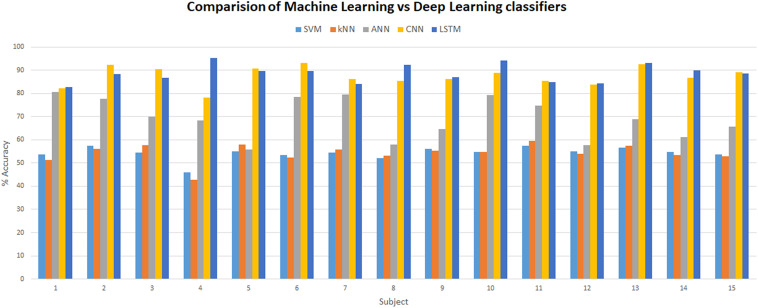
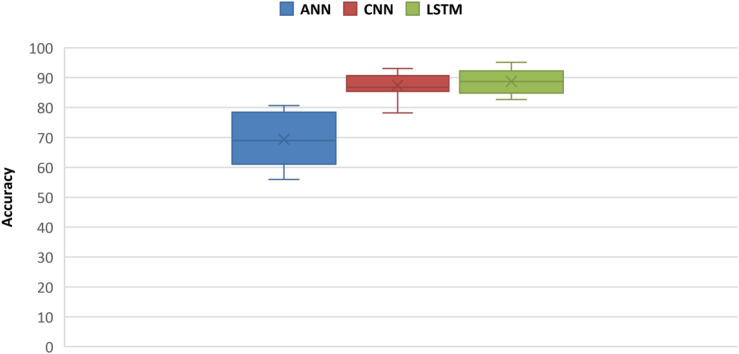
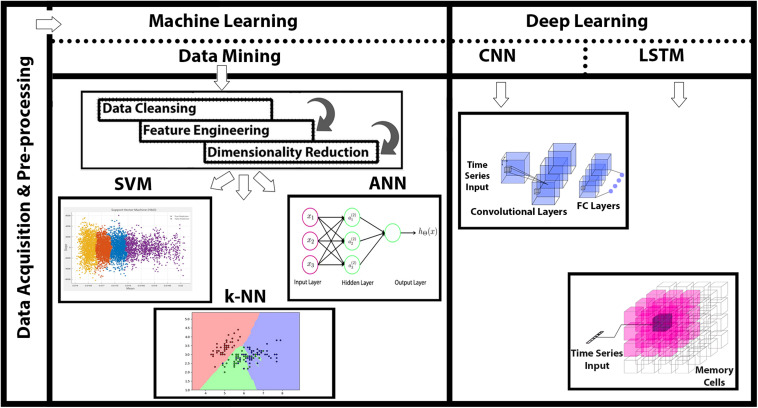
Cognitive workload is one of the widely invoked human factors in the areas of human-machine interaction (HMI) and neuroergonomics. The precise assessment of cognitive and mental workload (MWL) is vital and requires accurate neuroimaging to monitor and evaluate the cognitive states of the brain. In this study, we have decoded four classes of MWL using long short-term memory (LSTM) with 89.31% average accuracy for brain-computer interface (BCI). The brain activity signals are acquired using functional near-infrared spectroscopy (fNIRS) from the prefrontal cortex (PFC) region of the brain. We performed a supervised MWL experimentation with four varying MWL levels on 15 participants (both male and female) and 10 trials of each MWL per participant. Real-time four-level MWL states are assessed using fNIRS system, and initial classification is performed using three strong machine learning (ML) techniques, support vector machine (SVM), -nearest neighbor (-NN), and artificial neural network (ANN) with obtained average accuracies of 54.33, 54.31, and 69.36%, respectively. In this study, novel deep learning (DL) frameworks are proposed, which utilizes convolutional neural network (CNN) and LSTM with 87.45 and 89.31% average accuracies, respectively, to solve high-dimensional four-level cognitive states classification problem. Statistical analysis, -test, and one-way -test (ANOVA) are also performed on accuracies obtained through ML and DL algorithms. Results show that the proposed DL (LSTM and CNN) algorithms significantly improve classification performance as compared with ML (SVM, ANN, and -NN) algorithms.

摘要

认知工作量是人机交互(HMI)和神经工效学领域中广泛提及的人为因素之一。准确评估认知和心理工作量(MWL)至关重要,需要精确的神经成像来监测和评估大脑的认知状态。在本研究中,我们使用长短期记忆(LSTM)对四类MWL进行了解码,用于脑机接口(BCI)的平均准确率达到89.31%。大脑活动信号通过功能近红外光谱(fNIRS)从大脑前额叶皮层(PFC)区域获取。我们对15名参与者(包括男性和女性)进行了四种不同MWL水平的监督式MWL实验,每位参与者每种MWL水平进行10次试验。使用fNIRS系统评估实时四级MWL状态,并使用三种强大的机器学习(ML)技术进行初始分类,即支持向量机(SVM)、-最近邻(-NN)和人工神经网络(ANN),获得的平均准确率分别为54.33%、54.31%和69.36%。在本研究中,提出了新颖的深度学习(DL)框架,分别利用卷积神经网络(CNN)和LSTM,平均准确率分别为87.45%和89.31%,以解决高维四级认知状态分类问题。还对通过ML和DL算法获得的准确率进行了统计分析、-检验和单因素-检验(方差分析)。结果表明,与ML(SVM、ANN和-NN)算法相比,所提出的DL(LSTM和CNN)算法显著提高了分类性能。
https://cdn.ncbi.nlm.nih.gov/pmc/blobs/105e/7324788/fb3b8105c27f/fnins-14-00584-g013.jpg
https://cdn.ncbi.nlm.nih.gov/pmc/blobs/105e/7324788/f664f3711ba2/fnins-14-00584-g001.jpg
https://cdn.ncbi.nlm.nih.gov/pmc/blobs/105e/7324788/5f9e57b7d0d2/fnins-14-00584-g002.jpg
https://cdn.ncbi.nlm.nih.gov/pmc/blobs/105e/7324788/e05436cd8aff/fnins-14-00584-g003.jpg
https://cdn.ncbi.nlm.nih.gov/pmc/blobs/105e/7324788/eea410c10b7c/fnins-14-00584-g004.jpg
https://cdn.ncbi.nlm.nih.gov/pmc/blobs/105e/7324788/df76ac23079d/fnins-14-00584-g005.jpg
https://cdn.ncbi.nlm.nih.gov/pmc/blobs/105e/7324788/ff8bc223a424/fnins-14-00584-g006.jpg
https://cdn.ncbi.nlm.nih.gov/pmc/blobs/105e/7324788/b9d45dfa3e92/fnins-14-00584-g007.jpg
https://cdn.ncbi.nlm.nih.gov/pmc/blobs/105e/7324788/edf3f21c6dc3/fnins-14-00584-g008.jpg
https://cdn.ncbi.nlm.nih.gov/pmc/blobs/105e/7324788/3fb4517fce9c/fnins-14-00584-g009.jpg
https://cdn.ncbi.nlm.nih.gov/pmc/blobs/105e/7324788/0c3b5fe481b9/fnins-14-00584-g010.jpg
https://cdn.ncbi.nlm.nih.gov/pmc/blobs/105e/7324788/0e96605b03d1/fnins-14-00584-g011.jpg
https://cdn.ncbi.nlm.nih.gov/pmc/blobs/105e/7324788/ba8b8074104d/fnins-14-00584-g012.jpg
https://cdn.ncbi.nlm.nih.gov/pmc/blobs/105e/7324788/fb3b8105c27f/fnins-14-00584-g013.jpg
https://cdn.ncbi.nlm.nih.gov/pmc/blobs/105e/7324788/f664f3711ba2/fnins-14-00584-g001.jpg
https://cdn.ncbi.nlm.nih.gov/pmc/blobs/105e/7324788/5f9e57b7d0d2/fnins-14-00584-g002.jpg
https://cdn.ncbi.nlm.nih.gov/pmc/blobs/105e/7324788/e05436cd8aff/fnins-14-00584-g003.jpg
https://cdn.ncbi.nlm.nih.gov/pmc/blobs/105e/7324788/eea410c10b7c/fnins-14-00584-g004.jpg
https://cdn.ncbi.nlm.nih.gov/pmc/blobs/105e/7324788/df76ac23079d/fnins-14-00584-g005.jpg
https://cdn.ncbi.nlm.nih.gov/pmc/blobs/105e/7324788/ff8bc223a424/fnins-14-00584-g006.jpg
https://cdn.ncbi.nlm.nih.gov/pmc/blobs/105e/7324788/b9d45dfa3e92/fnins-14-00584-g007.jpg
https://cdn.ncbi.nlm.nih.gov/pmc/blobs/105e/7324788/edf3f21c6dc3/fnins-14-00584-g008.jpg
https://cdn.ncbi.nlm.nih.gov/pmc/blobs/105e/7324788/3fb4517fce9c/fnins-14-00584-g009.jpg
https://cdn.ncbi.nlm.nih.gov/pmc/blobs/105e/7324788/0c3b5fe481b9/fnins-14-00584-g010.jpg
https://cdn.ncbi.nlm.nih.gov/pmc/blobs/105e/7324788/0e96605b03d1/fnins-14-00584-g011.jpg
https://cdn.ncbi.nlm.nih.gov/pmc/blobs/105e/7324788/ba8b8074104d/fnins-14-00584-g012.jpg
https://cdn.ncbi.nlm.nih.gov/pmc/blobs/105e/7324788/fb3b8105c27f/fnins-14-00584-g013.jpg

相似文献

1
Enhanced Accuracy for Multiclass Mental Workload Detection Using Long Short-Term Memory for Brain-Computer Interface.使用长短期记忆网络的脑机接口在多类心理负荷检测中的精度提升
Front Neurosci. 2020 Jun 23;14:584. doi: 10.3389/fnins.2020.00584. eCollection 2020.
2
Analyzing Classification Performance of fNIRS-BCI for Gait Rehabilitation Using Deep Neural Networks.基于深度神经网络的 fNIRS-BCI 在步态康复中的分类性能分析。
Sensors (Basel). 2022 Mar 1;22(5):1932. doi: 10.3390/s22051932.
3
Motor Training Using Mental Workload (MWL) With an Assistive Soft Exoskeleton System: A Functional Near-Infrared Spectroscopy (fNIRS) Study for Brain-Machine Interface (BMI).使用心理负荷(MWL)结合辅助软外骨骼系统进行运动训练:一项用于脑机接口(BMI)的功能近红外光谱(fNIRS)研究。
Front Neurorobot. 2021 Mar 18;15:605751. doi: 10.3389/fnbot.2021.605751. eCollection 2021.
4
EEG-fNIRS-based hybrid image construction and classification using CNN-LSTM.基于脑电图-近红外光谱的混合图像构建与卷积神经网络-长短期记忆网络分类
Front Neurorobot. 2022 Aug 31;16:873239. doi: 10.3389/fnbot.2022.873239. eCollection 2022.
5
Enhancing Classification Accuracy with Integrated Contextual Gate Network: Deep Learning Approach for Functional Near-Infrared Spectroscopy Brain-Computer Interface Application.基于集成上下文门控网络的分类精度提升:用于功能性近红外光谱脑-机接口应用的深度学习方法。
Sensors (Basel). 2024 May 10;24(10):3040. doi: 10.3390/s24103040.
6
Measuring Mental Workload with EEG+fNIRS.使用脑电图+功能性近红外光谱技术测量心理负荷
Front Hum Neurosci. 2017 Jul 14;11:359. doi: 10.3389/fnhum.2017.00359. eCollection 2017.
7
Deep learning networks based decision fusion model of EEG and fNIRS for classification of cognitive tasks.基于深度学习网络的脑电图和功能近红外光谱用于认知任务分类的决策融合模型
Cogn Neurodyn. 2024 Aug;18(4):1489-1506. doi: 10.1007/s11571-023-09986-4. Epub 2023 Jun 30.
8
Transformer Model for Functional Near-Infrared Spectroscopy Classification.Transformer 模型在功能近红外光谱分类中的应用。
IEEE J Biomed Health Inform. 2022 Jun;26(6):2559-2569. doi: 10.1109/JBHI.2022.3140531. Epub 2022 Jun 3.
9
Deep Learning-Based Multilevel Classification of Alzheimer's Disease Using Non-invasive Functional Near-Infrared Spectroscopy.基于深度学习的非侵入式功能近红外光谱技术对阿尔茨海默病的多级分类
Front Aging Neurosci. 2022 Apr 26;14:810125. doi: 10.3389/fnagi.2022.810125. eCollection 2022.
10
Benchmarking framework for machine learning classification from fNIRS data.基于功能近红外光谱(fNIRS)数据的机器学习分类基准框架。
Front Neuroergon. 2023 Mar 3;4:994969. doi: 10.3389/fnrgo.2023.994969. eCollection 2023.

引用本文的文献

1
Human-Centric Cognitive State Recognition Using Physiological Signals: A Systematic Review of Machine Learning Strategies Across Application Domains.基于生理信号的以人为中心的认知状态识别:跨应用领域机器学习策略的系统综述
Sensors (Basel). 2025 Jul 5;25(13):4207. doi: 10.3390/s25134207.
2
Detection of cognitive load during computer-aided education using infrared sensors.使用红外传感器在计算机辅助教育期间检测认知负荷。
Cogn Neurodyn. 2025 Dec;19(1):58. doi: 10.1007/s11571-025-10242-0. Epub 2025 Apr 4.
3
A cross-attention swin transformer network for EEG-based subject-independent cognitive load assessment.

本文引用的文献

1
Brain at Work and in Everyday Life as the Next Frontier: Grand Field Challenges for Neuroergonomics.作为下一个前沿领域的工作与日常生活中的大脑:神经工效学的重大领域挑战
Front Neuroergon. 2020 Oct 27;1:583733. doi: 10.3389/fnrgo.2020.583733. eCollection 2020.
2
A survey on deep learning-based non-invasive brain signals: recent advances and new frontiers.基于深度学习的非侵入式脑信号研究综述:最新进展与新前沿
J Neural Eng. 2021 Mar 5;18(3). doi: 10.1088/1741-2552/abc902.
3
EEG-Based Brain-Computer Interfaces.基于脑电图的脑机接口。
一种用于基于脑电图的独立于个体的认知负荷评估的交叉注意力窗口变压器网络。
Cogn Neurodyn. 2024 Dec;18(6):3805-3819. doi: 10.1007/s11571-024-10160-7. Epub 2024 Aug 20.
4
Exploring cognitive load through neuropsychological features: an analysis using fNIRS-eye tracking.通过神经心理学特征探索认知负荷:一项使用功能性近红外光谱技术(fNIRS)与眼动追踪技术的分析
Med Biol Eng Comput. 2025 Jan;63(1):45-57. doi: 10.1007/s11517-024-03178-w. Epub 2024 Aug 6.
5
Cognitive workload estimation using physiological measures: a review.使用生理测量方法进行认知工作量估计:综述
Cogn Neurodyn. 2024 Aug;18(4):1445-1465. doi: 10.1007/s11571-023-10051-3. Epub 2023 Dec 26.
6
Working memory load recognition with deep learning time series classification.基于深度学习时间序列分类的工作记忆负荷识别
Biomed Opt Express. 2024 Apr 3;15(5):2780-2797. doi: 10.1364/BOE.516063. eCollection 2024 May 1.
7
CT-Net: an interpretable CNN-Transformer fusion network for fNIRS classification.CT-Net:一种可解释的 CNN-Transformer 融合网络,用于 fNIRS 分类。
Med Biol Eng Comput. 2024 Oct;62(10):3233-3247. doi: 10.1007/s11517-024-03138-4. Epub 2024 May 30.
8
Novel Feature Generation for Classification of Motor Activity from Functional Near-Infrared Spectroscopy Signals Using Machine Learning.利用机器学习从功能近红外光谱信号中生成用于运动活动分类的新特征
Diagnostics (Basel). 2024 May 13;14(10):1008. doi: 10.3390/diagnostics14101008.
9
Investigation of the neural correlation with task performance and its effect on cognitive load level classification.研究与任务表现的神经相关性及其对认知负荷水平分类的影响。
PLoS One. 2023 Dec 21;18(12):e0291576. doi: 10.1371/journal.pone.0291576. eCollection 2023.
10
Decoding Mental Effort in a Quasi-Realistic Scenario: A Feasibility Study on Multimodal Data Fusion and Classification.在准真实场景下解码心理努力:多模态数据融合与分类的可行性研究。
Sensors (Basel). 2023 Jul 20;23(14):6546. doi: 10.3390/s23146546.
Adv Exp Med Biol. 2019;1101:41-65. doi: 10.1007/978-981-13-2050-7_2.
4
Towards a Multimodal Model of Cognitive Workload Through Synchronous Optical Brain Imaging and Eye Tracking Measures.通过同步光学脑成像和眼动追踪测量建立认知工作量的多模态模型。
Front Hum Neurosci. 2019 Oct 23;13:375. doi: 10.3389/fnhum.2019.00375. eCollection 2019.
5
World's fastest brain-computer interface: Combining EEG2Code with deep learning.世界上最快的脑机接口:将 EEG2Code 与深度学习相结合。
PLoS One. 2019 Sep 6;14(9):e0221909. doi: 10.1371/journal.pone.0221909. eCollection 2019.
6
A Systematic Review of Integrated Functional Near-Infrared Spectroscopy (fNIRS) and Transcranial Magnetic Stimulation (TMS) Studies.整合功能近红外光谱(fNIRS)与经颅磁刺激(TMS)研究的系统评价
Front Neurosci. 2019 Feb 28;13:84. doi: 10.3389/fnins.2019.00084. eCollection 2019.
7
Speech Recognition via fNIRS Based Brain Signals.基于功能近红外光谱技术(fNIRS)脑信号的语音识别
Front Neurosci. 2018 Oct 9;12:695. doi: 10.3389/fnins.2018.00695. eCollection 2018.
8
Experienced mental workload, perception of usability, their interaction and impact on task performance.经验性的工作负荷、可用性感知、它们之间的相互作用以及对任务绩效的影响。
PLoS One. 2018 Aug 1;13(8):e0199661. doi: 10.1371/journal.pone.0199661. eCollection 2018.
9
Intersession Instability in fNIRS-Based Emotion Recognition.基于近红外光谱的情绪识别中的会话间不稳定性。
IEEE Trans Neural Syst Rehabil Eng. 2018 Jul;26(7):1324-1333. doi: 10.1109/TNSRE.2018.2842464.
10
An fNIRS-Based Feature Learning and Classification Framework to Distinguish Hemodynamic Patterns in Children Who Stutter.基于功能近红外光谱的特征学习和分类框架,以区分口吃儿童的血流动力学模式。
IEEE Trans Neural Syst Rehabil Eng. 2018 Jun;26(6):1254-1263. doi: 10.1109/TNSRE.2018.2829083.