Francki Michael G, Walker Esther, McMullan Christopher J, Morris W George
Department of Primary Industries and Regional Development, South Perth, WA, Australia.
State Agricultural Biotechnology Centre, Murdoch University, Murdoch, WA, Australia.
Front Plant Sci. 2020 Jun 10;11:771. doi: 10.3389/fpls.2020.00771. eCollection 2020.
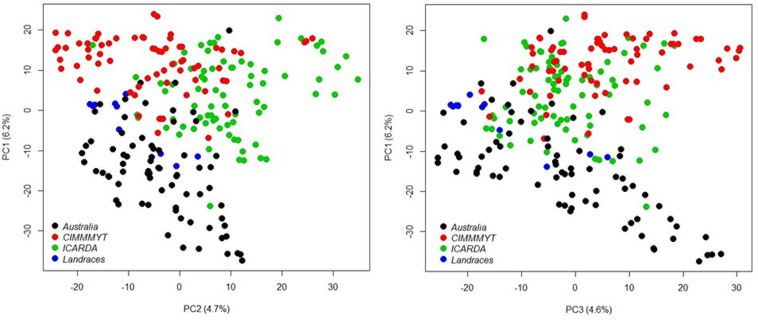
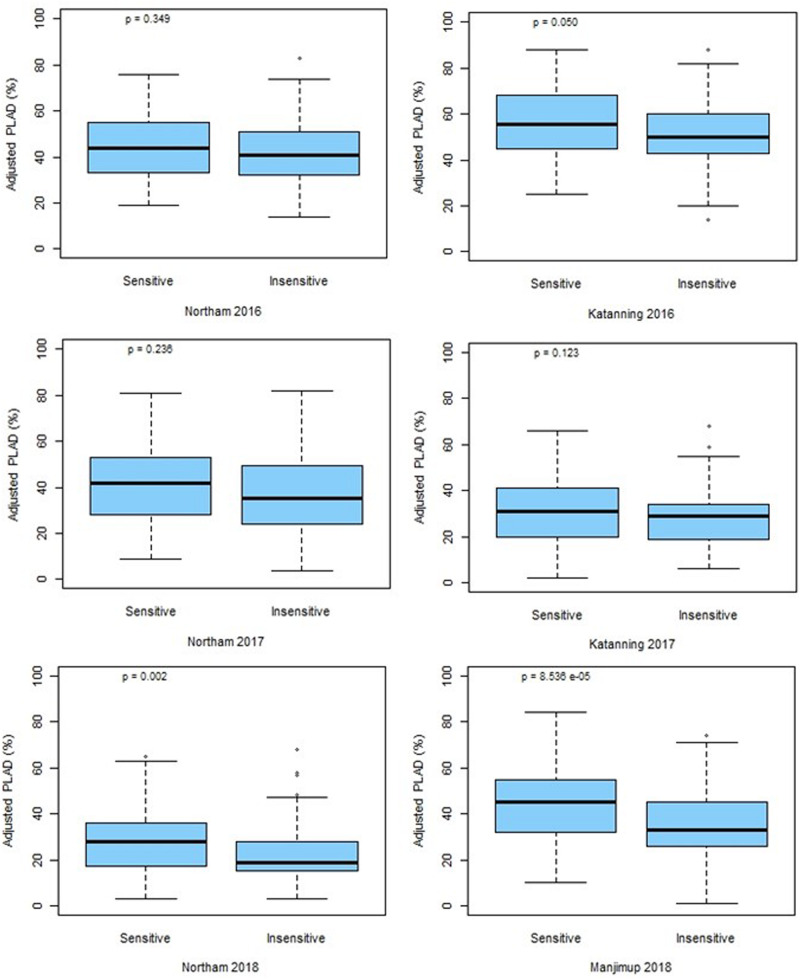
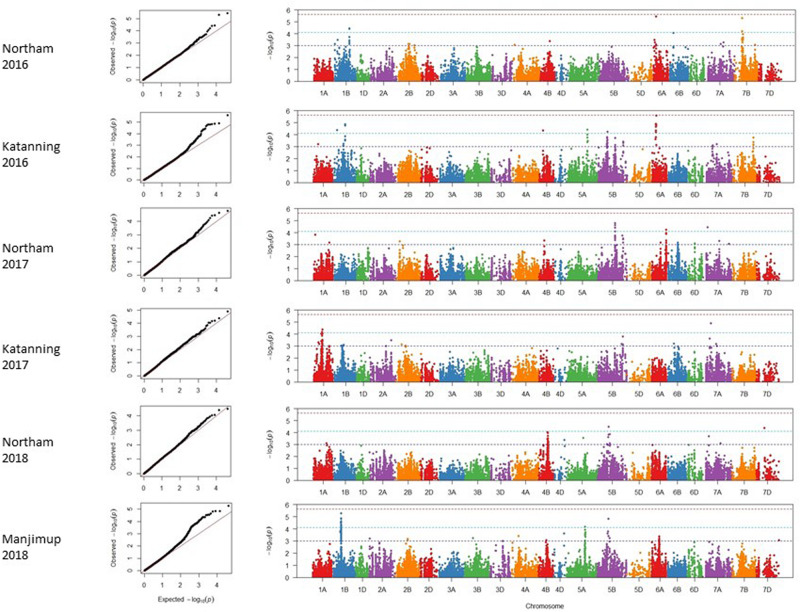
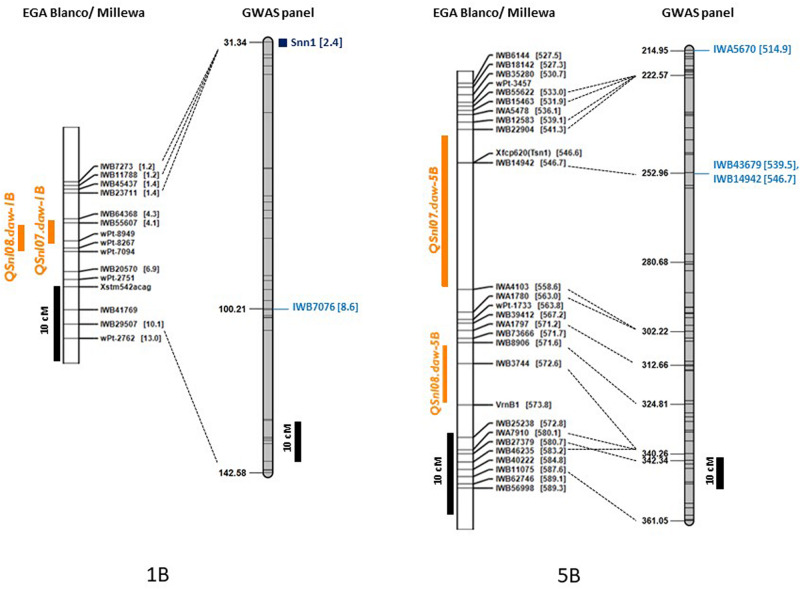
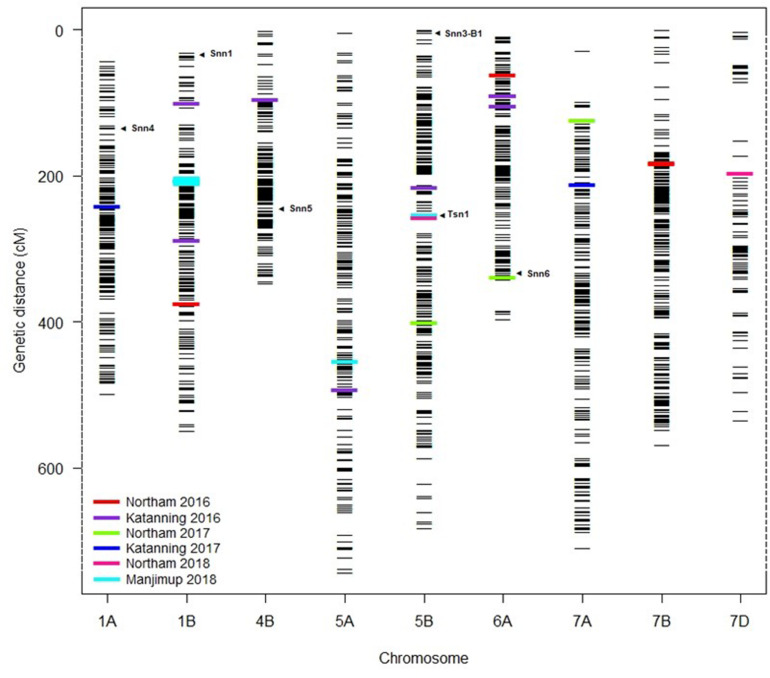
The slow rate of genetic gain for improving resistance to Septoria nodorum blotch (SNB) is due to the inherent complex interactions between host, isolates, and environments. Breeding for improved SNB resistance requires evaluation and selection of wheat genotypes consistently expressing low SNB response in different target production environments. The study focused on evaluating 232 genotypes from global origins for resistance to SNB in the flag leaf expressed in different Western Australian environments. The aim was to identify resistant donor germplasm against historical and contemporary pathogen isolates and enhance our knowledge of the genetic basis of genotype-by-environment interactions for SNB response. Australian wheat varieties, inbred lines from Centro Internacional de Mejoramiento de Maiz y Trigo (CIMMYT), and International Center for Agricultural Research in the Dry Areas (ICARDA), and landraces from discrete regions of the world showed low to moderate phenotypic correlation for disease response amongst genotypes when evaluated with historical and contemporary isolates at two locations across 3 years in Western Australia (WA). Significant ( < 0.001) genotype-by-environment interactions were detected regardless of same or different isolates used as an inoculum source. Joint regression analysis identified 19 genotypes that consistently expressed low disease severity under infection with different isolates in multi-locations. The CIMMYT inbred lines, 30ZJN09 and ZJN12 Qno25, were particularly pertinent as they had low SNB response and highest trait stability at two locations across 3 years. Genome wide association studies detected 20 QTL associated with SNB resistance on chromosomes 1A, 1B, 4B, 5A, 5B, 6A, 7A, 7B, and 7D. QTL on chromosomes 1B and 5B were previously reported in similar genomic regions. Multiple QTL were identified on 1B, 5B, 6A, and 5A and detected in response to SNB infection against different isolates and specific environments. Known SnTox- interactions were either not evident or variable across WA environments and SNB response may involve other multiple complex biological mechanisms.
提高对小麦颖枯病(SNB)抗性的遗传增益速度缓慢,这是由于寄主、分离株和环境之间存在固有的复杂相互作用。培育具有更高SNB抗性的品种需要评估和选择在不同目标生产环境中始终表现出低SNB反应的小麦基因型。该研究聚焦于评估来自全球各地的232个基因型在西澳大利亚不同环境下旗叶对SNB的抗性。目的是鉴定针对历史和当代病原菌分离株的抗性供体种质,并增进我们对SNB反应中基因型与环境相互作用遗传基础的了解。澳大利亚小麦品种、国际玉米和小麦改良中心(CIMMYT)的自交系、国际干旱地区农业研究中心(ICARDA)的材料以及来自世界不同地区的地方品种,在西澳大利亚(WA)的两个地点,用历史和当代分离株进行了3年的评估,结果显示不同基因型间的病害反应表现出低到中等的表型相关性。无论接种源使用相同还是不同的分离株,均检测到显著的(<0.001)基因型与环境的相互作用。联合回归分析确定了19个基因型,它们在多个地点感染不同分离株时始终表现出低病害严重度。CIMMYT的自交系30ZJN09和ZJN12 Qno25尤为突出,因为它们在3年中的两个地点都具有低SNB反应和最高的性状稳定性。全基因组关联研究在1A、1B、4B、5A、5B、6A、7A、7B和7D染色体上检测到20个与SNB抗性相关的QTL。1B和5B染色体上的QTL先前在类似的基因组区域已有报道。在1B、5B、6A和5A染色体上鉴定出多个QTL,并在针对不同分离株和特定环境的SNB感染反应中检测到。已知的SnTox-相互作用在WA环境中要么不明显,要么变化不定,SNB反应可能涉及其他多种复杂的生物学机制。