Department of Crop and Soil Sciences, North Carolina State University, Raleigh, North Carolina, United States of America.
U.S. Department of Agriculture - Agricultural Research Service, North Carolina State University, Raleigh, North Carolina, United States of America.
PLoS One. 2022 May 19;17(5):e0268546. doi: 10.1371/journal.pone.0268546. eCollection 2022.
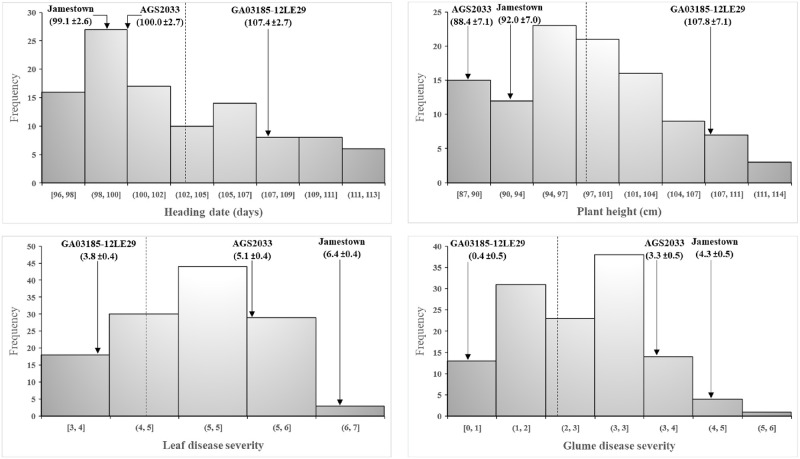
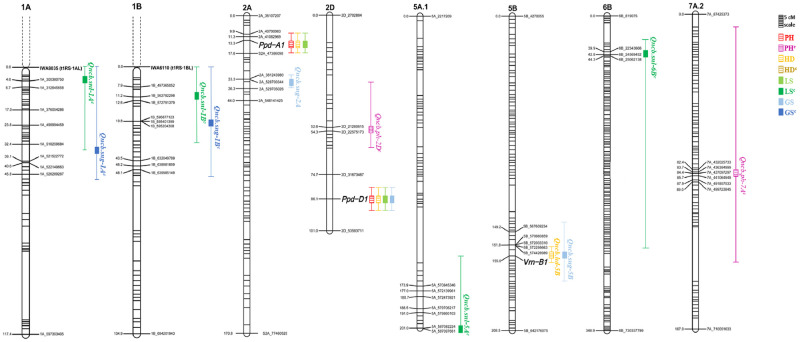
In humid and temperate areas, Septoria nodorum blotch (SNB) is a major fungal disease of common wheat (Triticum aestivum L.) in which grain yield is reduced when the pathogen, Parastagonospora nodorum, infects leaves and glumes during grain filling. Foliar SNB susceptibility may be associated with sensitivity to P. nodorum necrotrophic effectors (NEs). Both foliar and glume susceptibility are quantitative, and the underlying genetics are not understood in detail. We genetically mapped resistance quantitative trait loci (QTL) to leaf and glume blotch using a double haploid (DH) population derived from the cross between the moderately susceptible cultivar AGS2033 and the resistant breeding line GA03185-12LE29. The population was evaluated for SNB resistance in the field in four successive years (2018-2021). We identified major heading date (HD) and plant height (PH) variants on chromosomes 2A and 2D, co-located with SNB escape mechanisms. Five QTL with small effects associated with adult plant resistance to SNB leaf and glume blotch were detected on 1A, 1B, and 6B linkage groups. These QTL explained a relatively small proportion of the total phenotypic variation, ranging from 5.6 to 11.8%. The small-effect QTL detected in this study did not overlap with QTL associated with morphological and developmental traits, and thus are sources of resistance to SNB.
在潮湿和温带地区,条锈病(SNB)是普通小麦(Triticum aestivum L.)的一种主要真菌病害,当病原体禾柄锈菌(Parastagonospora nodorum)在灌浆期感染叶片和颖片时,会导致谷物产量降低。叶片 SNB 易感性可能与对禾柄锈菌坏死效应物(NEs)的敏感性有关。叶片和颖片易感性都是定量的,其潜在遗传机制尚未详细了解。我们使用源自中度敏感品种 AGS2033 和抗性育种系 GA03185-12LE29 杂交的双单倍体(DH)群体,对叶片和颖片条锈病抗性进行了遗传作图。该群体在四个连续年份(2018-2021 年)在田间进行了 SNB 抗性评估。我们在染色体 2A 和 2D 上鉴定出主要抽穗期(HD)和株高(PH)变体,这些变体与 SNB 逃避机制相关。在 1A、1B 和 6B 连锁群上检测到与 SNB 叶片和颖片成株期抗性相关的 5 个小效应 QTL。这些 QTL 解释了总表型变异的相对较小比例,范围从 5.6%到 11.8%。本研究中检测到的小效应 QTL 与与形态和发育性状相关的 QTL 不重叠,因此是 SNB 抗性的来源。