Lee Yue-Chune, Chang Li-Chuan, Hsu Chieh, Chen Pei-Ching
Institute of Health and Welfare Policy, School of Medicine, National Yang-Ming University, Taipei City 112, Taiwan.
Master Program on Trans-Disciplinary Long-Term Care and Management, National Yang-Ming University, Taipei City 112, Taiwan.
J Environ Public Health. 2020 Jun 20;2020:7391587. doi: 10.1155/2020/7391587. eCollection 2020.
Our objective in this study was to identify the risk factors for cigarette, e-cigarette, and IQOS use among adolescents in Taiwan, with a particular focus on socioeconomic status, smoking status of parents and peers, cigarette promotions, and anti-tobacco campaigns.
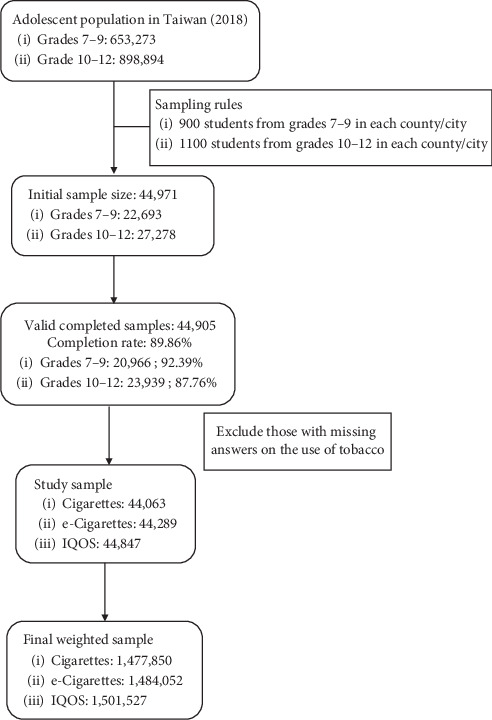
Data were obtained from the 2018 version of the annual cross-sectional Taiwan Global Youth Tobacco Survey, which is used to monitor tobacco use among Taiwanese adolescents in junior and senior high schools. The dependent variables in the study were "current cigarette smoking," "current use of e-cigarettes," and "current use of IQOS devices" (i.e., during the 30 days prior to survey completion). Independent variables included gender, school grade, monthly income/allowance, educational level of parents, smoking status of parents, smoking status of close friends, access to free cigarettes, exposure to cigarette advertisements, and attendance at anti-tobacco courses. Logistic regression was used in the identification of factors correlated with the current use of cigarettes, e-cigarettes, or IQOS.
We determined that 5.65% of the adolescents in the study were currently using cigarettes, 2.74% were currently using e-cigarettes, and 2.33% were currently using IQOS. Our analysis revealed a number of factors that have a bearing on smoking behavior, including gender, monthly allowance, educational level of parents, smoking status of parents and close friends, access to free cigarettes, and exposure to cigarette advertisements.
The tobacco product that was most widely used by adolescents was cigarettes, followed by e-cigarettes and IQOS. The socioeconomic status, smoking status of parents/close friends, and access to cigarettes were all identified as important factors related to the current use of cigarettes, e-cigarettes, and IQOS by adolescents.
本研究的目的是确定台湾青少年使用香烟、电子烟和加热不燃烧烟草制品(IQOS)的风险因素,特别关注社会经济地位、父母及同伴的吸烟状况、香烟促销活动和反烟草运动。
数据来自2018年版的年度横断面台湾全球青少年烟草调查,该调查用于监测台湾初、高中青少年的烟草使用情况。研究中的因变量为“当前吸烟”、“当前使用电子烟”和“当前使用加热不燃烧烟草制品(IQOS)设备”(即在调查完成前30天内)。自变量包括性别、年级、月收入/津贴、父母教育水平、父母吸烟状况、密友吸烟状况、是否能获得免费香烟、接触香烟广告情况以及参加反烟草课程情况。采用逻辑回归来确定与当前使用香烟、电子烟或加热不燃烧烟草制品相关的因素。
我们确定研究中的青少年中有5.65%当前正在吸烟,2.74%当前正在使用电子烟,2.33%当前正在使用加热不燃烧烟草制品(IQOS)。我们的分析揭示了一些与吸烟行为有关的因素,包括性别、月津贴、父母教育水平、父母及密友吸烟状况、是否能获得免费香烟以及接触香烟广告情况。
青少年中使用最广泛的烟草产品是香烟,其次是电子烟和加热不燃烧烟草制品(IQOS)。社会经济地位、父母/密友吸烟状况以及获得香烟的机会均被确定为与青少年当前使用香烟、电子烟和加热不燃烧烟草制品相关的重要因素。