Khan Naeem, Bano Asghari, Curá José Alfredo
Department of Agronomy, Institute of Food and Agricultural Sciences, University of Florida, Gainesville, FL 32611, USA.
Department of Biosciences, University of Wah, Wah Cantt 47040, Pakistan.
Microorganisms. 2020 Jul 9;8(7):1018. doi: 10.3390/microorganisms8071018.
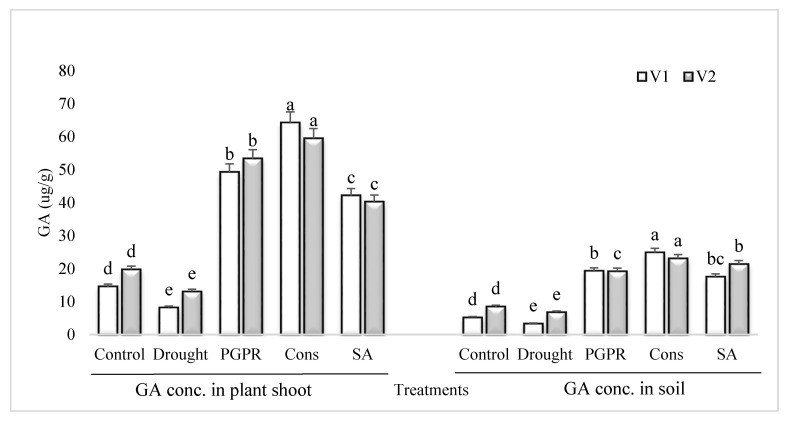
Moisture stress in rainfed areas has significant adverse impacts on plant growth and yield. Plant growth promoting rhizobacteria (PGPR) plays an important role in the revegetation and rehabilitation of rainfed areas by modulating plant growth and metabolism and improving the fertility status of the rhizosphere soils. The current study explored the positive role of PGPR and salicylic acid (SA) on the health of the rhizosphere soil and plants grown under rainfed conditions. Maize seeds of two different varieties, i.e., SWL-2002 (drought tolerant) and CZP-2001 (drought sensitive), were soaked for 4 h prior to sowing in 24-h old culture of strain P1 (accession no. MF616408) and strain P2 (accession no. MF616406). The foliar spray of SA (150 mg/L) was applied on 28-days old seedlings. The combined treatment of the consortium of PGPR and SA not only alleviated the adverse effects of low moisture stress of soil in rainfed area but also resulted in significant accumulation of leaf chlorophyll content (40% and 24%), chlorophyll fluorescence (52% and 34%) and carotenoids (57% and 36%) in the shoot of both the varieties. The PGPR inoculation significantly reduced lipid peroxidation (33% and 23%) and decreased the proline content and antioxidant enzymes activities (32% and 38%) as compared to plants grown in rainfed soil. Significant increases (>52%) were noted in the contents of Ca, Mg, K Cu, Co, Fe and Zn in the shoots of plants and rhizosphere of maize inoculated with the PGPR consortium. The soil organic matter, total nitrogen and C/N ratio were increased (42%), concomitant with the decrease in the bulk density of the rhizosphere. The PGPR consortium, SA and their combined treatment significantly enhanced the IAA (73%) and GA (70%) contents but decreased (55%) the ABA content of shoot. The rhizosphere of plants treated with PGPR, SA and consortium showed a maximum accumulation (>50%) of IAA, GA and ABA contents, the sensitive variety had much higher ABA content than the tolerant variety. It is inferred from the results that rhizosphere soil of treated plants enriched with nutrients content, organic matter and greater concentration of growth promoting phytohormones, as well as stress hormone ABA, which has better potential for seed germination and establishment of seedlings for succeeding crops.
雨养地区的水分胁迫对植物生长和产量有显著的不利影响。植物促生根际细菌(PGPR)通过调节植物生长和代谢以及改善根际土壤肥力状况,在雨养地区的植被恢复和重建中发挥着重要作用。当前研究探讨了PGPR和水杨酸(SA)对雨养条件下根际土壤健康和植物生长的积极作用。在播种前,将两个不同品种的玉米种子,即SWL - 2002(耐旱品种)和CZP - 2001(干旱敏感品种),在菌株P1(登录号MF616408)和菌株P2(登录号MF616406)的24小时龄培养物中浸泡4小时。在28日龄的幼苗上进行SA(150毫克/升)的叶面喷施。PGPR和SA组合处理不仅减轻了雨养地区土壤低水分胁迫的不利影响,而且还使两个品种的地上部叶片叶绿素含量(分别增加40%和24%)、叶绿素荧光(分别增加52%和34%)和类胡萝卜素(分别增加57%和36%)显著积累。与在雨养土壤中生长的植物相比,接种PGPR显著降低了脂质过氧化(分别降低33%和23%),并降低了脯氨酸含量和抗氧化酶活性(分别降低32%和38%)。接种PGPR组合的玉米植株地上部和根际中Ca、Mg、K、Cu、Co、Fe和Zn的含量显著增加(>52%)。土壤有机质、全氮和碳氮比增加(42%),同时根际容重降低。PGPR组合、SA及其组合处理显著提高了地上部IAA(73%)和GA(70%)的含量,但降低了ABA含量(55%)。用PGPR、SA和组合处理的植物根际中IAA、GA和ABA含量积累最多(>50%),敏感品种的ABA含量比耐旱品种高得多。从结果推断,处理过的植物根际土壤富含养分、有机质以及更高浓度的促进生长的植物激素,还有胁迫激素ABA,这对后续作物的种子萌发和幼苗定植具有更好的潜力。