Damian Laura, Lebovici Andrei, Pamfil Cristina, Belizna Cristina, Vulturar Romana
Cab. Reumatologie Dr. Damian, 6-8 Petru Maior St, 400002 Cluj-Napoca, Romania.
Rheumatology Department, Emergency Clinical County Hospital Cluj, Center for Rare Musculoskeletal Autoimmune and Autoinflammatory Diseases, 2-4 Clinicilor St, 400006 Cluj-Napoca, Romania.
Diagnostics (Basel). 2020 Jul 9;10(7):467. doi: 10.3390/diagnostics10070467.
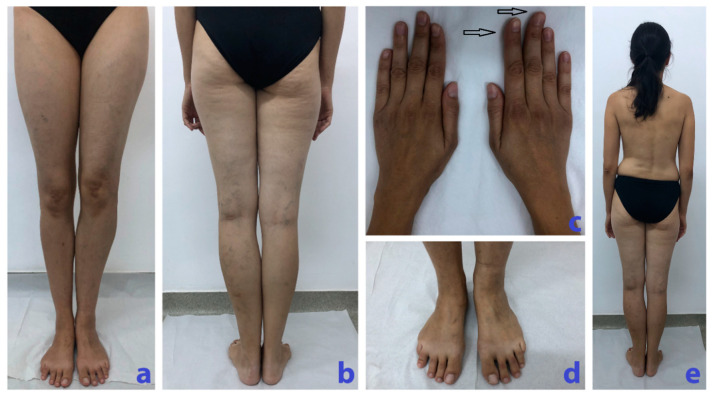
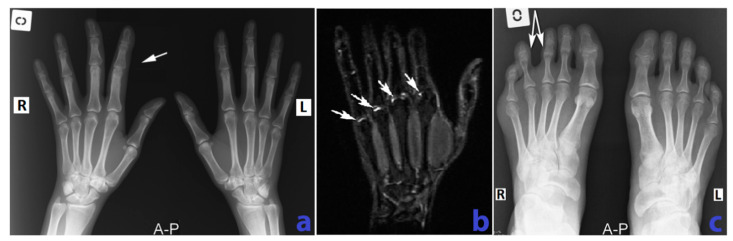
The PI3K/AKT/mTOR signaling pathway is significantly activated in rheumatoid arthritis. In addition, somatic activating mutations of the PI3K/AKT/mTOR pathway may result in -related overgrowth spectrum diseases, including CLOVES (Congenital Lipomatous Overgrowth, Vascular malformation, Epidermal nevi, Skeletal abnormalities/Scoliosis) syndrome. We describe the case of a young female patient, with anti-citrullinated peptide antibodies-positive rheumatoid arthritis, referred for persistent finger pain and stiffness. Examination revealed discrete macrodactyly involving two fingers, scoliosis, asymmetrical calves, venectasias, a shoulder nevus and triangular feet with a "sandal gap" between two toes. These mild dysmorphic features with early-onset and the history of surgeries for thoracic lipoma and venous malformation were strongly suggestive of CLOVES syndrome. Confirmatory mutation analysis was not performed, as blood or saliva testing is not contributive for tissue-specific localized effects in the -related overgrowth spectrum. Nevertheless, lack of detection of a mutation does not exclude the diagnosis in patients fulfilling clinical criteria. Due to the patient's wish to plan a pregnancy, therapy consisted in sulfasalazine and hydroxychloroquine, along with orthotic correction of leg length discrepancy. Overgrowth syndromes and arthritis may share common pathways. Mild macrodactyly should be differentiated from dactylitis. Diagnosing patients with minimal dysmorphic features within the PI3K-related overgrowth spectrum may help design better care strategies, in the quest for personalized medicine.
PI3K/AKT/mTOR信号通路在类风湿性关节炎中显著激活。此外,PI3K/AKT/mTOR通路的体细胞激活突变可能导致相关的过度生长谱系疾病,包括CLOVES(先天性脂肪瘤过度生长、血管畸形、表皮痣、骨骼异常/脊柱侧凸)综合征。我们描述了一名年轻女性患者的病例,该患者抗瓜氨酸化肽抗体阳性类风湿性关节炎,因持续性手指疼痛和僵硬前来就诊。检查发现两个手指出现离散性巨指症、脊柱侧凸、不对称小腿、静脉扩张、肩部痣以及两脚趾间有“凉鞋间隙”的三角形足。这些具有早发性的轻度畸形特征以及胸部脂肪瘤和静脉畸形的手术史强烈提示为CLOVES综合征。由于血液或唾液检测对相关过度生长谱系中的组织特异性局部效应无帮助,因此未进行确诊性突变分析。然而,在符合临床标准的患者中,未检测到突变并不排除诊断。由于患者希望计划怀孕,治疗包括柳氮磺胺吡啶和羟氯喹,以及对腿长差异进行矫形矫正。过度生长综合征和关节炎可能有共同的途径。轻度巨指症应与指炎相鉴别。在PI3K相关过度生长谱系中诊断具有最小畸形特征的患者可能有助于设计更好的护理策略,以寻求个性化医疗。