Guevara-Hoyer Kissy, Saz-Leal Paula, Diez-Rivero Carmen M, Ochoa-Grullón Juliana, Fernández-Arquero Miguel, Pérez de Diego Rebeca, Sánchez-Ramón Silvia
Department of Immunology, IML and IdSSC, Hospital Clínico San Carlos, SN 28040 Madrid, Spain.
Department of Immunology, Ophthalmology and ENT, School of Medicine, Complutense University, 28040 Madrid, Spain.
Biomedicines. 2020 Jul 9;8(7):203. doi: 10.3390/biomedicines8070203.
A major concern in the care of common variable immunodeficiency (CVID) patients is the persistence of subclinical or recurrent respiratory tract infections (RRTI) despite adequate trough IgG levels, which impacts the quality of life (QoL) and morbidity. Therefore, the development of new approaches to prevent and treat infection, especially RRTI, is necessary.
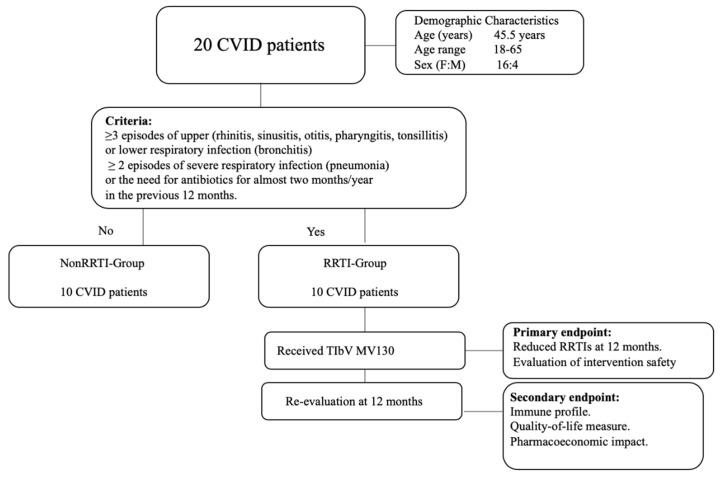
We conducted a clinical observational study from May, 2016 to December, 2017 in 20 CVID patients; ten of these patients had a history of RRTI and received the polybacterial preparation MV130, a trained immunity-based vaccine (TIbV) to assess its impact on their QoL and prognosis.
Subjects with RRTI received MV130 for 3 months and were followed up to 12 months after initiation of the treatment. The primary endpoint was a reduction in RRTI at the end of the study. We analyzed the pharmacoeconomic impact on the RRTI group before and after immunotherapy by estimating the direct and indirect costs, and assessed CVID-QoL and cytokine profile. Specific antibody responses to the bacteria contained in MV130 were measured.
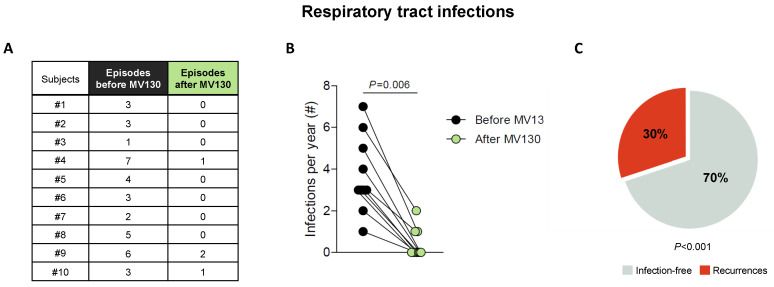
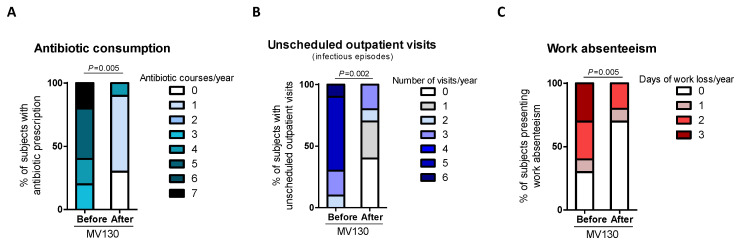
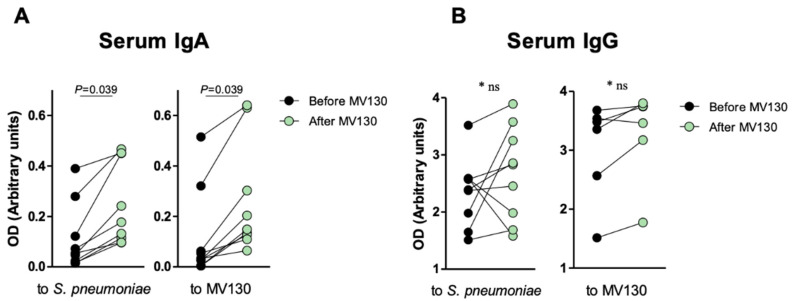
The RRTI-group treated with TIbV MV130 showed a significant decrease in infection rate ( = 0.006) throughout the 12 months after initiation of the treatment. A decrease in antibiotic use and unscheduled outpatient visits was observed ( = 0.005 and = 0.002, respectively). Significant increases in anti-pneumococcus and anti-MV130 IgA antibodies ( = 0.039 both) were detected after 12 months of MV130. Regarding the CVID QoL questionnaire, an overall decrease in the score by more than 50% was observed ( < 0.05) which demonstrated that patients experienced an improvement in their QoL. The pharmacoeconomic analysis showed that the real annual direct costs decreased up to 4 times per patient with the prophylactic intervention ( = 0.005).
The sublingual administration of the TIbV MV130 significantly reduced the rate of respiratory infections, antibiotic use and unscheduled visits, while increasing specific IgA responses in CVID patients. Additionally, the CVID population felt that their QoL was improved, and a decrease in expenses derived from health care was predicted.
在普通可变免疫缺陷(CVID)患者的护理中,一个主要问题是尽管谷值IgG水平充足,但仍存在亚临床或复发性呼吸道感染(RRTI),这会影响生活质量(QoL)和发病率。因此,开发预防和治疗感染,尤其是RRTI的新方法是必要的。
我们在2016年5月至2017年12月期间对20例CVID患者进行了一项临床观察性研究;其中10例患者有RRTI病史,并接受了多细菌制剂MV130,一种基于训练免疫的疫苗(TIbV),以评估其对患者生活质量和预后的影响。
患有RRTI的受试者接受MV130治疗3个月,并在治疗开始后随访12个月。主要终点是研究结束时RRTI的减少。我们通过估计直接和间接成本分析了免疫治疗前后对RRTI组的药物经济学影响,并评估了CVID-QoL和细胞因子谱。测量了对MV130中所含细菌的特异性抗体反应。
用TIbV MV130治疗的RRTI组在治疗开始后的12个月内感染率显著降低(P = 0.006)。观察到抗生素使用和非计划门诊就诊次数减少(分别为P = 0.005和P = 0.002)。MV130治疗12个月后,抗肺炎球菌和抗MV130 IgA抗体显著增加(两者均为P = 0.039)。关于CVID生活质量问卷,观察到得分总体下降超过50%(P < 0.05),这表明患者的生活质量有所改善。药物经济学分析表明,预防性干预后每位患者的实际年度直接成本降低了4倍(P = 0.005)。
舌下给予TIbV MV130可显著降低CVID患者的呼吸道感染率、抗生素使用和非计划就诊次数,同时增加特异性IgA反应。此外,CVID患者群体感觉他们的生活质量得到了改善,并预计医疗保健费用会减少。