Departments of Neurosurgery, Georg-August-University Goettingen, Robert-Koch-Str. 40, 37075, Goettingen, Germany.
Departments of Neuroradiology, Georg-August-University Goettingen, Göttingen, Germany.
BMC Neurol. 2020 Jul 14;20(1):279. doi: 10.1186/s12883-020-01860-8.
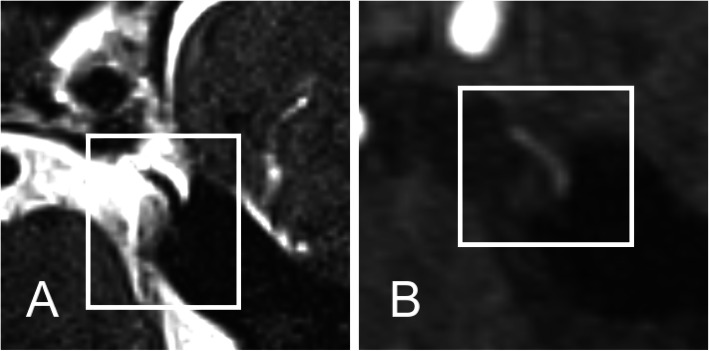
Balanced Steady State Free Precession (b-SSFP) sequences and the newly developed Fast-Spin-Echo (FSE)-sequences enable an optimized visualization of neurovascular compression (NVC) in patients with trigeminal neuralgia (TN). Arterial conflicts are mostly associated with a favorable outcome of microvascular decompression (MVD) compared to venous conflicts. An additional Time-of-Flight (TOF) angiography provides the differentiation between offending arteries and veins and a precise counselling of the patient concerning postoperative pain relief. The goal of this study was to analyze the reliability and impact of the combination of highly-resoluted MRI techniques on the correct prediction of the vessel type and the estimation of postoperative outcome of microvascular decompression (MVD).
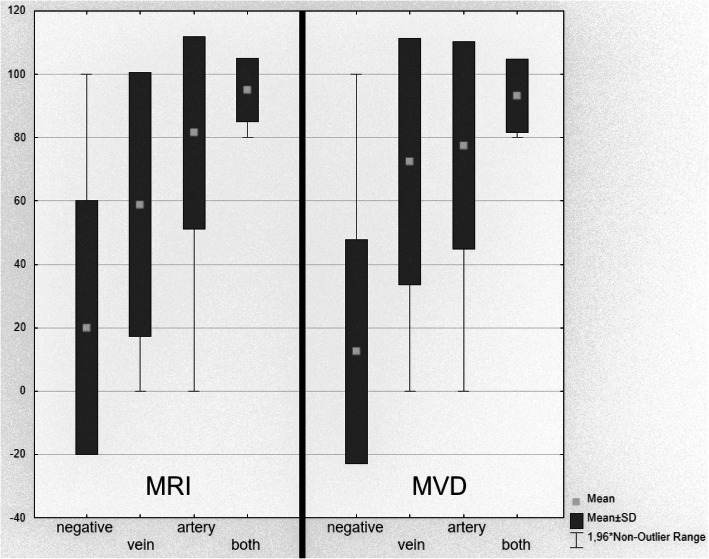
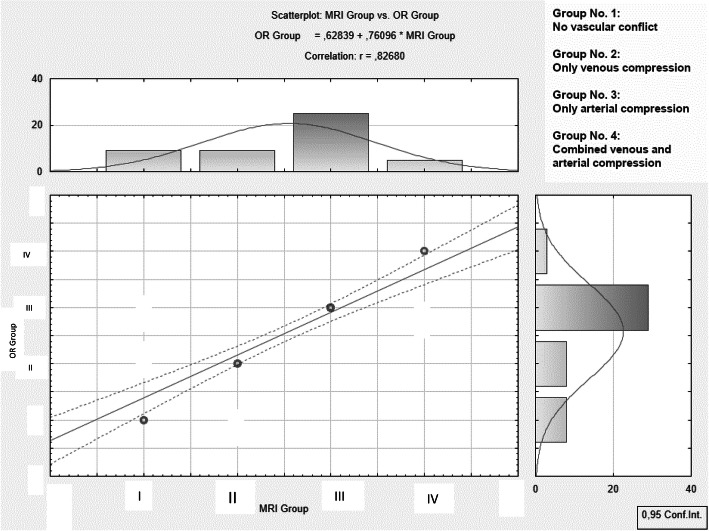
In total, 48 patients (m/f: 32/16) underwent MVD for TN. All the preoperative imaging data (T2: b-SFFP and FSE, MRA: TOF) were compared to the intraoperative microsurgical findings during MVD. b-SFFP was available in 14 patients, FSE in 34 patients and an additional TOF sequence was available in 38 patients (9 times in combination with b-SSFP, 29 times in combination with FSE). The patients were categorized into four subgroups: 1) NVC negative, 2) venous NVC, 3) arterial NVC, 4) combined arterial and venous NVC. The preoperative MRI findings were compared to the intraoperative morphological findings. Postoperative pain relief was quantified by the Barrow Neurological Institute pain score.
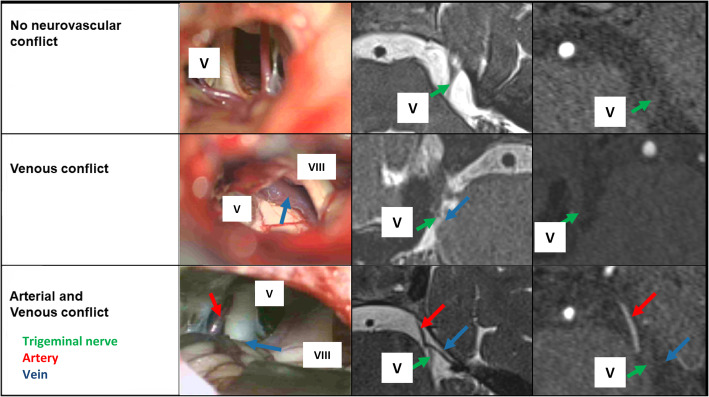
Twenty-five purely arterial NVC, 9 purely venous NVC and 5 combined arterial and venous NVC were detected by MRI. In 9 cases NVC was absent on MRI. Overall, the MRI findings correctly predicted the intraoperative findings in 91.7% of the 48 patients. The percentage of correct prediction increased from 80 to 94.7%, when TOF angiography was adjoined.
The visualization of the trigeminal nerve using sequences such as b-SSFP or FSE in combination with TOF angiography enables an optimized delineation of arterial and venous neurovascular conflicts and may allow a more reliable differentiation between veins and arteries, resulting in superior prediction of postoperative pain relief compared to T2 imaging data alone.
平衡稳态自由进动(b-SSFP)序列和新开发的快速自旋回波(FSE)序列能够优化三叉神经痛(TN)患者的神经血管压迫(NVC)可视化。与静脉冲突相比,动脉冲突与微血管减压(MVD)的良好结果大多相关。附加的时间飞跃(TOF)血管造影术可区分致病动脉和静脉,并为患者提供关于术后疼痛缓解的精确咨询。本研究的目的是分析高分辨率 MRI 技术组合对正确预测血管类型和微血管减压(MVD)术后结果的可靠性和影响。
共有 48 名患者(男女比:32/16)接受了 TN 的 MVD。所有术前成像数据(T2:b-SSFP 和 FSE,MRA:TOF)均与 MVD 期间的术中显微镜检查结果进行比较。14 名患者进行了 b-SSFP,34 名患者进行了 FSE,38 名患者(9 次与 b-SSFP 联合,29 次与 FSE 联合)进行了附加 TOF 序列。患者分为四组:1)NVC 阴性,2)静脉 NVC,3)动脉 NVC,4)动脉和静脉 NVC 联合。术前 MRI 结果与术中形态学结果进行比较。术后疼痛缓解通过巴罗神经研究所疼痛评分进行量化。
MRI 检测到 25 例单纯动脉 NVC、9 例单纯静脉 NVC 和 5 例动脉和静脉 NVC 联合。9 例患者 MRI 未见 NVC。总的来说,48 例患者中有 91.7%的 MRI 检查结果与术中检查结果相符。当附加 TOF 血管造影时,正确预测的百分比从 80%增加到 94.7%。
使用 b-SSFP 或 FSE 等序列结合 TOF 血管造影术对三叉神经进行可视化,可以优化动脉和静脉神经血管压迫的描绘,并可能允许更可靠地区分静脉和动脉,与单独使用 T2 成像数据相比,可更好地预测术后疼痛缓解。