Tanimura Kazuya, Sato Susumu, Sato Atsuyasu, Tanabe Naoya, Hasegawa Koichi, Uemasu Kiyoshi, Hamakawa Yoko, Hirai Toyohiro, Muro Shigeo
Dept of Respiratory Medicine, Graduate School of Medicine, Kyoto University, Kyoto, Japan.
Dept of Respiratory Medicine, Nara Medical University, Nara, Japan.
ERJ Open Res. 2020 Jul 6;6(2). doi: 10.1183/23120541.00288-2019. eCollection 2020 Apr.
Most exacerbations of chronic obstructive pulmonary disease (COPD) are triggered by respiratory tract infections. Adaptive immunity antibody production is important in preventing infections. Impaired antibody production is reported to be associated with an increased risk of exacerbations of COPD. In the present study, we elucidated whether reduced free light chains (FLCs), which are excessive amounts of light chains produced during antibody synthesis and can be used to estimate systemic antibody production, may be a promising biomarker to predict the risk of exacerbations of COPD.
We enrolled stable male patients with COPD and prospectively observed them for 2 years. At baseline, serum combined FLC (cFLC; sum of kappa and lambda values) and pulmonary function were evaluated. Exacerbation was defined as a worsening of symptoms requiring treatments with antibiotics, corticosteroids or both.
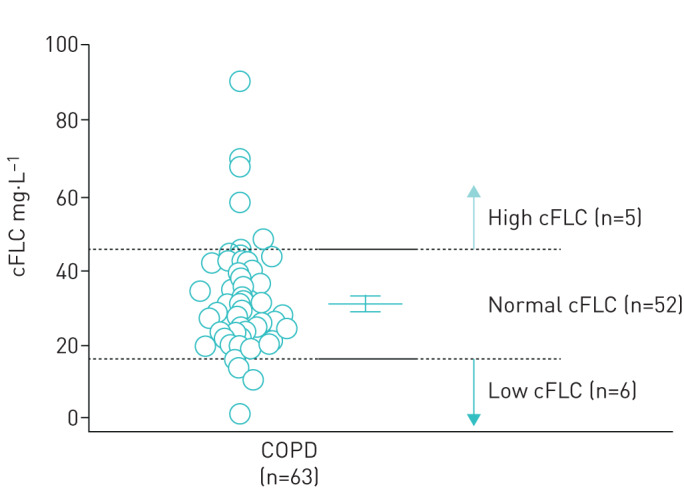
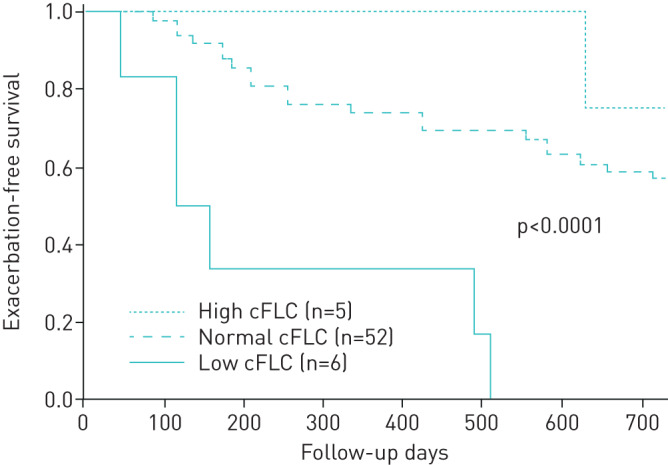
63 patients with stable COPD were enrolled (72.8±8.1 years, GOLD A/B/C/D=24/28/6/5), and 51 patients completed the 2-year follow-up. Serum cFLC was 31.1 mg·L on average and ranged widely (1.4 to 89.9 mg·L). The patients with low cFLC (below the mean-sd, n=6) experienced a significantly shorter time to the first exacerbation of COPD (p<0.0001 by the log-rank test). A multivariate Cox proportional hazard model, including the COPD assessment test score, % predicted forced expiratory volume in 1 s (FEV % pred), and number of previous exacerbations demonstrated that low cFLC and low FEV % pred were independently and significantly correlated with the risk for exacerbations of COPD.
Low cFLC may be a B-cell-associated novel biomarker associated with risk of COPD exacerbation.
慢性阻塞性肺疾病(COPD)的大多数急性加重由呼吸道感染引发。适应性免疫抗体产生在预防感染中起重要作用。据报道,抗体产生受损与COPD急性加重风险增加相关。在本研究中,我们阐明了游离轻链(FLC)减少是否可能是预测COPD急性加重风险的有前景的生物标志物,游离轻链是抗体合成过程中产生的过量轻链,可用于评估全身抗体产生。
我们纳入了稳定期男性COPD患者,并对其进行了2年的前瞻性观察。在基线时,评估血清组合FLC(cFLC;kappa和lambda值之和)和肺功能。急性加重定义为症状恶化,需要使用抗生素、皮质类固醇或两者进行治疗。
纳入63例稳定期COPD患者(72.8±8.1岁,GOLD A/B/C/D分级分别为24/28/6/5例),51例患者完成了2年随访。血清cFLC平均为31.1mg·L,范围广泛(1.4至89.9mg·L)。cFLC低的患者(低于均值减标准差,n = 6)首次发生COPD急性加重的时间显著缩短(对数秩检验p<0.0001)。多因素Cox比例风险模型,包括COPD评估测试评分、第1秒用力呼气容积预测值百分比(FEV%pred)和既往急性加重次数,表明低cFLC和低FEV%pred与COPD急性加重风险独立且显著相关。
低cFLC可能是一种与B细胞相关的新型生物标志物,与COPD急性加重风险相关。