Wang Jennifer M, Labaki Wassim W, Murray Susan, Martinez Fernando J, Curtis Jeffrey L, Hoffman Eric A, Ram Sundaresh, Bell Alexander J, Galban Craig J, Han MeiLan K, Hatt Charles
Division of Pulmonary and Critical Care Medicine, University of Michigan, Ann Arbor, MI, United States.
Department of Biostatistics, School of Public Health, University of Michigan, Ann Arbor, MI, United States.
Front Physiol. 2023 Apr 21;14:1144192. doi: 10.3389/fphys.2023.1144192. eCollection 2023.
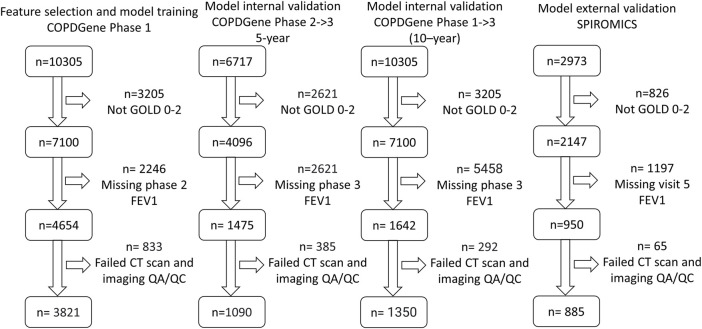
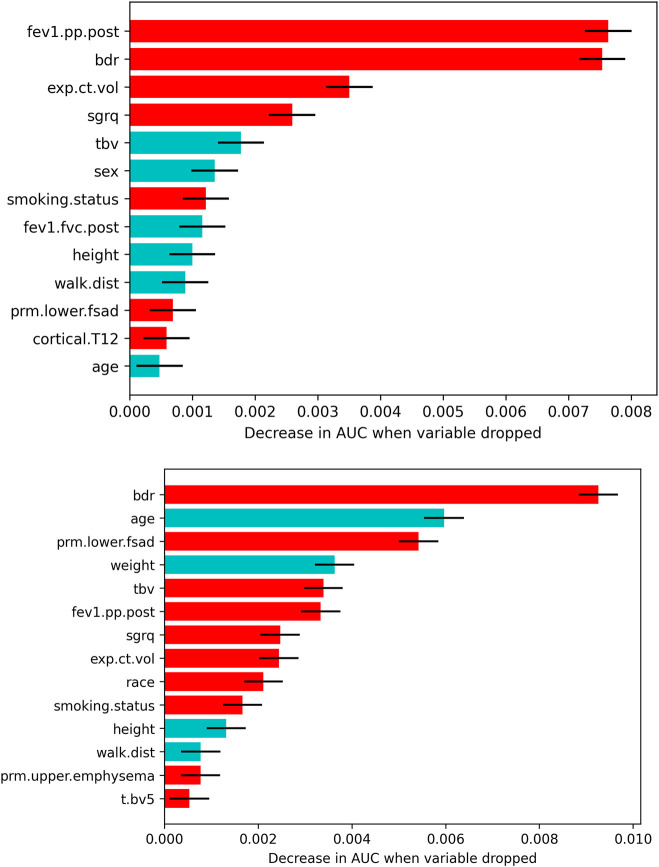
The purpose of this study was to train and validate machine learning models for predicting rapid decline of forced expiratory volume in 1 s (FEV) in individuals with a smoking history at-risk-for chronic obstructive pulmonary disease (COPD), Global Initiative for Chronic Obstructive Lung Disease (GOLD 0), or with mild-to-moderate (GOLD 1-2) COPD. We trained multiple models to predict rapid FEV decline using demographic, clinical and radiologic biomarker data. Training and internal validation data were obtained from the COPDGene study and prediction models were validated against the SPIROMICS cohort. We used GOLD 0-2 participants ( = 3,821) from COPDGene (60.0 ± 8.8 years, 49.9% male) for variable selection and model training. Accelerated lung function decline was defined as a mean drop in FEV% predicted of > 1.5%/year at 5-year follow-up. We built logistic regression models predicting accelerated decline based on 22 chest CT imaging biomarker, pulmonary function, symptom, and demographic features. Models were validated using = 885 SPIROMICS subjects (63.6 ± 8.6 years, 47.8% male). The most important variables for predicting FEV decline in GOLD 0 participants were bronchodilator responsiveness (BDR), post bronchodilator FEV% predicted (FEV.pp.post), and CT-derived expiratory lung volume; among GOLD 1 and 2 subjects, they were BDR, age, and PRM. In the validation cohort, GOLD 0 and GOLD 1-2 full variable models had significant predictive performance with AUCs of 0.620 ± 0.081 ( = 0.041) and 0.640 ± 0.059 ( < 0.001). Subjects with higher model-derived risk scores had significantly greater odds of FEV decline than those with lower scores. Predicting FEV decline in at-risk patients remains challenging but a combination of clinical, physiologic and imaging variables provided the best performance across two COPD cohorts.
本研究的目的是训练和验证机器学习模型,以预测有吸烟史且有慢性阻塞性肺疾病(COPD)风险、全球慢性阻塞性肺疾病倡议组织(GOLD 0)或轻度至中度(GOLD 1-2)COPD的个体1秒用力呼气量(FEV)的快速下降。我们使用人口统计学、临床和放射学生物标志物数据训练了多个模型来预测FEV的快速下降。训练和内部验证数据来自COPDGene研究,预测模型在SPIROMICS队列中进行了验证。我们使用来自COPDGene的GOLD 0-2参与者(n = 3821,年龄60.0±8.8岁,男性占49.9%)进行变量选择和模型训练。加速肺功能下降定义为在5年随访中预测的FEV%平均下降>1.5%/年。我们建立了基于22种胸部CT成像生物标志物、肺功能、症状和人口统计学特征预测加速下降的逻辑回归模型。使用n = 885名SPIROMICS受试者(年龄63.6±8.6岁,男性占47.8%)对模型进行了验证。预测GOLD 0参与者FEV下降的最重要变量是支气管扩张剂反应性(BDR)、支气管扩张剂后预测的FEV%(FEV.pp.post)和CT衍生的呼气肺容积;在GOLD 1和2受试者中,它们是BDR、年龄和PRM。在验证队列中,GOLD 0和GOLD 1-2全变量模型具有显著的预测性能,AUC分别为0.620±0.081(P = 0.041)和0.640±0.059(P < 0.001)。模型衍生风险评分较高的受试者FEV下降的几率显著高于评分较低的受试者。预测高危患者的FEV下降仍然具有挑战性,但临床、生理和成像变量的组合在两个COPD队列中提供了最佳性能。