The First School of Clinical Medicine, Southern Medical University, Guangzhou, 510515, People's Republic of China.
Department of Respiratory and Critical Care Medicine, General Hospital of Southern Theatre Command, Guangzhou, 510010, People's Republic of China.
Int J Chron Obstruct Pulmon Dis. 2021 Oct 28;16:2945-2951. doi: 10.2147/COPD.S332505. eCollection 2021.
Persistent chronic inflammation of chronic obstructive pulmonary disease (COPD) is associated with poor outcomes and frequently results in acute exacerbation. Predicting the number of exacerbations is important. Because interleukin 6 (IL-6) plays an important role in inducing and maintaining chronic inflammation, we sought to observe whether IL-6 measurement can predict the frequency of acute exacerbation of COPD.
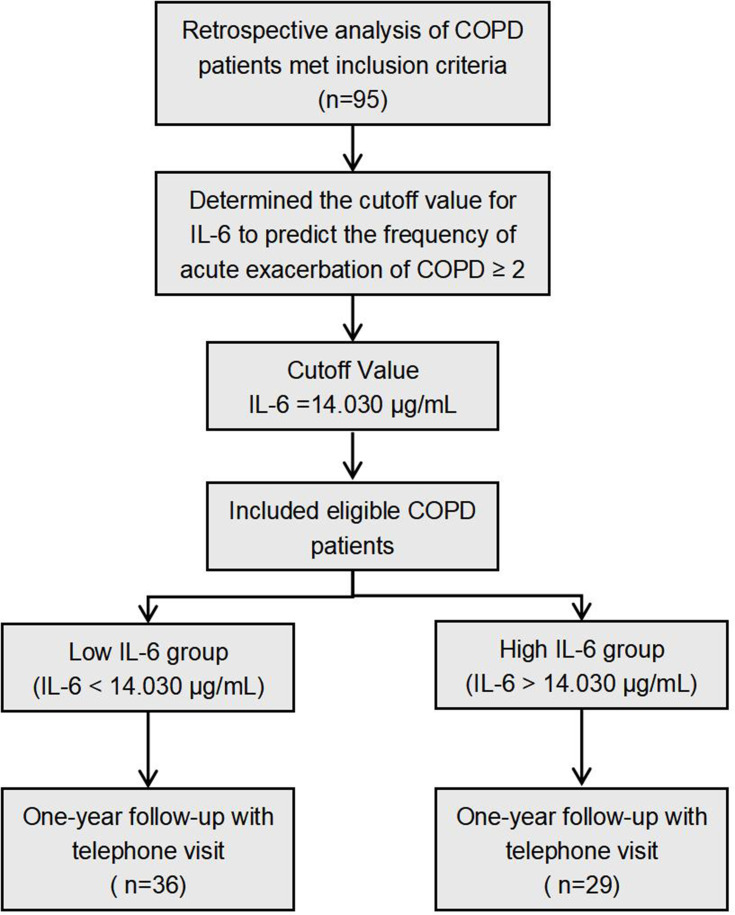
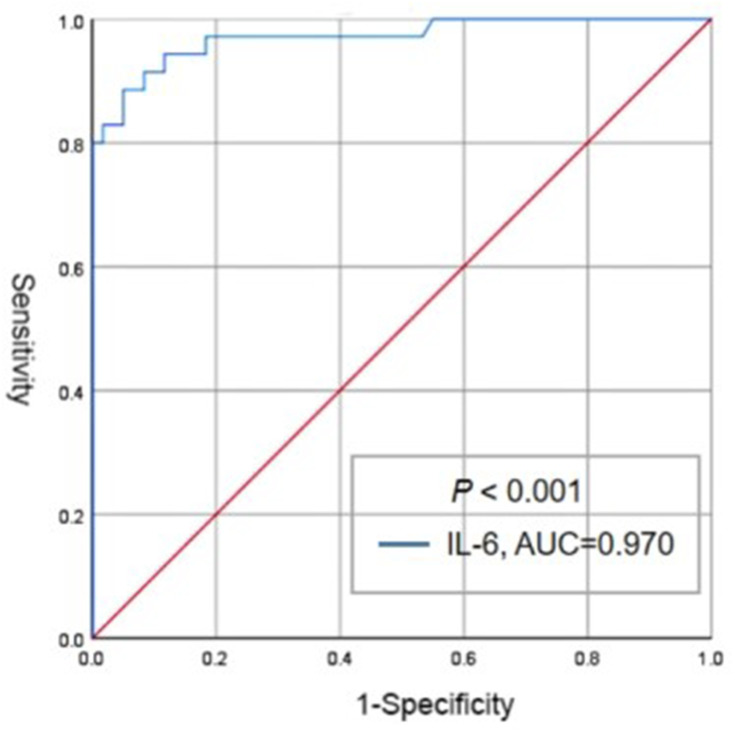
We reviewed serum IL-6 concentrations of stable COPD patients from January 2016 to December 2017 and statistically analyzed them to determine the optimal threshold value to predict the frequency of COPD acute exacerbations. Outpatients with stable COPD were then recruited between January 2018 and December 2019 and grouped into a low IL-6 group and a high IL-6 group according to this threshold value. We then compared the number of exacerbations of COPD in 1 year between the two groups.
We reviewed data from 95 COPD patients, who had a median of 1.00 exacerbations in preceding year; 35 of these patients had no fewer than two. The median IL-6 concentration was 8.80 pg/mL. IL-6 and hs-CRP were positively correlated with frequency of acute exacerbation in the preceding year, COPD assessment test (CAT) score and British medical research council (mMRC) score, and negatively correlated with forced expiratory volume in one second as percentage of predicted value (FEV%pred) and FEV/FVC% (forced vital capacity). IL-6 was the risk factor of COPD patients with two or more exacerbations in 1 year. Finally, we enrolled 65 COPD patients and divided into low IL-6 group and high IL-6 group; the high IL-6 group experienced more frequent exacerbations than did the low IL-6 group.
An IL-6 measurement of 14.030 pg/mL or more is a risk factor for ≥2 acute exacerbations of COPD in the following year.
慢性阻塞性肺疾病(COPD)的持续性慢性炎症与不良结局相关,并常导致急性加重。预测加重次数很重要。由于白细胞介素 6(IL-6)在诱导和维持慢性炎症中发挥重要作用,我们试图观察 IL-6 测量是否可以预测 COPD 急性加重的频率。
我们回顾了 2016 年 1 月至 2017 年 12 月稳定期 COPD 患者的血清 IL-6 浓度,并对其进行了统计学分析,以确定预测 COPD 急性加重频率的最佳阈值。然后,在 2018 年 1 月至 2019 年 12 月期间招募了稳定期 COPD 门诊患者,并根据该阈值将其分为低 IL-6 组和高 IL-6 组。然后,我们比较了两组患者在 1 年内 COPD 加重的次数。
我们回顾了 95 例 COPD 患者的数据,这些患者在前一年中有中位数为 1.00 次的加重事件,其中 35 例患者的加重次数不少于 2 次。中位 IL-6 浓度为 8.80 pg/mL。IL-6 和高敏 C 反应蛋白与前一年急性加重的频率、COPD 评估测试(CAT)评分和英国医学研究委员会(mMRC)评分呈正相关,与 1 秒用力呼气量占预计值的百分比(FEV%pred)和 FEV/FVC%(用力肺活量)呈负相关。IL-6 是 COPD 患者 1 年内发生 2 次或以上加重的危险因素。最后,我们纳入了 65 例 COPD 患者,并将其分为低 IL-6 组和高 IL-6 组;高 IL-6 组患者的加重次数多于低 IL-6 组。
IL-6 测量值≥14.030 pg/mL 是 COPD 患者次年发生≥2 次急性加重的危险因素。