The Institute of Environmental Medicine.
Division of Physiological Chemistry II, Department of Medical Biochemistry and Biophysics.
Am J Respir Crit Care Med. 2021 Jan 1;203(1):37-53. doi: 10.1164/rccm.201909-1869OC.
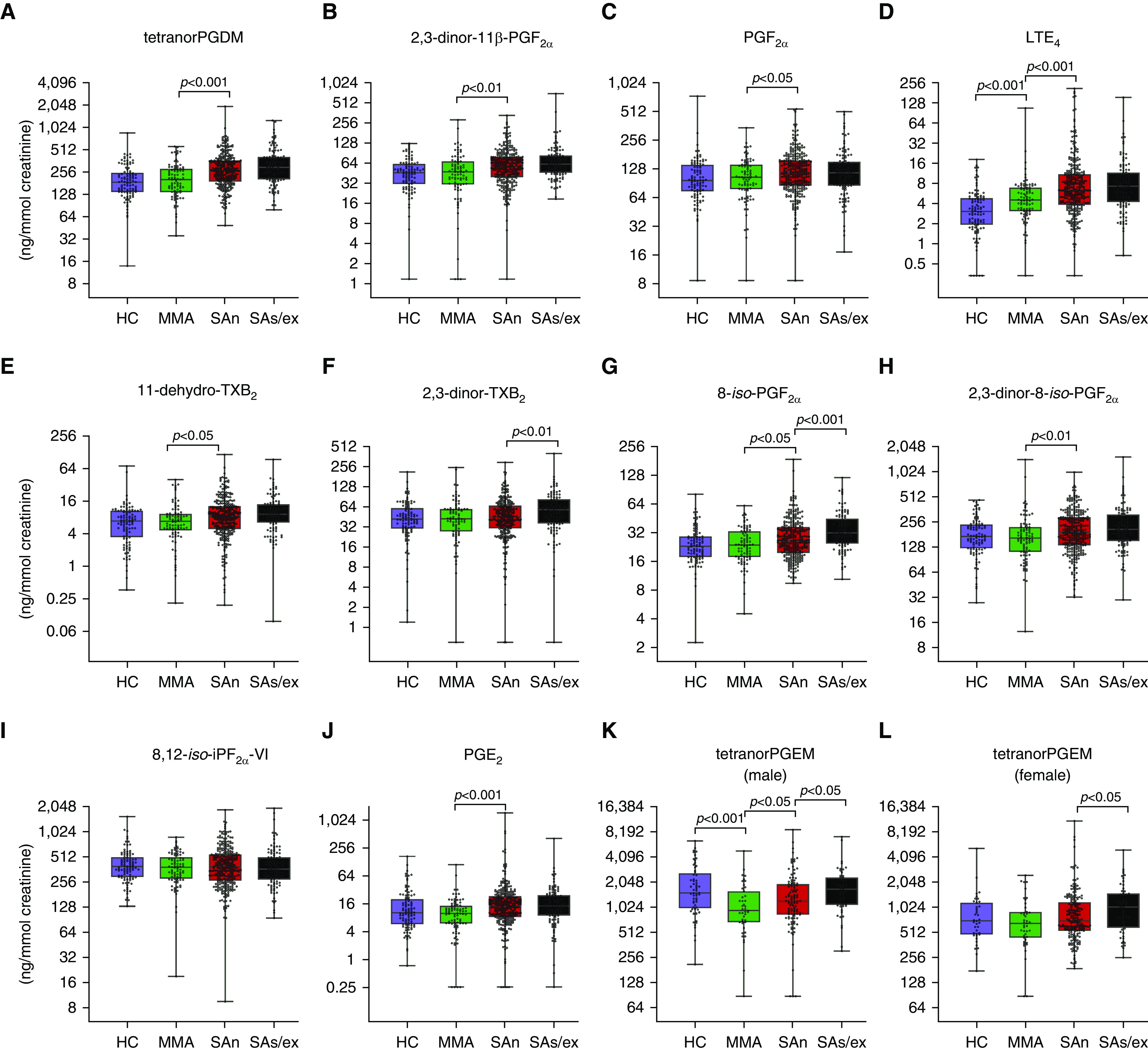
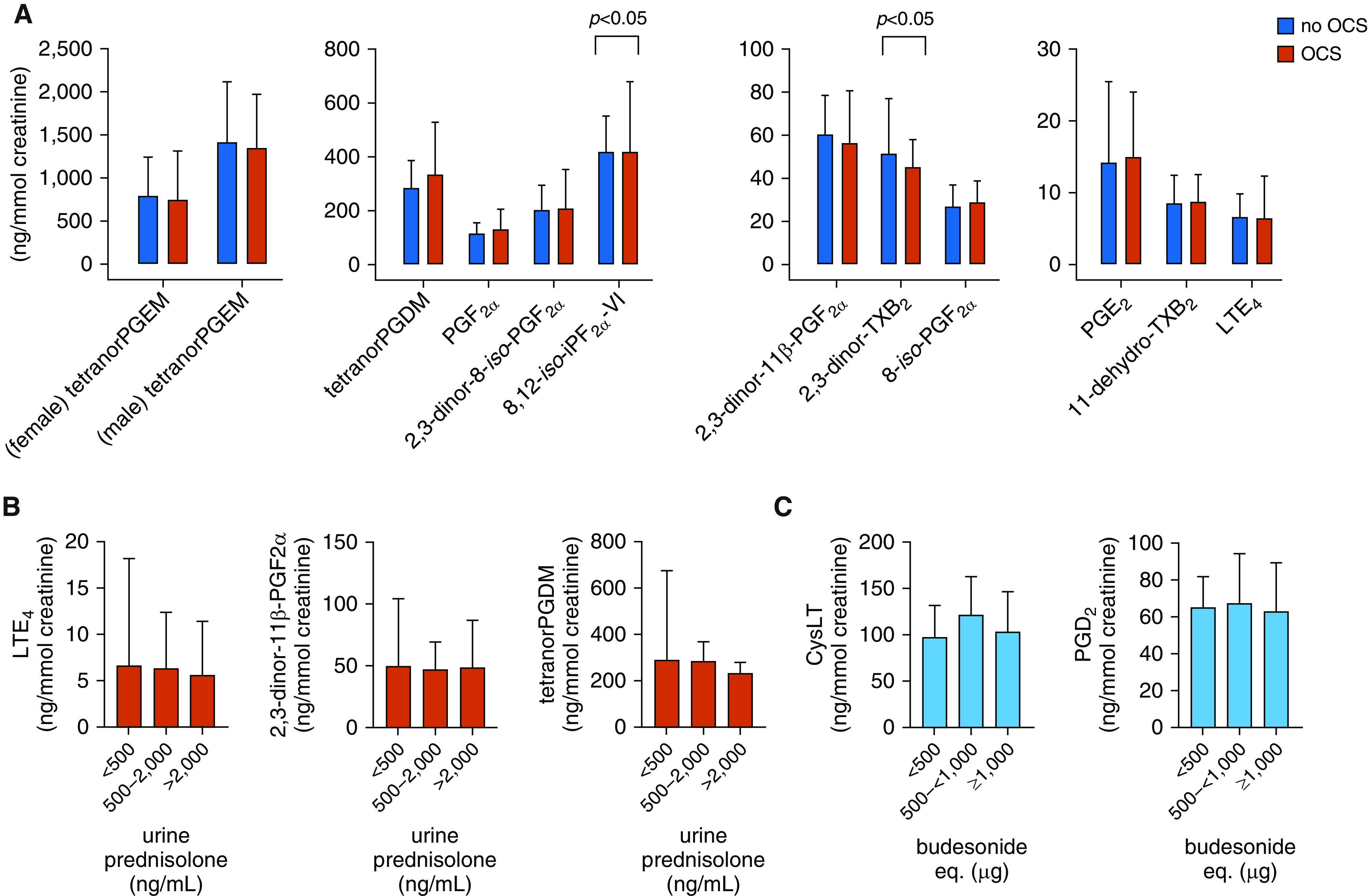
New approaches are needed to guide personalized treatment of asthma. To test if urinary eicosanoid metabolites can direct asthma phenotyping. Urinary metabolites of prostaglandins (PGs), cysteinyl leukotrienes (CysLTs), and isoprostanes were quantified in the U-BIOPRED (Unbiased Biomarkers for the Prediction of Respiratory Diseases Outcomes) study including 86 adults with mild-to-moderate asthma (MMA), 411 with severe asthma (SA), and 100 healthy control participants. Validation was performed internally in 302 participants with SA followed up after 12-18 months and externally in 95 adolescents with asthma. Metabolite concentrations in healthy control participants were unrelated to age, body mass index, and sex, except for the PGE pathway. Eicosanoid concentrations were generally greater in participants with MMA relative to healthy control participants, with further elevations in participants with SA. However, PGE metabolite concentrations were either the same or lower in male nonsmokers with asthma than in healthy control participants. Metabolite concentrations were unchanged in those with asthma who adhered to oral corticosteroid treatment as documented by urinary prednisolone detection, whereas those with SA treated with omalizumab had lower concentrations of LTE and the PGD metabolite 2,3-dinor-11β-PGF. High concentrations of LTE and PGD metabolites were associated with lower lung function and increased amounts of exhaled nitric oxide and eosinophil markers in blood, sputum, and urine in U-BIOPRED participants and in adolescents with asthma. These type 2 (T2) asthma associations were reproduced in the follow-up visit of the U-BIOPRED study and were found to be as sensitive to detect T2 inflammation as the established biomarkers. Monitoring of urinary eicosanoids can identify T2 asthma and introduces a new noninvasive approach for molecular phenotyping of adult and adolescent asthma.Clinical trial registered with www.clinicaltrials.gov (NCT01976767).
需要新的方法来指导哮喘的个体化治疗。为了测试尿二十烷类代谢物是否可以指导哮喘表型分型,在 U-BIOPRED(用于预测呼吸疾病结局的无偏生物标志物)研究中对前列腺素(PGs)、半胱氨酰白三烯(CysLTs)和异前列烷的尿代谢物进行了定量分析,该研究纳入了 86 名轻度至中度哮喘(MMA)成人、411 名重度哮喘(SA)患者和 100 名健康对照参与者。在随后的 12-18 个月内对 302 名 SA 参与者进行了内部验证,并在 95 名青少年哮喘患者中进行了外部验证。健康对照参与者的代谢物浓度与年龄、体重指数和性别无关,除了 PGE 途径。与健康对照参与者相比,MMA 参与者的二十烷类代谢物浓度通常更高,SA 参与者的浓度进一步升高。然而,与健康对照参与者相比,男性非吸烟者的哮喘患者 PGE 代谢物浓度要么相同,要么更低。在接受口服皮质类固醇治疗的哮喘患者中,代谢物浓度保持不变,这在尿中检测到泼尼松龙时得到证实,而接受奥马珠单抗治疗的 SA 患者的 LTE 和 PGD 代谢物 2,3-二去-11β-PGF 浓度较低。在 U-BIOPRED 参与者和青少年哮喘患者中,高浓度的 LTE 和 PGD 代谢物与较低的肺功能以及呼出气一氧化氮和血液、痰和尿液中嗜酸性粒细胞标志物的增加有关。在 U-BIOPRED 研究的随访中重现了这种 2 型(T2)哮喘关联,并且发现其对 T2 炎症的检测与既定的生物标志物一样敏感。尿二十烷类代谢物的监测可以识别 T2 哮喘,并为成人和青少年哮喘的分子表型提供一种新的非侵入性方法。该临床试验已在 www.clinicaltrials.gov 上注册(NCT01976767)。