Bhaskar Lakshmi, Tripathi Vaibhav, Kharya Chhaya, Kotabagi Vijayalakshmi, Bhatia Manvir, Kochupillai Vinod
Sri Sri Institute of Advanced Research, Ved Vignan Maha Vidya Peeth, Bengaluru, Karnataka, India.
Department of Psychological and Brain Sciences, Boston University, Boston, Massachusetts, USA.
Int J Yoga. 2020 May-Aug;13(2):130-136. doi: 10.4103/ijoy.IJOY_25_19. Epub 2020 May 1.
Respiration is known to modulate neuronal oscillations in the brain and is measured by electroencephalogram (EEG). Sudarshan Kriya Yoga (SKY) is a popular breathing process and is established for its significant effects on the various aspects of physiology and psychology.
This study aimed to observe neuronal oscillations in multifrequency bands and interhemispheric synchronization following SKY.
This study employed before- and after-study design.
Forty healthy volunteers (average age 25.45 ± 5.75, 23 males and 17 females) participated in the study. Nineteen-channel EEG was recorded and analyzed for 5 min each: before and after SKY. Spectral power for delta, theta, alpha, beta, and gamma frequency band was calculated using Multi-taper Fast Fourier Transform (Chronux toolbox). The Asymmetry Index was calculated by subtracting the natural log of powers of left (L) hemisphere from the right to show interhemispheric synchronization.
Paired -test was used for statistical analysis.
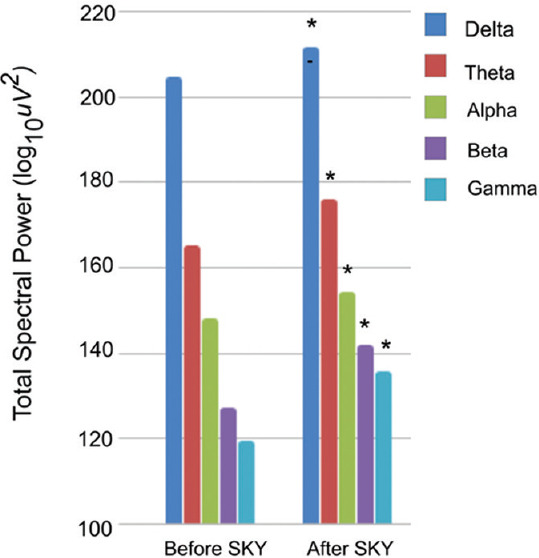
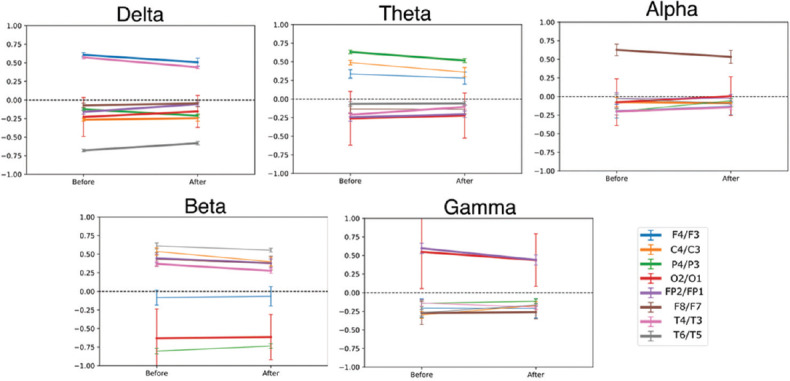
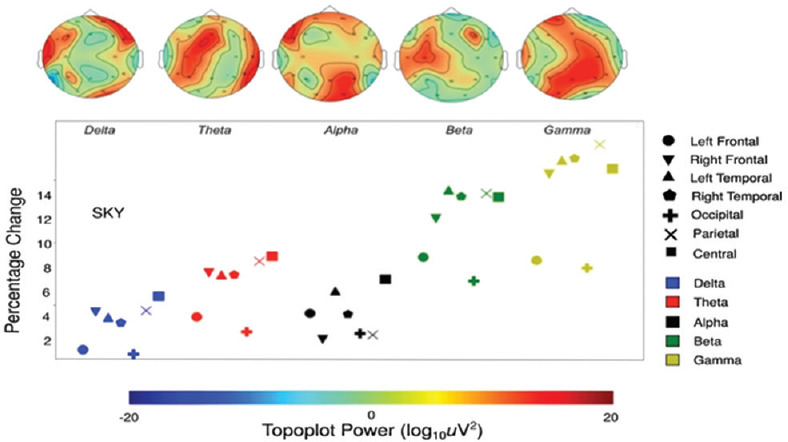
Spectral power increased significantly in all frequency bands bilaterally in frontal, central, parietal, temporal, and occipital regions of the brain after long SKY. Electrical activity shifted from lower to higher frequency range with a significant rise in the gamma and beta powers following SKY. Asymmetry Index values tended toward 0 following SKY.
A single session of SKY generates global brain rhythm dominantly with high-frequency cerebral activation and initiates appropriate interhemispheric synchronization in brain rhythms as state effects. This suggests that SKY leads to better attention, memory, and emotional and autonomic control along with enhanced cognitive functions, which finally improves physical and mental well-being.
已知呼吸可调节大脑中的神经元振荡,并通过脑电图(EEG)进行测量。苏达山克里亚瑜伽(SKY)是一种流行的呼吸法,因其对生理和心理各个方面的显著影响而闻名。
本研究旨在观察SKY后多频段的神经元振荡和半球间同步。
本研究采用前后对照研究设计。
40名健康志愿者(平均年龄25.45±5.75岁,男性23名,女性17名)参与了该研究。记录19通道脑电图,并在SKY前后各分析5分钟。使用多窗快速傅里叶变换(Chronux工具箱)计算δ、θ、α、β和γ频段的频谱功率。通过从右侧半球减去左侧半球功率的自然对数来计算不对称指数,以显示半球间同步。
采用配对t检验进行统计分析。
长时间进行SKY后,大脑额叶、中央、顶叶、颞叶和枕叶区域的所有频段双侧频谱功率均显著增加。电活动从低频范围转移到高频范围,SKY后γ和β功率显著上升。SKY后不对称指数值趋于0。
单次SKY练习主要产生全脑节律,伴有高频脑激活,并引发脑节律中适当的半球间同步,作为一种状态效应。这表明SKY可带来更好的注意力、记忆力、情绪和自主控制,同时增强认知功能,最终改善身心健康。