Telles Shirley, Gandharva Kumar, Gupta Ram Kumar, Sharma Sachin Kumar, Balkrishna Acharya
Patanjali Research Foundation, Haridwar, Uttarakhand, India.
Int J Yoga. 2020 May-Aug;13(2):168-172. doi: 10.4103/ijoy.IJOY_70_19. Epub 2020 May 1.
is traditionally described as "increasing the inner fire" and is believed to be heat generating.
The present study aimed at determining whether the surface body temperature would increase after practice compared with sitting quietly for the same duration as a control.
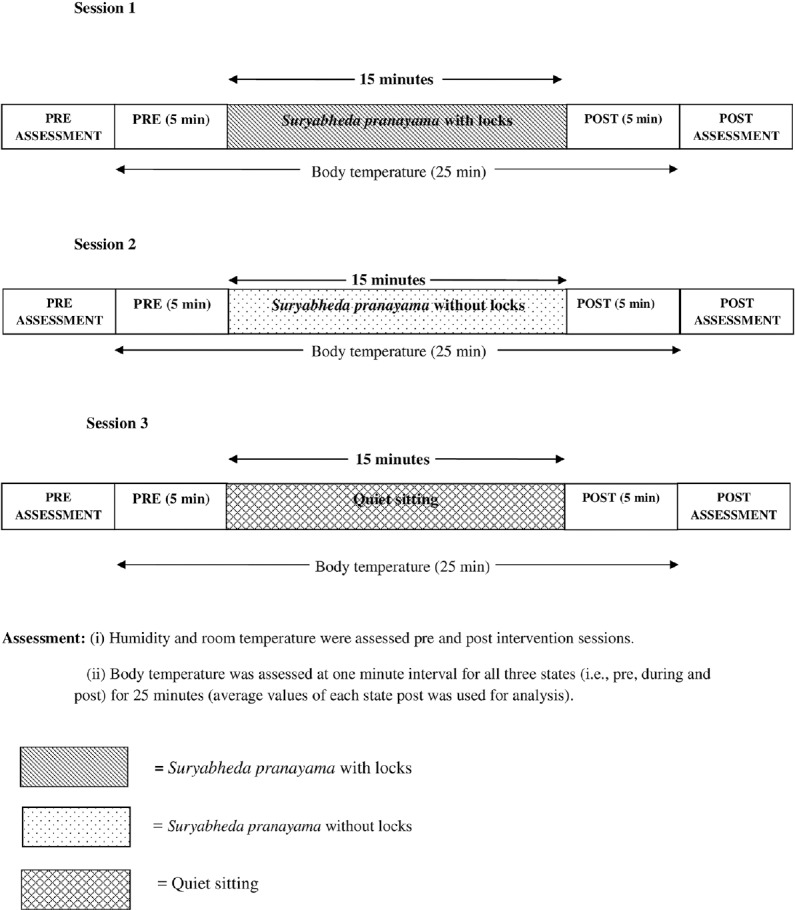
Nineteen participants with experience of practice (group mean experience ± standard deviation, 30.2 ± 22.8 months) were assessed in 3 sessions on separate days. The sessions were (i) with physiological locks or breath retention, (ii) without physiological locks or breath retention, and (iii) quiet sitting (control session). The axillary surface body temperature was monitored in all three sessions before (5 min), during (15 min), and after (5 min) the intervention. Ambient temperature and humidity in the recording cabin used for testing were noted. From the ambient temperature and humidity, the heat index was derived.
Repeated measures analyses of variance were performed to compare values before, during, and after the 3 sessions, using SPSS version 24.0.
The surface body temperature increased during and after with physiological locks ( < 0.001; < 0.001), without physiological locks ( < 0.01; < 0.001), and quiet sitting ( < 0.001; < 0.001) compared to the respective before values.
The control (i.e., quiet sitting) and experimental sessions (i.e., with locks and without locks) showed a comparable increase in the surface body temperature. Hence, the increase in surface body temperature during and after experimental sessions does not appear to be related to the techniques. The possible factors which may have contributed to increased surface body temperature in the control and experimental sessions have been discussed.
传统上被描述为“内火上升”,被认为会产生热量。
本研究旨在确定与安静坐相同时长作为对照相比,练习后体表温度是否会升高。
19名有练习经验的参与者(组平均经验±标准差,30.2±22.8个月)在不同日期分3次进行评估。这3次分别是:(i)有生理锁或屏气的练习,(ii)无生理锁或屏气的练习,(iii)安静坐(对照时段)。在所有3次时段中,在干预前(5分钟)、干预期间(15分钟)和干预后(5分钟)监测腋窝体表温度。记录用于测试的小室内的环境温度和湿度。根据环境温度和湿度得出热指数。
使用SPSS 24.0版本进行重复测量方差分析,以比较3次时段前、期间和后的数值。
与各自的前测值相比,有生理锁的练习期间及之后体表温度升高(P<0.001;P<0.001),无生理锁的练习期间及之后体表温度升高(P<0.01;P<0.001),安静坐期间及之后体表温度升高(P<0.001;P<0.001)。
对照(即安静坐)和实验时段(即有锁练习和无锁练习)体表温度升高情况相当。因此,实验时段期间及之后体表温度的升高似乎与练习技巧无关。讨论了可能导致对照和实验时段体表温度升高的因素。