Wang Xuesong, Jiang Guosheng, Ren Weidan, Wang Bo, Yang Chuanwei, Li Meishuang
Department of Colorectal & Anal Surgery, Central Hospital of Cangzhou, Cangzhou 061000, Hebei, People's Republic of China.
Onco Targets Ther. 2020 Jul 1;13:6373-6383. doi: 10.2147/OTT.S239432. eCollection 2020.
Colorectal cancer (CRC) is one of the most prevalent malignancies in the world. Long non-coding RNA (lncRNA) nuclear enriched abundant transcript 1 (NEAT1) is involved in the development of many cancers. However, its role and mechanism in CRC progression still need further exploration.
The expression levels of lnc-NEAT1, microRNA-150-5p (miR-150-5p) and cleavage and polyadenylation specific factor 4 (CPSF4) were determined by quantitative real-time PCR (qRT-PCR). The sensitivity of cells to 5-fluorouracil (5-Fu) was measured by 3-(4,5-dimethyl-2 thiazolyl)-2,5-diphenyl-2-H-tetrazolium bromide (MTT) assay. Cell apoptosis and invasion were evaluated by flow cytometry and transwell assays, respectively. Western blot (WB) analysis was used to assess the levels of resistance-related proteins and CPSF4 protein. Besides, dual-luciferase reporter assay was used to verify the interactions among lnc-NEAT1, miR-150-5p and CPSF4. Also, mice xenograft models were used to determine the effect of lnc-NEAT1 on CRC tumor growth in vivo.
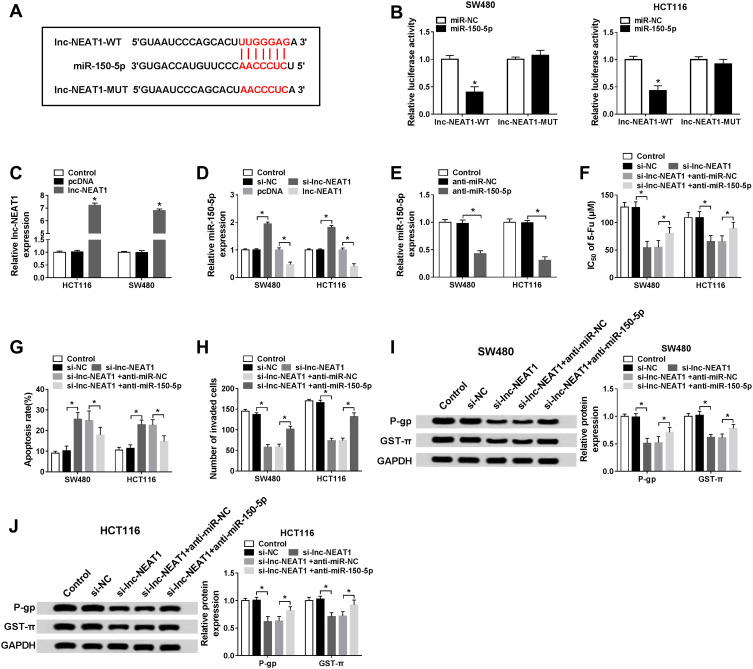
In CRC, the expression of lnc-NEAT1 was upregulated and miR-150-5p was downregulated, and the expression of both was negatively correlated. Silencing of lnc-NEAT1 promoted the 5-Fu sensitivity, enhanced the apoptosis and suppressed the invasion of CRC cells. MiR-150-5p could be sponged by lnc-NEAT1, and its inhibitors could partially reverse the effect of lnc-NEAT1 silencing on CRC progression. Besides, CPSF4 could be targeted by miR-150-5p, and its overexpression also could invert the effect of lnc-NEAT1 knockdown on CRC progression. Further, CPSF4 expression was regulated by lnc-NEAT1 and miR-150-5p. In addition, interference of lnc-NEAT1 reduced tumor volume and improved the sensitivity of CRC to 5-Fu in vivo.
Lnc-NEAT1 acted as an oncogene in CRC through regulating CPSF4 expression by sponging miR-150-5p. The discovery of lnc-NEAT1/miR-150-5p/CPSF4 axis provided a novel approach for CRC genomic therapy strategy.
结直肠癌(CRC)是全球最常见的恶性肿瘤之一。长链非编码RNA(lncRNA)核富集丰富转录本1(NEAT1)参与多种癌症的发生发展。然而,其在CRC进展中的作用及机制仍需进一步探索。
采用定量实时PCR(qRT-PCR)检测lnc-NEAT1、微小RNA-150-5p(miR-150-5p)和切割及聚腺苷酸化特异性因子4(CPSF4)的表达水平。通过3-(4,5-二甲基-2-噻唑基)-2,5-二苯基-2-H-四氮唑溴盐(MTT)法检测细胞对5-氟尿嘧啶(5-Fu)的敏感性。分别采用流式细胞术和Transwell实验评估细胞凋亡和侵袭情况。采用蛋白质免疫印迹(WB)分析评估耐药相关蛋白和CPSF4蛋白的水平。此外,采用双荧光素酶报告基因实验验证lnc-NEAT1、miR-150-5p和CPSF4之间的相互作用。同时,利用小鼠异种移植模型确定lnc-NEAT1对体内CRC肿瘤生长的影响。
在CRC中,lnc-NEAT1表达上调,miR-150-5p表达下调,二者表达呈负相关。沉默lnc-NEAT1可提高5-Fu敏感性,增强CRC细胞凋亡并抑制其侵袭。lnc-NEAT1可吸附miR-150-5p,其抑制剂可部分逆转lnc-NEAT1沉默对CRC进展的影响。此外,CPSF4可被miR-150-5p靶向,其过表达也可逆转lnc-NEAT1敲低对CRC进展的影响。进一步研究发现,CPSF4表达受lnc-NEAT1和miR-150-5p调控。此外,干扰lnc-NEAT1可减小体内肿瘤体积并提高CRC对5-Fu的敏感性。
lnc-NEAT1在CRC中通过吸附miR-150-5p调控CPSF4表达发挥癌基因作用。lnc-NEAT1/miR-150-5p/CPSF4轴的发现为CRC基因治疗策略提供了新方法。