Saha Amrita, Bhattacharjee Anindita, Vij Amit, Das Pijush K, Bhattacharya Arijit, Biswas Arunima
Infectious Diseases and Immunology, CSIR-Indian Institute of Chemical Biology, Kolkata, India.
Department of Zoology, Cell and Molecular Biology Laboratory, University of Kalyani, Kalyani, India.
Front Pharmacol. 2020 May 29;11:782. doi: 10.3389/fphar.2020.00782. eCollection 2020.
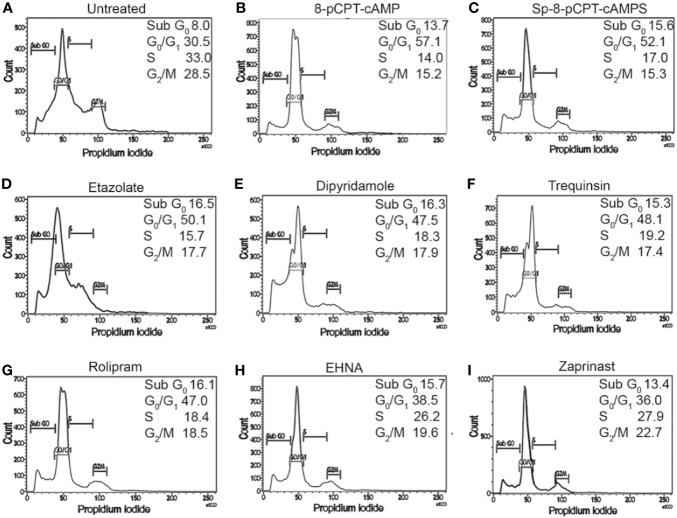
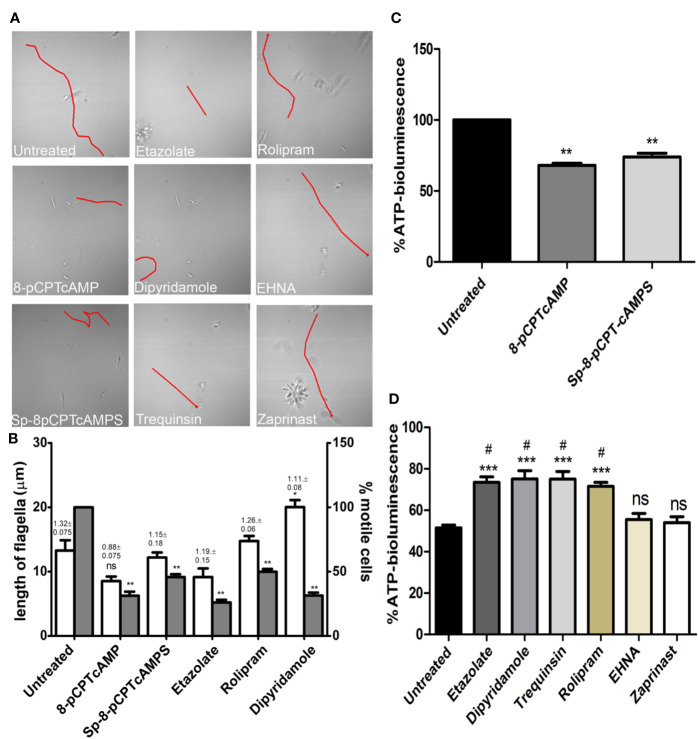
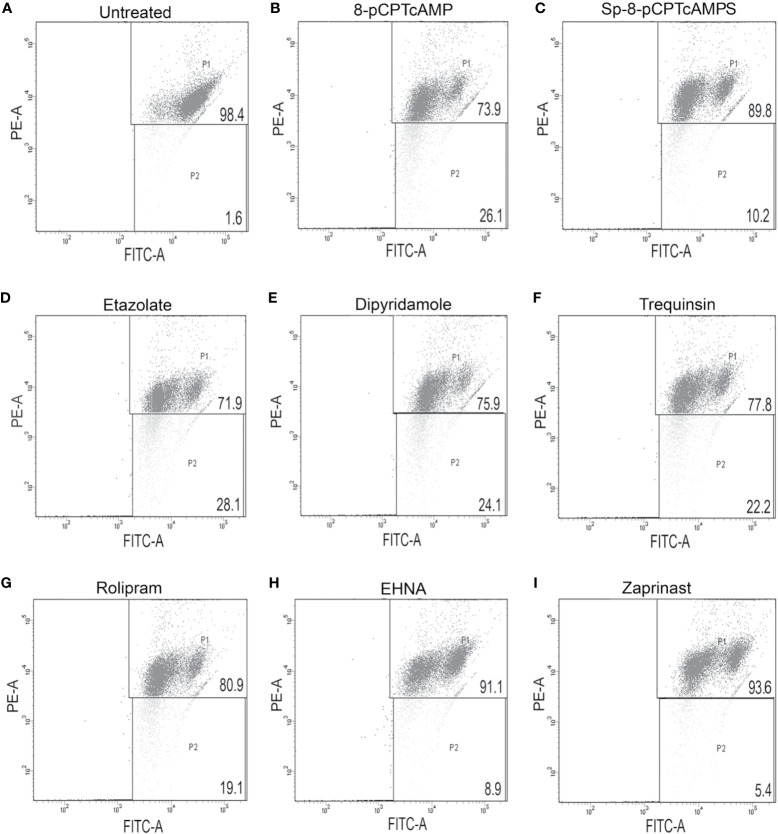
With the identification of novel cAMP binding effector molecules in , the role of cAMP in kinetoplastida parasites gained an intriguing breakthrough. Despite earlier demonstrations of the role of cAMP in the survival of during macrophage infection, there is essential need to specifically clarify the involvement of cAMP in various cellular processes in the parasite. In this context, we sought to gain a comprehensive understanding of the effect of cAMP analogs and cAMP-cyclic nucleotide phosphodiesterase (PDE) inhibitors on proliferation of log phase parasites. Administration of both hydrolyzable (8-pCPT-cAMP) and nonhydrolyzable analogs (Sp-8-pCPT-cAMPS) of cAMP resulted in a significant decrease of proliferation. Among the various PDE inhibitors, etazolate was found to be potently antiproliferative. BrdU cell proliferation and K/N/F-enumeration microscopic study revealed that both cAMP analogs and selective PDE inhibitors resulted in significant cell cycle arrest at G phase with reduced S-phase population. Furthermore, careful examination of the flagellar motility patterns revealed significantly reduced coordinated forward flagellar movement of the promastigotes with a concomitant decrease in cellular ATP levels. Alongside, 8-pCPT-cAMP and PDE inhibitors etazolate and trequinsin showed marked reduction in mitochondrial membrane potential. Treatment of etazolate at subcytotoxic concentration to infected macrophages significantly reduced parasite burden, and administration of etazolate to -infected BALB/c mice showed reduced liver and spleen parasite burden. Collectively, these results imply involvement of cAMP in various crucial processes paving the avenue for developing potent antileishmanial agent.
随着新型环磷酸腺苷(cAMP)结合效应分子的鉴定,cAMP在动基体寄生虫中的作用取得了引人注目的突破。尽管早期已证明cAMP在巨噬细胞感染期间利什曼原虫存活中的作用,但仍迫切需要具体阐明cAMP在该寄生虫各种细胞过程中的参与情况。在此背景下,我们试图全面了解cAMP类似物和cAMP-环核苷酸磷酸二酯酶(PDE)抑制剂对对数期寄生虫增殖的影响。给予可水解的(8-对氯苯硫基-cAMP)和不可水解的cAMP类似物(Sp-8-对氯苯硫基-cAMPS)均导致利什曼原虫增殖显著减少。在各种PDE抑制剂中,发现乙唑胺具有强效抗增殖作用。溴脱氧尿苷(BrdU)细胞增殖和K/N/F计数显微镜研究表明,cAMP类似物和选择性PDE抑制剂均导致细胞周期在G期显著停滞,S期细胞群体减少。此外,仔细观察鞭毛运动模式发现,前鞭毛体的协调向前鞭毛运动显著减少,同时细胞ATP水平降低。与此同时,8-对氯苯硫基-cAMP以及PDE抑制剂乙唑胺和曲喹辛显示线粒体膜电位明显降低。以亚细胞毒性浓度的乙唑胺处理感染的巨噬细胞可显著降低寄生虫负荷,给感染利什曼原虫的BALB/c小鼠施用乙唑胺可减轻肝脏和脾脏中的寄生虫负荷。总体而言,这些结果表明cAMP参与了各种关键过程,为开发有效的抗利什曼原虫药物铺平了道路。