Duong Cao Nguyen, Vestweber Dietmar
Department of Vascular Cell Biology, Max Planck Institute for Molecular Biomedicine, Münster, Germany.
Front Physiol. 2020 May 21;11:519. doi: 10.3389/fphys.2020.00519. eCollection 2020.
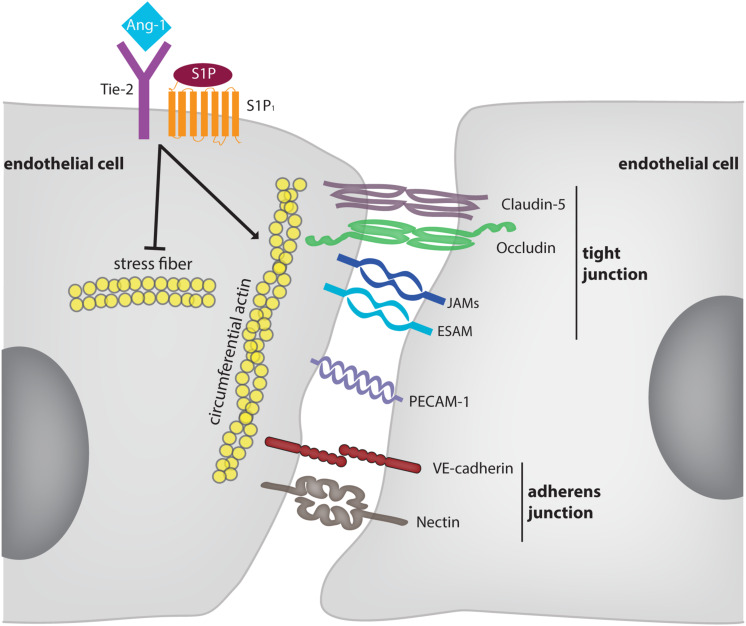
Endothelial junctions provide blood and lymph vessel integrity and are essential for the formation of a vascular system. They control the extravasation of solutes, leukocytes and metastatic cells from blood vessels and the uptake of fluid and leukocytes into the lymphatic vascular system. A multitude of adhesion molecules mediate and control the integrity and permeability of endothelial junctions. VE-cadherin is arguably the most important adhesion molecule for the formation of vascular structures, and the stability of their junctions. Interestingly, despite this prominence, its elimination from junctions in the adult organism has different consequences in the vasculature of different organs, both for blood and lymph vessels. In addition, even in tissues where the lack of VE-cadherin leads to strong plasma leaks from venules, the physical integrity of endothelial junctions is preserved. Obviously, other adhesion molecules can compensate for a loss of VE-cadherin and this review will discuss which other adhesive mechanisms contribute to the stability and regulation of endothelial junctions and cooperate with VE-cadherin in intact vessels. In addition to adhesion molecules, endothelial receptors will be discussed, which stimulate signaling processes that provide junction stability by modulating the actomyosin system, which reinforces tension of circumferential actin and dampens pulling forces of radial stress fibers. Finally, we will highlight most recent reports about the formation and control of the specialized button-like junctions of initial lymphatics, which represent the entry sites for fluid and cells into the lymphatic vascular system.
内皮连接维持血管和淋巴管的完整性,对血管系统的形成至关重要。它们控制溶质、白细胞和转移细胞从血管外渗,以及液体和白细胞进入淋巴管系统。多种黏附分子介导并控制内皮连接的完整性和通透性。血管内皮钙黏蛋白(VE-钙黏蛋白)可以说是形成血管结构及其连接稳定性的最重要黏附分子。有趣的是,尽管它如此重要,但在成年生物体中,其从连接中消除在不同器官的脉管系统中,对血管和淋巴管都会产生不同的后果。此外,即使在缺乏VE-钙黏蛋白会导致小静脉大量血浆渗漏的组织中,内皮连接的物理完整性仍得以保留。显然,其他黏附分子可以补偿VE-钙黏蛋白的缺失,本综述将讨论哪些其他黏附机制有助于内皮连接的稳定性和调节,并在完整血管中与VE-钙黏蛋白协同作用。除了黏附分子,还将讨论内皮受体,它们刺激信号传导过程,通过调节肌动球蛋白系统来提供连接稳定性,该系统增强周向肌动蛋白的张力并减弱径向应力纤维的拉力。最后,我们将重点介绍有关初始淋巴管特化纽扣状连接的形成和控制的最新报道,这些连接代表了液体和细胞进入淋巴管系统的入口部位。