Lau Alexandria, So Hon-Cheong
School of Biomedical Sciences, Faculty of Medicine, The Chinese University of Hong Kong, Hong Kong SAR, China.
KIZ-CUHK Joint Laboratory of Bioresources and Molecular Research of Common Diseases, Kunming Zoology Institute of Zoology and The Chinese University of Hong Kong, Hong Kong SAR, China.
Comput Struct Biotechnol J. 2020 Jun 12;18:1639-1650. doi: 10.1016/j.csbj.2020.06.015. eCollection 2020.
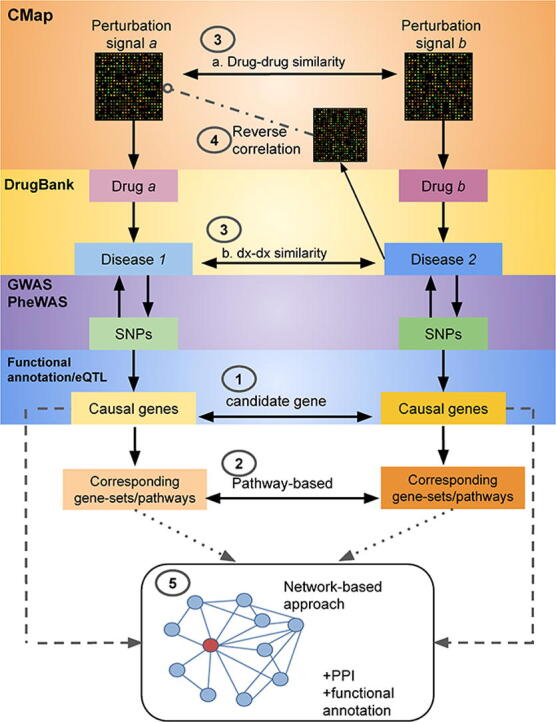
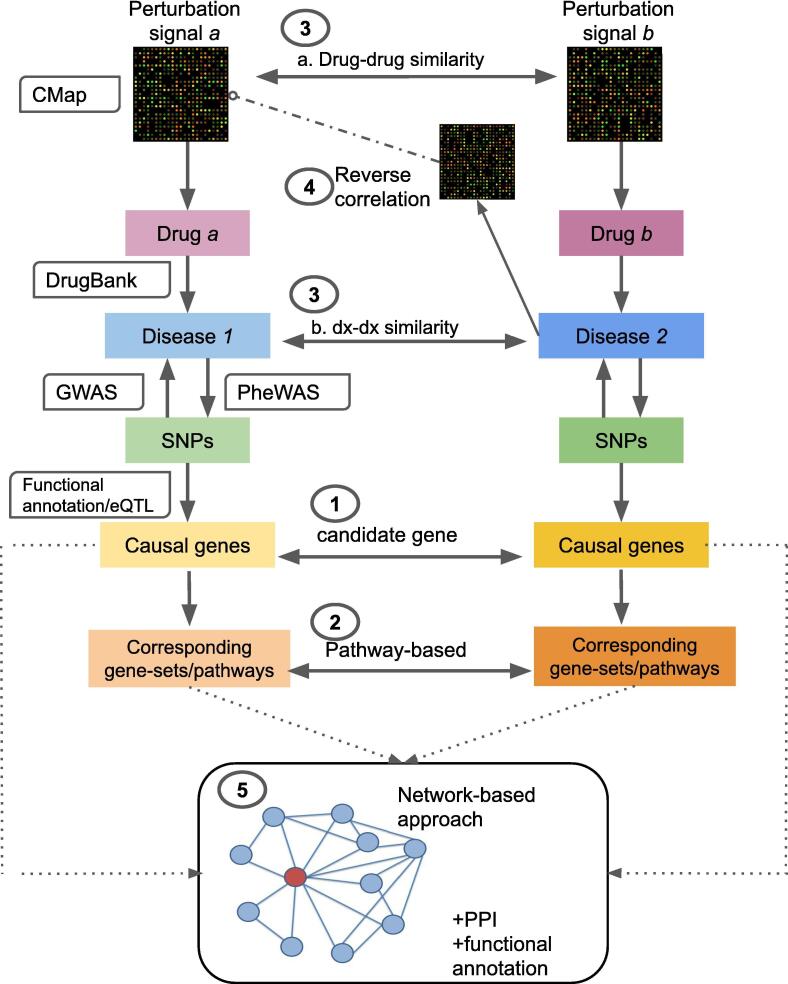
Drug development is a very costly and lengthy process, while repositioned or repurposed drugs could be brought into clinical practice within a shorter time-frame and at a much reduced cost. Numerous computational approaches to drug repositioning have been developed, but methods utilizing genome-wide association studies (GWASs) data are less explored. The past decade has observed a massive growth in the amount of data from GWAS; the rich information contained in GWAS has great potential to guide drug repositioning or discovery. While multiple tools are available for finding the most relevant genes from GWAS hits, searching for top susceptibility genes is only one way to guide repositioning, which has its own limitations. Here we provide a comprehensive review of different computational approaches that employ GWAS data to guide drug repositioning. These methods include selecting top candidate genes from GWAS as drug targets, deducing drug candidates based on drug-drug and disease-disease similarities, searching for reversed expression profiles between drugs and diseases, pathway-based methods as well as approaches based on analysis of biological networks. Each method is illustrated with examples, and their respective strengths and limitations are discussed. We also discussed several areas for future research.
药物研发是一个成本高昂且耗时漫长的过程,而重新定位或重新利用的药物能够在更短的时间内且以大幅降低的成本进入临床应用。已经开发出了众多用于药物重新定位的计算方法,但利用全基因组关联研究(GWAS)数据的方法却较少被探索。在过去十年中,GWAS数据量大幅增长;GWAS中包含的丰富信息具有指导药物重新定位或发现的巨大潜力。虽然有多种工具可用于从GWAS命中结果中找到最相关的基因,但寻找顶级易感基因只是指导重新定位的一种方式,它有其自身的局限性。在此,我们全面综述了利用GWAS数据指导药物重新定位的不同计算方法。这些方法包括从GWAS中选择顶级候选基因作为药物靶点,基于药物-药物和疾病-疾病相似性推导候选药物,寻找药物与疾病之间的反向表达谱,基于通路的方法以及基于生物网络分析的方法。每种方法都配有示例说明,并讨论了它们各自的优缺点。我们还讨论了未来研究的几个领域。