Kim Dong Min, Park Dongjun, Kim Hyojune, Lee Eui-Sup, Shin Myung Jin, Jeon In-Ho, Koh Kyoung Hwan
Department of Orthopedic Surgery, Asan Medical Center, University of Ulsan College of Medicine, Seoul, South Korea.
Geriatr Orthop Surg Rehabil. 2020 Jul 6;11:2151459320938571. doi: 10.1177/2151459320938571. eCollection 2020.
The aims of this study were to investigate (1) whether demographic factors would be risk factors for severe proximal humerus fracture (PHF), (2) relationship of radiological parameters with bone mineral density (BMD), deltoid tuberosity index (DTI), or severe PHF, and (3) correlation between DTI and BMD.
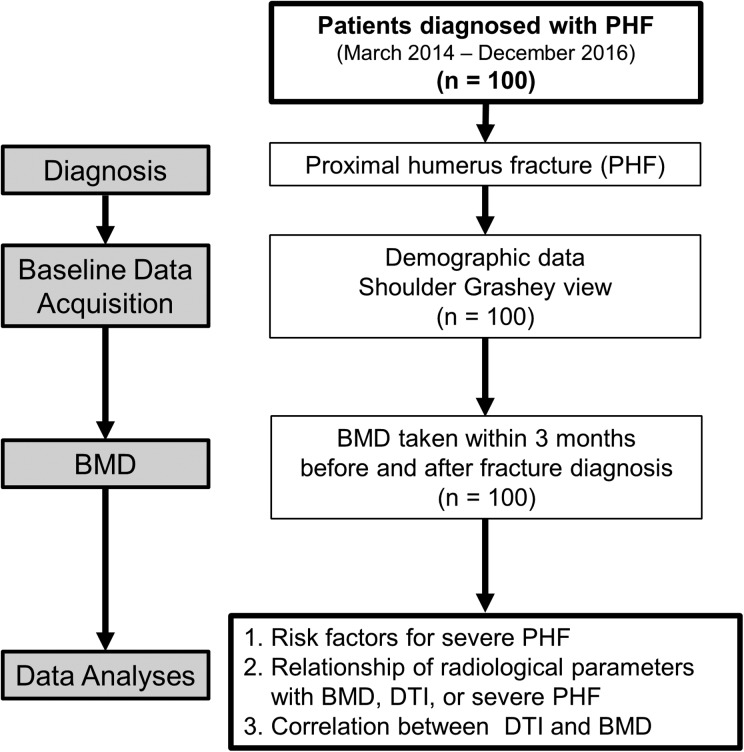
We conducted a cross-sectional study based on radiographs and medical records taken during admission or the visit to the orthopedic clinic. We reviewed consecutive 100 adult patients who were diagnosed with PHF in our hospital from March 2014 to December 2016. Three- and 4-part fractures were regarded as severe PHFs. Univariable and multivariable logistic regression analyses were performed to evaluate risk factors for severe PHF. Also, we investigated the correlation between BMD and DTI using the additional BMD data of the patients who underwent shoulder surgeries.
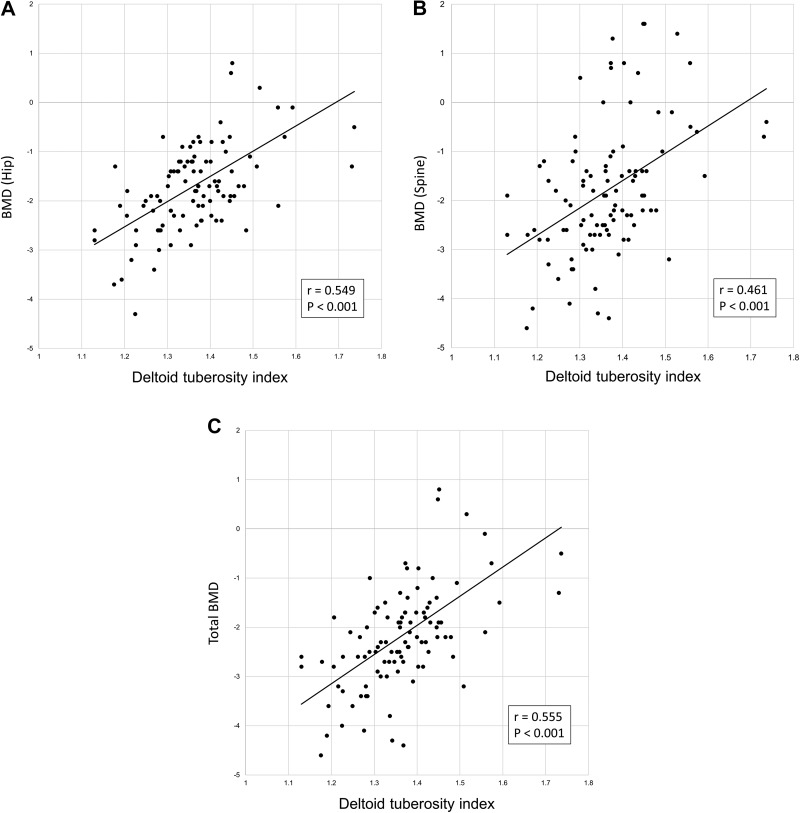
This study included 62 nonsevere PHFs and 38 severe PHFs. There were 30 male and 70 female patients with a mean age of 66.4 ± 16.4 years. Mean T score of BMD was -2.5 ± 0.9 at the time of injury. Logistic regression analyses showed that age (odds ratio: 1.044, range: 1.011-1.079, = .009) and sex (odds ratio of females: 3.763, range: 1.236-11.459, = .020) were related to severe PHF. The group satisfying the radiological parameter criteria had significantly higher rates of severe PHF. The correlation coefficient (r) between DTI and T score was 0.555 ( < .001).
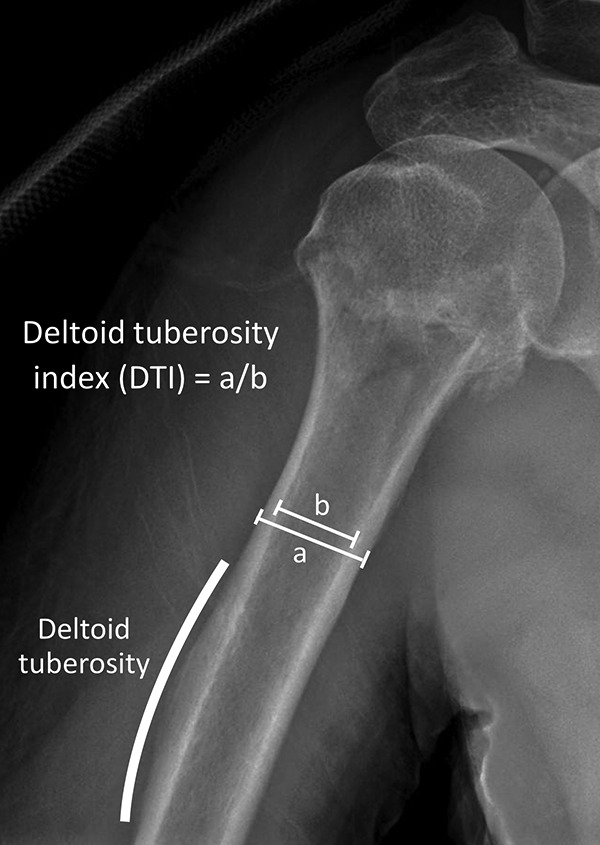
Older age and female were the independent risk factors for severe PHF. Conversely, BMD and other medical comorbidities were not risk factors for severe PHF. Deltoid tuberosity index showed significantly high intraclass correlation coefficient and a strong correlation with the T score of BMD. Therefore, DTI may be useful for screening osteoporosis in PHF patients.
Level IV, Cross-sectional study.
本研究的目的是调查:(1)人口统计学因素是否为严重肱骨近端骨折(PHF)的危险因素;(2)放射学参数与骨密度(BMD)、三角肌粗隆指数(DTI)或严重PHF之间的关系;(3)DTI与BMD之间的相关性。
我们基于入院时或骨科门诊就诊时拍摄的X线片和病历进行了一项横断面研究。我们回顾了2014年3月至2016年12月在我院连续诊断为PHF的100例成年患者。三部分和四部分骨折被视为严重PHF。进行单变量和多变量逻辑回归分析以评估严重PHF的危险因素。此外,我们使用接受肩部手术患者的额外BMD数据研究了BMD与DTI之间的相关性。
本研究包括62例非严重PHF和38例严重PHF。有30例男性和70例女性患者,平均年龄为66.4±16.4岁。受伤时BMD的平均T值为-2.5±0.9。逻辑回归分析表明,年龄(比值比:1.044,范围:1.011-1.079,P = 0.009)和性别(女性比值比:3.763,范围:1. .236-11.459,P = 0.020)与严重PHF有关。满足放射学参数标准的组严重PHF发生率显著更高。DTI与T值之间的相关系数(r)为0.555(P < 0.001)。
年龄较大和女性是严重PHF的独立危险因素。相反,BMD和其他内科合并症不是严重PHF的危险因素。三角肌粗隆指数显示出显著高的组内相关系数,并且与BMD的T值有很强的相关性。因此,DTI可能有助于筛查PHF患者的骨质疏松症。
IV级,横断面研究。