Zhou Ting, Huang Ru, Huang Mengqi, Shen Jinjin, Shan Yuanyue, Xing Da
MOE Key Laboratory of Laser Life Science & Institute of Laser Life Science College of Biophotonics South China Normal University Guangzhou 510631 China.
Adv Sci (Weinh). 2020 May 27;7(13):1903661. doi: 10.1002/advs.201903661. eCollection 2020 Jul.
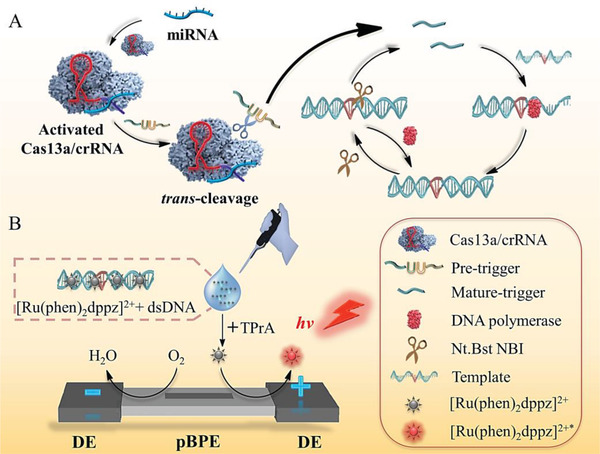
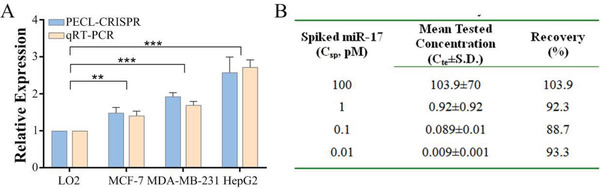
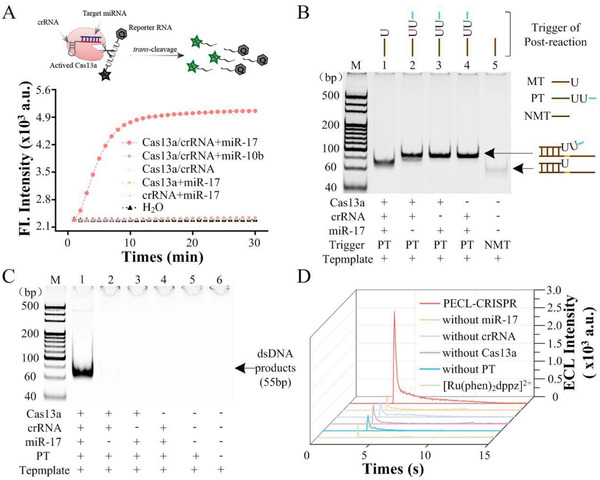
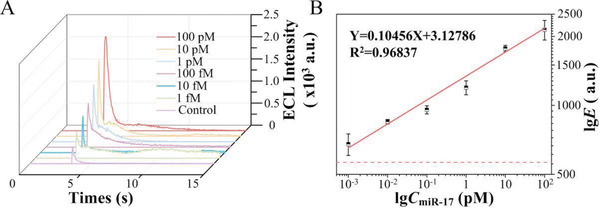
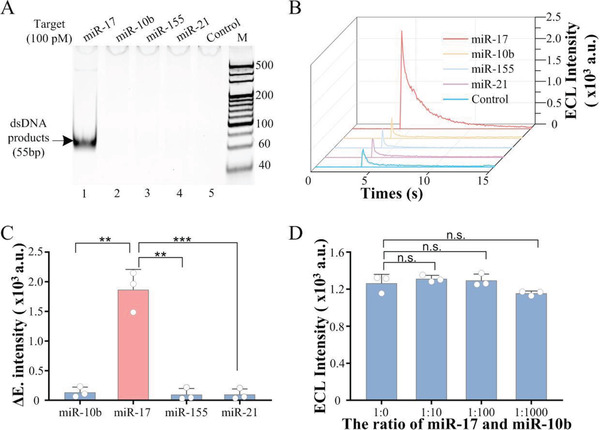
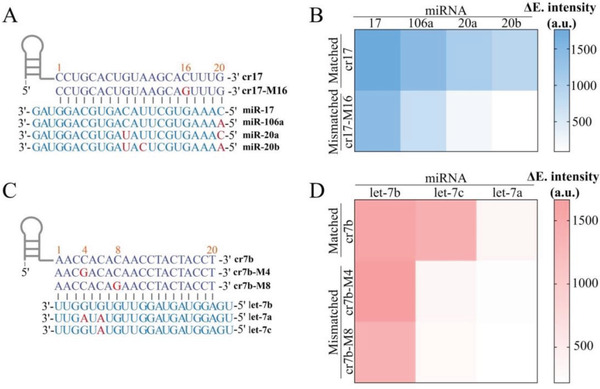
MicroRNAs (miRNAs) have been widely investigated as potential biomarkers for early clinical diagnosis of cancer. Developing an miRNA detection platform with high specificity, sensitivity, and exploitability is always necessary. Electrochemiluminescence (ECL) is an electrogenerated chemiluminescence technology that greatly decreases background noise and improves detection sensitivity. The development of a paper-based ECL biosensor further makes ECL suitable for point-of-care detection. Recently, clustered regularly interspaced short palindromic repeats (CRISPR)/Cas13a as high-fidelity, efficient, and programmable CRISPR RNA (crRNA) guided RNase has brought a next-generation biosensing technology. However, existing CRISPR/Cas13a based detection often faces a trade-off between sensitivity and specificity. In this research, a CRISPR/Cas13a powered portable ECL chip (PECL-CRISPR) is constructed. Wherein target miRNA activates Cas13a to cleave a well-designed preprimer, and triggers the subsequent exponential amplification and ECL detection. Under optimized conditions, a limit-of-detection of 1 × 10 m for miR-17 is achieved. Through rationally designing the crRNA, the platform can provide single nucleotide resolution to dramatically distinguish miRNA target from its highly homologous family members. Moreover, the introduction of "light-switch" molecule [Ru(phen)dppz] allows the platform to avoid tedious electrode modification and washing processes, thereby simplifying the experimental procedure and lower testing cost. Analysis results of miRNA from tumor cells also demonstrate the PECL-CRISPR platform holds a promising potential for molecular diagnosis.
微小RNA(miRNA)作为癌症早期临床诊断的潜在生物标志物已得到广泛研究。开发具有高特异性、高灵敏度和可操作性的miRNA检测平台一直是必要的。电化学发光(ECL)是一种电化学产生的化学发光技术,可大大降低背景噪声并提高检测灵敏度。基于纸的ECL生物传感器的开发进一步使ECL适用于即时检测。最近,成簇规律间隔短回文重复序列(CRISPR)/Cas13a作为高保真、高效且可编程的CRISPR RNA(crRNA)引导的核糖核酸酶带来了下一代生物传感技术。然而,现有的基于CRISPR/Cas13a的检测通常在灵敏度和特异性之间面临权衡。在本研究中,构建了一种由CRISPR/Cas13a驱动的便携式ECL芯片(PECL-CRISPR)。其中,目标miRNA激活Cas13a以切割精心设计的前引物,并触发随后的指数扩增和ECL检测。在优化条件下,实现了对miR-17的检测限为1×10⁻¹²M。通过合理设计crRNA,该平台可提供单核苷酸分辨率,以显著区分miRNA靶标与其高度同源的家族成员。此外,“光开关”分子[Ru(phen)dppz]的引入使该平台避免了繁琐的电极修饰和洗涤过程,从而简化了实验步骤并降低了测试成本。来自肿瘤细胞的miRNA分析结果也表明,PECL-CRISPR平台在分子诊断方面具有广阔的应用前景。