Chen Daobing, Liu Qingping, Han Zhiwu, Zhang Junqiu, Song HongLie, Wang Kejun, Song Zhengyi, Wen Shifeng, Zhou Yan, Yan Chunze, Shi Yusheng
State Key Laboratory of Material Processing and Die & Mould Technology Huazhong University of Science and Technology Wuhan Hubei 430074 China.
Key Laboratory of Bionic Engineering Ministry of Education Jilin University Jilin Changchun 130022 P. R. China.
Adv Sci (Weinh). 2020 May 13;7(13):2000584. doi: 10.1002/advs.202000584. eCollection 2020 Jul.
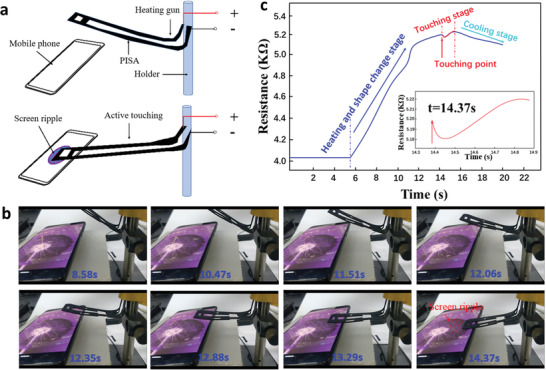
Integrated sensor-actuators with exciting functionalities, such as action self-sensing, position self-sensing, posture self-sensing, or active sensing, are promising for applications in biomedical device, human-machine interaction, intelligent self-protection devices, and humanoid robots. Despite recent progress, it remains challenging to achieve a macroscopical integrated sensor-actuator in a material system with microstructures. To address this critical challenge, a 4D printing bioinspired microstructure strategy is reported to design a high-performance integrated sensor-actuator capable of simultaneous actuation and sensation. Decoupled thermal stimulation and strain sensation is achieved by combining nanocarbon black/polylactic acid composites with bioinspired gradient microgap structures. As a result, printed integrated sensor-actuators can actively touch objects triggered by thermal stimulation and self-sense the touching state through the resistance change. It is anticipated that the basic design principle underlying this behavior can be used to develop integrated sensor-actuators of various shapes and functionalities to meet desirable applications.
具有诸如动作自感知、位置自感知、姿态自感知或主动感知等令人兴奋功能的集成传感器-致动器,在生物医学设备、人机交互、智能自我保护设备和类人机器人等应用中具有广阔前景。尽管最近取得了进展,但在具有微观结构的材料系统中实现宏观集成传感器-致动器仍然具有挑战性。为应对这一关键挑战,报道了一种4D打印生物启发微观结构策略,以设计一种能够同时进行致动和传感的高性能集成传感器-致动器。通过将纳米炭黑/聚乳酸复合材料与生物启发的梯度微间隙结构相结合,实现了热刺激与应变传感的解耦。结果,打印的集成传感器-致动器可以主动触摸由热刺激触发的物体,并通过电阻变化自感知触摸状态。预计这种行为背后的基本设计原理可用于开发各种形状和功能的集成传感器-致动器,以满足理想的应用需求。