Wong L Y, Zafari N, Churilov L, Stammers L, Price S, Ekinci E I, Sumithran P
Department of Medicine (Austin), University of Melbourne, Melbourne, Victoria, Australia.
Department of Endocrinology, Austin Health, Melbourne, Victoria, Australia.
BJS Open. 2020 Jul 16;4(6):995-1014. doi: 10.1002/bjs5.50318.
The effect of bariatric surgery on 'emotional eating' (EE) in people with obesity is unclear. This systematic review and meta-analysis aimed to examine changes in self-reported emotional eating behaviour after bariatric surgery.
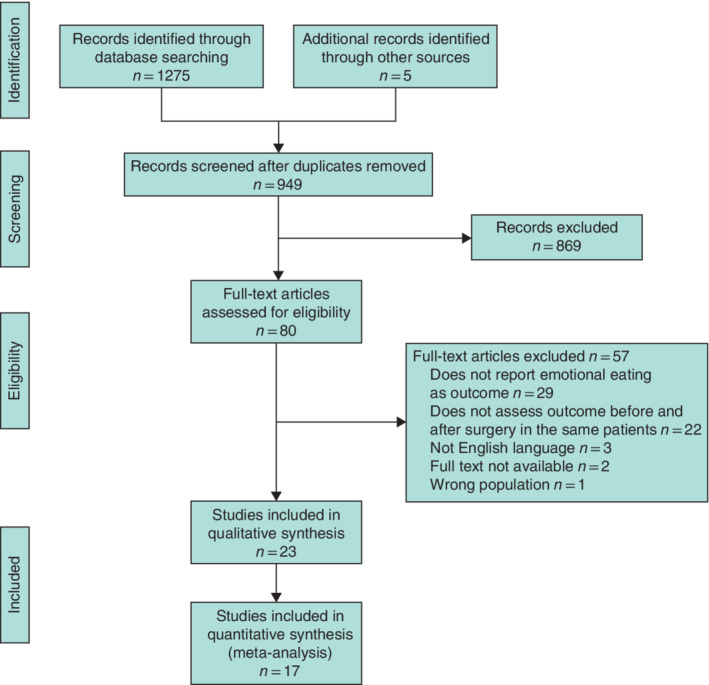
Fifteen electronic databases were searched from inception to August 2019. Included studies encompassed patients undergoing primary bariatric surgery, quantitatively assessed EE, and reported EE scores before and after surgery in the same participants. Studies were excluded if they were not in English or available in full text. The systematic review and meta-analysis were conducted according to the PRISMA guidelines. Random-effects models were used for quantitative analysis. Study quality was assessed using the National Heart, Lung, and Blood Institute quality assessment tool for before-after (pre-post) studies with no control group.
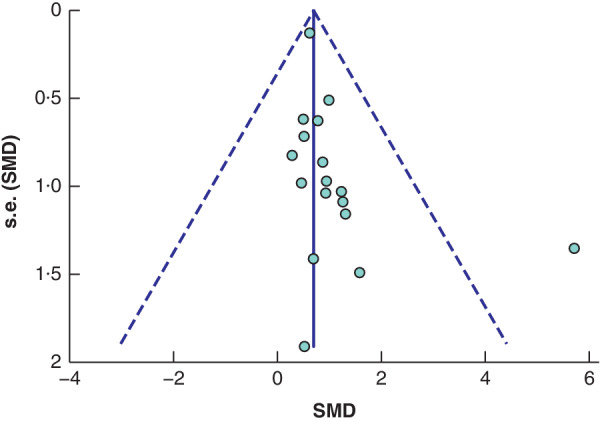
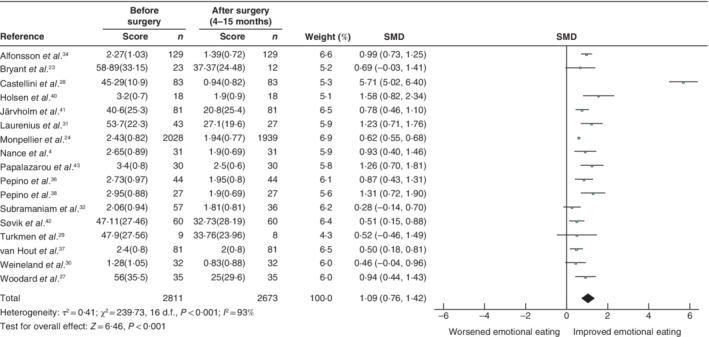
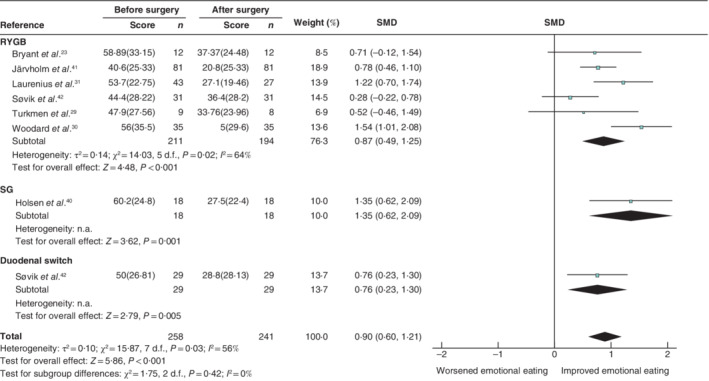
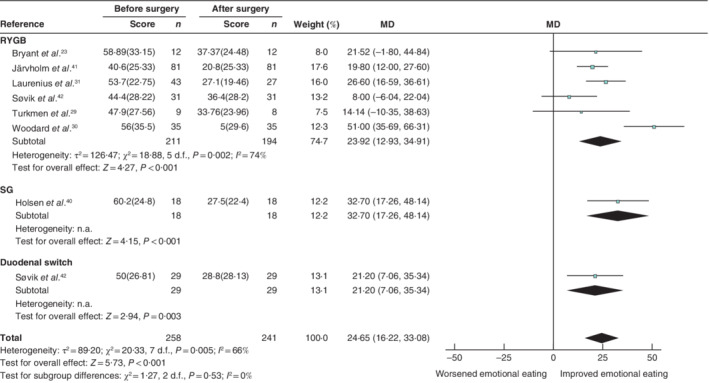
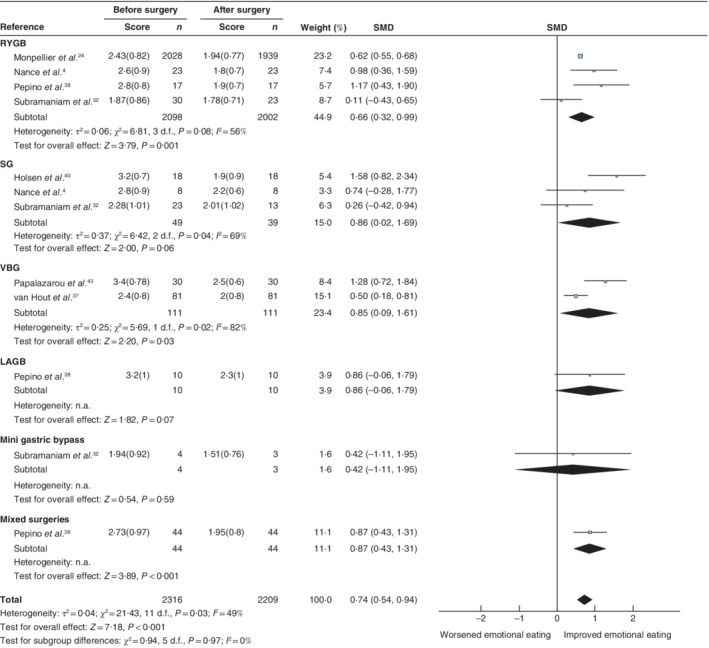
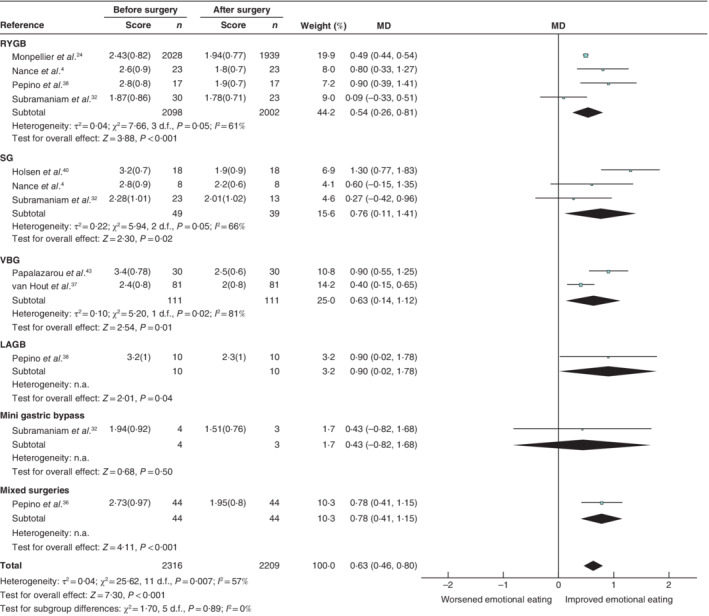
Some 23 studies containing 6749 participants were included in the qualitative synthesis, with follow-up of from 2 weeks to 48 months. EE scores decreased to 12 months after surgery. Results were mixed beyond 12 months. Quantitative synthesis of 17 studies (2811 participants) found that EE scores decreased by a standardized mean difference of 1·09 (95 per cent c.i. 0·76 to 1·42) 4-18 months after surgery, indicating a large effect size.
Bariatric surgery may mitigate the tendency to eat in response to emotions in the short to medium term.
减肥手术对肥胖人群“情绪化进食”(EE)的影响尚不清楚。本系统评价和荟萃分析旨在研究减肥手术后自我报告的情绪化进食行为的变化。
检索了15个电子数据库,时间跨度从建库至2019年8月。纳入的研究包括接受初次减肥手术的患者,对EE进行了定量评估,并报告了同一参与者手术前后的EE评分。如果研究不是英文的或没有全文,则将其排除。系统评价和荟萃分析按照PRISMA指南进行。采用随机效应模型进行定量分析。使用美国国立心肺血液研究所的前后对照(术前-术后)研究质量评估工具对研究质量进行评估,该研究无对照组。
定性综合分析纳入了约23项研究,共6749名参与者,随访时间为2周至48个月。EE评分在术后12个月时下降。12个月后的结果不一。对17项研究(2811名参与者)的定量综合分析发现,术后4 - 18个月,EE评分的标准化平均差下降了1.09(95%置信区间为0.76至1.42),表明效应量较大。
减肥手术可能在短期至中期减轻因情绪而进食的倾向。