Division of Women's Health, Department of Medicine, Brigham & Women's Hospital, Boston, MA, USA.
Department of Psychiatry, Brigham & Women's Hospital, Boston, MA, USA.
Int J Obes (Lond). 2018 Apr;42(4):785-793. doi: 10.1038/ijo.2017.190. Epub 2017 Aug 14.
BACKGROUND/OBJECTIVES: Despite the effectiveness of bariatric surgery, there is still substantial variability in long-term weight outcomes and few factors with predictive power to explain this variability. Neuroimaging may provide a novel biomarker with utility beyond other commonly used variables in bariatric surgery trials to improve prediction of long-term weight-loss outcomes. The purpose of this study was to evaluate the effects of sleeve gastrectomy (SG) on reward and cognitive control circuitry postsurgery and determine the extent to which baseline brain activity predicts weight loss at 12-month postsurgery.
SUBJECTS/METHODS: Using a longitudinal design, behavioral, hormone and neuroimaging data (during a desire for palatable food regulation paradigm) were collected from 18 patients undergoing SG at baseline (<1 month prior) and 12-month post-SG.
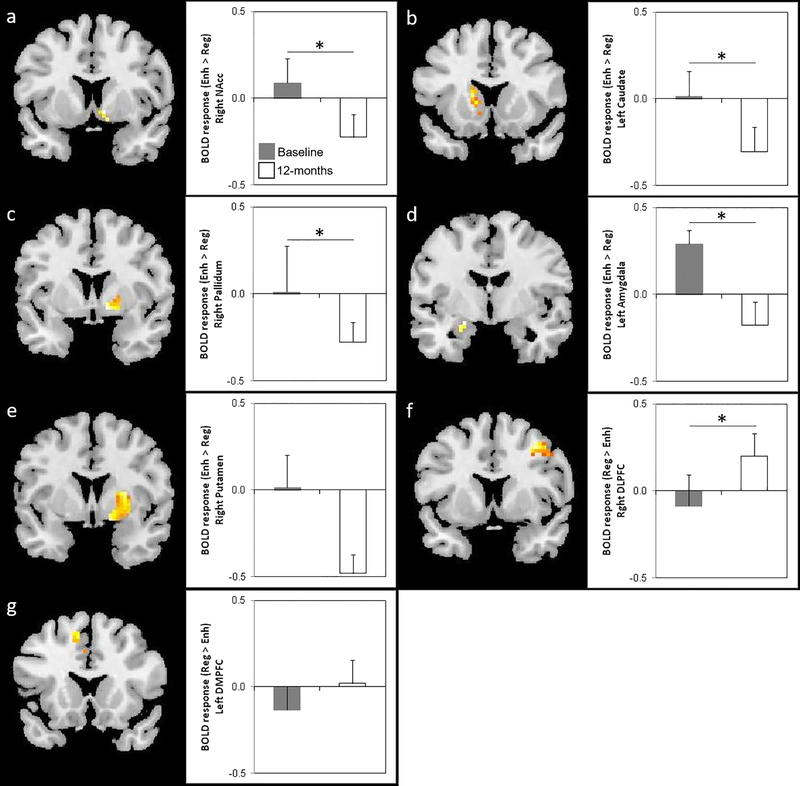
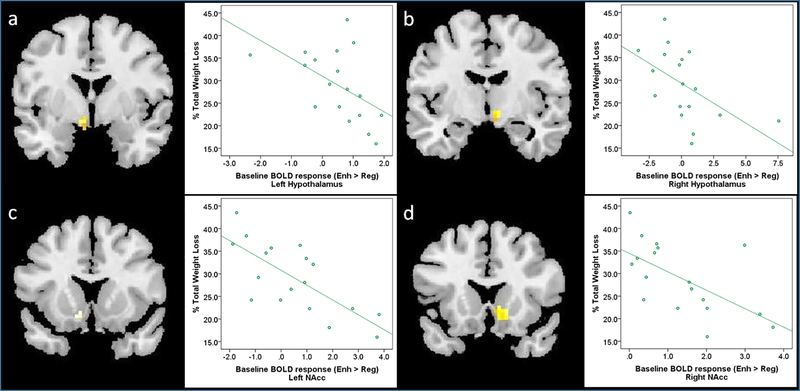
SG patients lost an average of 29.0% of their weight (percentage of total weight loss (%TWL)) at 12-month post-SG, with significant variability (range: 16.0-43.5%). Maladaptive eating behaviors (uncontrolled, emotional and externally cued eating) improved (P<0.01), in parallel with reductions in fasting hormones (acyl ghrelin, leptin, glucose, insulin; P<0.05). Brain activity in the nucleus accumbens (NAcc), caudate, pallidum and amygdala during desire for palatable food enhancement vs regulation decreased from baseline to 12 months (P (family-wise error (FWE))<0.05). Dorsolateral and dorsomedial prefrontal cortex activity during desire for palatable food regulation (vs enhancement) increased from baseline to 12 months (P(FWE)<0.05). Baseline activity in the NAcc and hypothalamus during desire for palatable food enhancement was significantly predictive of %TWL at 12 months (P (FWE)<0.05), superior to behavioral and hormone predictors, which did not significantly predict %TWL (P>0.10). Using stepwise linear regression, left NAcc activity accounted for 54% of the explained variance in %TWL at 12 months.
Consistent with previous obesity studies, reward-related neural circuit activity may serve as an objective, relatively robust predictor of postsurgery weight loss. Replication in larger studies is necessary to determine true effect sizes for outcome prediction.
背景/目的:尽管减重手术有效,但长期体重结果仍存在较大差异,并且很少有具有预测能力的因素可以解释这种差异。神经影像学可能提供一种新的生物标志物,其效用超出了减重手术试验中常用的其他变量,可改善长期减重结果的预测。本研究旨在评估袖状胃切除术(SG)对术后奖励和认知控制回路的影响,并确定基线大脑活动在多大程度上可以预测术后 12 个月的体重减轻。
对象/方法:采用纵向设计,在基线(<1 个月前)和术后 12 个月时,从 18 例接受 SG 的患者中收集行为、激素和神经影像学数据(在渴望美味食物调节范式期间)。
SG 患者在术后 12 个月时平均减轻了体重的 29.0%(体重减轻的百分比(%TWL)),体重减轻幅度存在显著差异(范围:16.0-43.5%)。不良进食行为(失控、情绪化和外部线索进食)得到改善(P<0.01),同时空腹激素(酰基 ghrelin、瘦素、葡萄糖、胰岛素)水平降低(P<0.05)。在渴望美味食物增强与调节期间,伏隔核(NAcc)、尾状核、苍白球和杏仁核的大脑活动从基线到 12 个月时降低(P(FWE)<0.05)。在渴望美味食物调节期间,背外侧和背内侧前额叶皮质的活动从基线到 12 个月时增加(P(FWE)<0.05)。在渴望美味食物增强期间,NAcc 和下丘脑的基线活动可显著预测 12 个月时的%TWL(P(FWE)<0.05),优于行为和激素预测因子,这些预测因子对%TWL 的预测并不显著(P>0.10)。通过逐步线性回归,左侧 NAcc 活动占 12 个月时%TWL 解释方差的 54%。
与之前的肥胖研究一致,与奖励相关的神经回路活动可能是术后体重减轻的客观、相对稳定的预测指标。需要在更大的研究中进行复制,以确定用于结果预测的真实效应量。