Proctor Joanna, Naughton Felix, Sloan Melanie, Hopewell Sarah, Brimicombe James, Prevost A Toby, Wilson Edward C F, Coleman Tim, Sutton Stephen
University of Cambridge, Cambridge, United Kingdom.
University of East Anglia, Norwich, United Kingdom.
JMIR Res Protoc. 2020 Jul 14;9(7):e17160. doi: 10.2196/17160.
The prevalence of smoking is declining; however, it continues to be a major public health burden. In England, primary care is the health setting that provides smoking cessation support to most smokers. However, this setting has one of the lowest success rates. The iQuit in practice intervention (iQuit) is a tailored web-based and text message intervention developed for use in primary care consultations as an adjunct to routine smoking cessation support with the aim of increasing success rates. iQuit has demonstrated feasibility, acceptability, and potential effectiveness.
This definitive trial aims to determine the effectiveness and cost-effectiveness of iQuit when used as an adjunct to the usual support provided to patients who wish to quit smoking, compared with usual care alone.
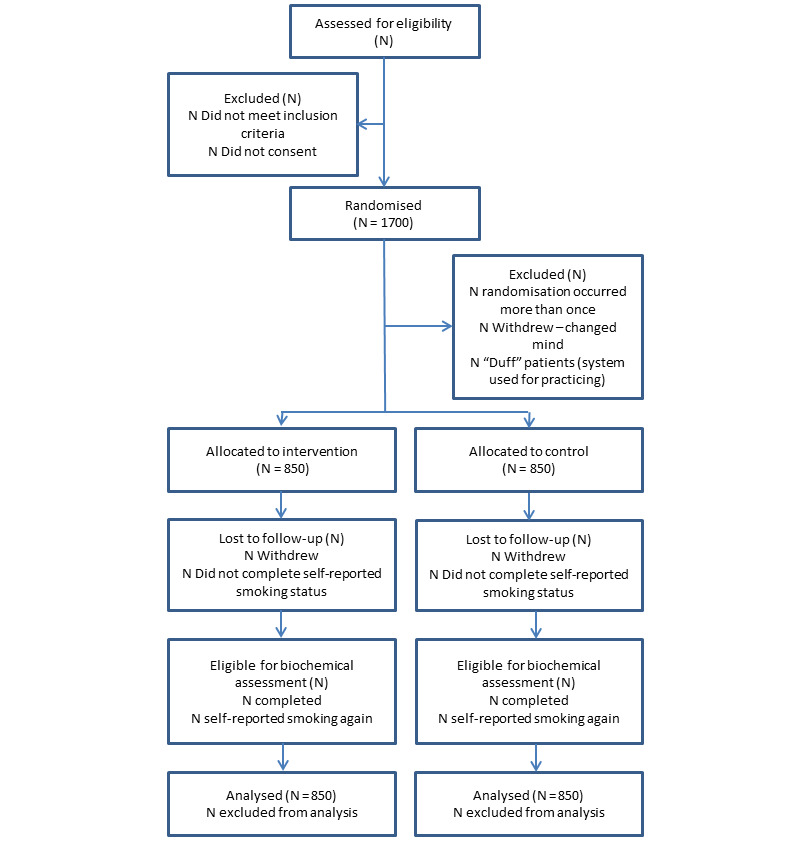
The iQuit in Practice II trial is a two-arm, parallel-group, randomized controlled trial (RCT) with a 1:1 individual allocation comparing usual care (ie, pharmacotherapy combined with multisession behavioral support)-the control-with usual care plus iQuit-the intervention. Participants were recruited through primary care clinics and talked to a smoking cessation advisor. Participants were randomized during the initial consultation, and those allocated to the intervention group received a tailored advice report and 90 days of text messaging in addition to the standard support provided to all patients.
The primary outcome is self-reported prolonged abstinence biochemically verified using saliva cotinine at 6 months after the quit date. A sample size of 1700 participants, with 850 per arm, would yield 90% power to detect a 4.3% difference in validated quit rates between the groups at the two-sided 5% level of significance. The Cambridge East Research Ethics Committee approved the study in February 2016, and funding for the study was granted from May 2016. In total, 1671 participants were recruited between August 2016 and July 2019. Follow-up for all participants was completed in January 2020. Data analysis will begin in the summer of 2020.
iQuit in Practice II is a definitive, pragmatic RCT assessing whether a digital intervention can augment the impact of routine smoking cessation support in primary care. Previous research has found good acceptability and feasibility for delivering iQuit among smoking cessation advisors working in primary care. If demonstrated to be cost-effective, iQuit could be delivered across primary care and other settings, such as community pharmacies. The potential benefit would likely be highest where less behavioral support is delivered.
International Standard Randomized Controlled Trial Number (ISRCTN): 44559004; http://www.isrctn.com /ISRCTN44559004.
INTERNATIONAL REGISTERED REPORT IDENTIFIER (IRRID): DERR1-10.2196/17160.
吸烟率正在下降;然而,它仍然是一个主要的公共卫生负担。在英国,初级保健是为大多数吸烟者提供戒烟支持的健康服务领域。然而,这一领域的成功率却是最低的之一。实践中的iQuit干预措施(iQuit)是一种量身定制的基于网络和短信的干预措施,专为初级保健咨询而开发,作为常规戒烟支持的辅助手段,旨在提高成功率。iQuit已证明具有可行性、可接受性和潜在有效性。
这项确定性试验旨在确定与单纯常规护理相比,iQuit作为辅助手段用于为希望戒烟的患者提供的常规支持时的有效性和成本效益。
实践中的iQuit II试验是一项双臂、平行组随机对照试验(RCT),采用1:1个体分配,将常规护理(即药物治疗联合多阶段行为支持)——对照组——与常规护理加iQuit——干预组——进行比较。参与者通过初级保健诊所招募,并与戒烟顾问进行交谈。参与者在初次咨询时被随机分组,分配到干预组的参与者除了接受提供给所有患者的标准支持外,还会收到一份量身定制的建议报告和90天的短信服务。
主要结局是在戒烟日期后6个月通过唾液可替宁进行生化验证的自我报告的长期戒烟情况。样本量为1700名参与者,每组850名,将有90%的把握度在双侧5%的显著性水平上检测出两组间验证戒烟率4.3%的差异。剑桥东部研究伦理委员会于2016年2月批准了该研究,研究资金于2016年5月获得。2016年8月至2019年7月期间共招募了1671名参与者。所有参与者的随访于2020年1月完成。数据分析将于2020年夏季开始。
实践中的iQuit II是一项确定性、务实的RCT,评估数字干预是否可以增强初级保健中常规戒烟支持的效果。先前的研究发现,在初级保健工作的戒烟顾问中提供iQuit具有良好的可接受性和可行性。如果证明具有成本效益,iQuit可以在初级保健和其他场所(如社区药房)提供。在提供较少行为支持的地方,潜在益处可能最大。
国际标准随机对照试验编号(ISRCTN):44559004;http://www.isrctn.com /ISRCTN44559004。
国际注册报告识别码(IRRID):DERR1-10.2196/17160。
