ISI Foundation, Turin, Italy.
Institute for Biocomputation and Physics of Complex Systems (BIFI), University of Zaragoza, Zaragoza, Spain.
PLoS Comput Biol. 2020 Jul 16;16(7):e1008035. doi: 10.1371/journal.pcbi.1008035. eCollection 2020 Jul.
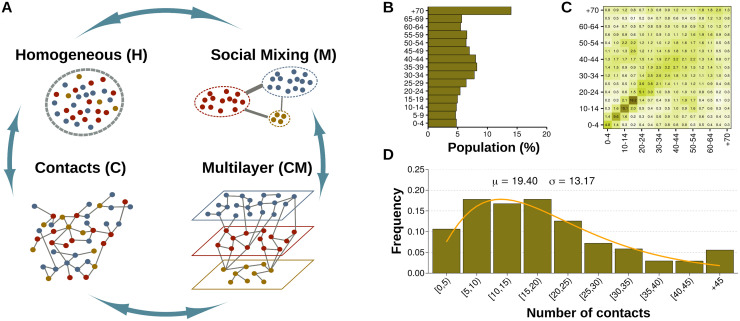
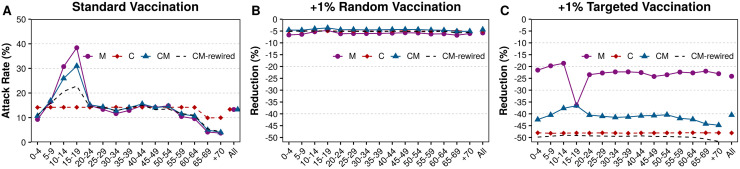
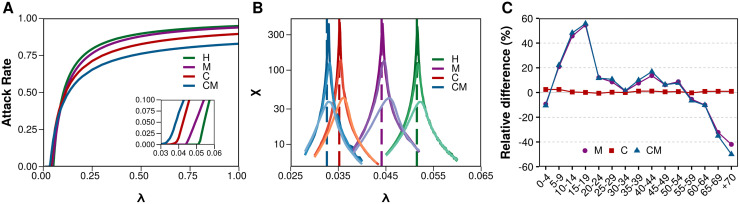
The modeling of the spreading of communicable diseases has experienced significant advances in the last two decades or so. This has been possible due to the proliferation of data and the development of new methods to gather, mine and analyze it. A key role has also been played by the latest advances in new disciplines like network science. Nonetheless, current models still lack a faithful representation of all possible heterogeneities and features that can be extracted from data. Here, we bridge a current gap in the mathematical modeling of infectious diseases and develop a framework that allows to account simultaneously for both the connectivity of individuals and the age-structure of the population. We compare different scenarios, namely, i) the homogeneous mixing setting, ii) one in which only the social mixing is taken into account, iii) a setting that considers the connectivity of individuals alone, and finally, iv) a multilayer representation in which both the social mixing and the number of contacts are included in the model. We analytically show that the thresholds obtained for these four scenarios are different. In addition, we conduct extensive numerical simulations and conclude that heterogeneities in the contact network are important for a proper determination of the epidemic threshold, whereas the age-structure plays a bigger role beyond the onset of the outbreak. Altogether, when it comes to evaluate interventions such as vaccination, both sources of individual heterogeneity are important and should be concurrently considered. Our results also provide an indication of the errors incurred in situations in which one cannot access all needed information in terms of connectivity and age of the population.
在过去的二十年左右,传染病传播模型取得了重大进展。这得益于数据的普及以及收集、挖掘和分析数据的新方法的发展。网络科学等新兴学科的最新进展也起到了关键作用。尽管如此,当前的模型仍然缺乏对所有可能的异质性和可以从数据中提取的特征的忠实表示。在这里,我们弥合了传染病数学建模中的一个当前差距,并开发了一个框架,该框架允许同时考虑个体的连接性和人口的年龄结构。我们比较了不同的情景,即 i)同质混合设置,ii)仅考虑社会混合的情景,iii)仅考虑个体连接性的情景,最后,iv)在该情景中,社会混合和接触次数都包含在模型中。我们从理论上证明了这四个场景的阈值是不同的。此外,我们进行了广泛的数值模拟,并得出结论,接触网络中的异质性对于正确确定传染病阈值很重要,而年龄结构在疫情爆发后则起着更大的作用。总之,在评估疫苗接种等干预措施时,个体异质性的这两个来源都很重要,应同时考虑。我们的结果还表明,在无法获取有关人口连接性和年龄的所有必要信息的情况下,会产生一定的误差。