Faculty of Engineering, China University of Geosciences, Wuhan 430074, China.
Int J Environ Res Public Health. 2020 Jul 14;17(14):5044. doi: 10.3390/ijerph17145044.
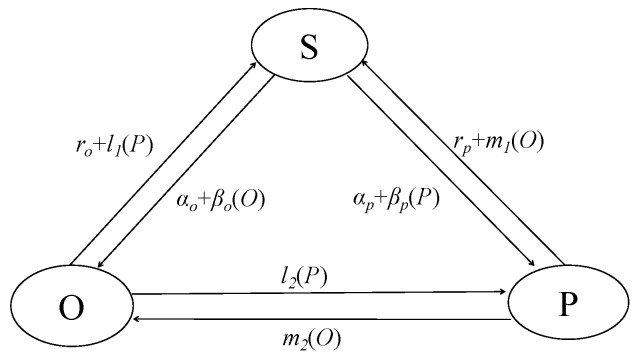
Sentiment contagion is similar to an infectious disease that spreads in a crowd. In this study, we explore the law of emotional infection under sudden public events by SIR model. The paper adds an emotionally stable node and establishes a group emotional infection model of U-SOSPa-SPSOa model. Simulation results show that our model is reasonable and can better explain the entire contagion process by considering four groups (unsusceptible-susceptible-optimistic-pessimistic) of people. Our theoretical results show: When the pessimists were below the critical value of 0.34, the number of negative emotional groups first increased and then decreased. As the proportion increases, the emotional peak of pessimists increases. The cure probability has the least influence on the (), and at the same time, under the action of , the () reaches the stable state first. The increase of the risk coefficient can promote the pessimist infection. When the degree of risk is low, the rate of emotional infection is increased. When the degree of risk is high, the rate of infection is slowed. Therefore, system customizers and related managers can improve the efficiency of stable groups, adjust the proportion of initial negative emotions, control the infection of the spontaneous infection process, and directly deal with negative emotions. They can carry out treatment and other means to stabilize group emotions and maintain social stability.
情绪传染类似于在人群中传播的传染病。在本研究中,我们通过 SIR 模型探讨了突发公共事件下的情感传染规律。本文添加了一个情绪稳定节点,建立了 U-SOSPa-SPSOa 模型的群体情绪传染模型。仿真结果表明,我们的模型是合理的,可以通过考虑四类人群(易感-易感-乐观-悲观)更好地解释整个传染过程。我们的理论结果表明:当悲观主义者低于 0.34 的临界值时,负面情绪群体的数量先增加后减少。随着比例的增加,悲观主义者的情绪峰值增加。治愈概率 对()的影响最小,同时,在 的作用下,()首先达到稳定状态。风险系数的增加可以促进悲观主义者的感染。当风险程度较低时,情绪感染率增加。当风险程度较高时,感染率会减缓。因此,系统定制者和相关管理人员可以提高稳定群体的效率,调整初始负面情绪的比例,控制自发感染过程的感染,直接处理负面情绪。他们可以采取治疗等手段稳定群体情绪,维护社会稳定。