Department of Applied Physiology and Kinesiology, University of Florida, Gainesville, FL, 32608 USA.
Department of Physical Education, State University of Londrina, Londrina 860570-970, Brazil.
Cells. 2020 Jul 14;9(7):1688. doi: 10.3390/cells9071688.
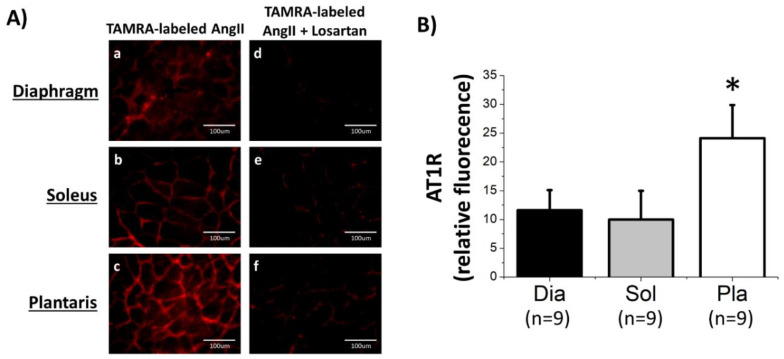
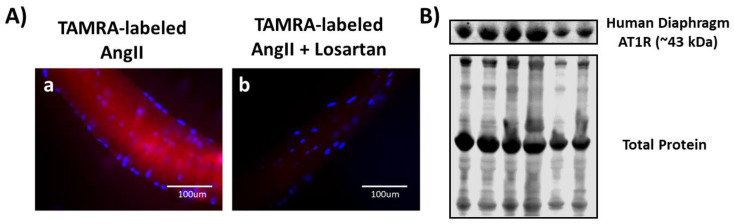
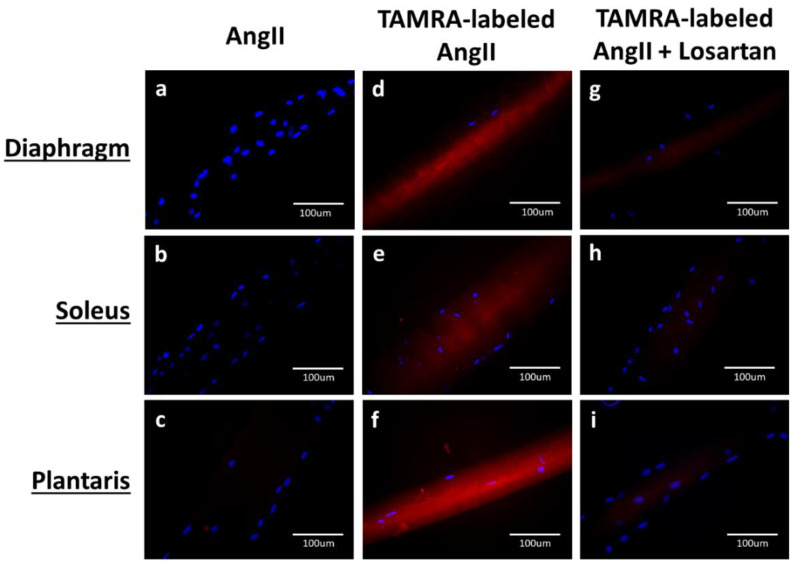
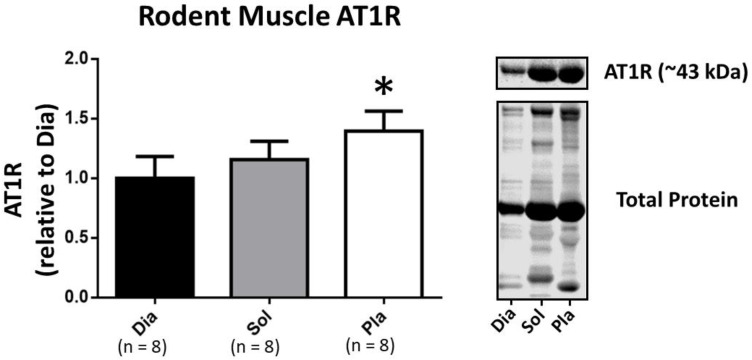
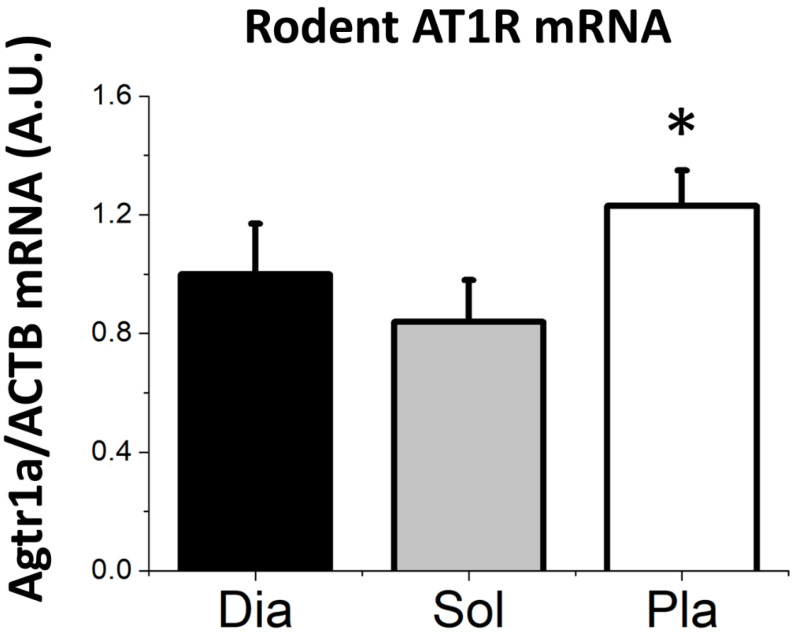
Abundant evidence reveals that activation of the renin-angiotensin system promotes skeletal muscle atrophy in several conditions including congestive heart failure, chronic kidney disease, and prolonged mechanical ventilation. However, controversy exists about whether circulating angiotensin II (AngII) promotes skeletal muscle atrophy by direct or indirect effects; the centerpiece of this debate is the issue of whether skeletal muscle fibers express AngII type 1 receptors (AT1Rs). While some investigators assert that skeletal muscle expresses AT1Rs, others argue that skeletal muscle fibers do not contain AT1Rs. These discordant findings in the literature are likely the result of study design flaws and additional research using a rigorous experimental approach is required to resolve this issue. We tested the hypothesis that AT1Rs are expressed in both human and rat skeletal muscle fibers. Our premise was tested using a rigorous, multi-technique experimental design. First, we established both the location and abundance of AT1Rs on human and rat skeletal muscle fibers by means of an AngII ligand-binding assay. Second, using a new and highly selective AT1R antibody, we carried out Western blotting and determined the abundance of AT1R protein within isolated single muscle fibers from humans and rats. Finally, we confirmed the presence of AT1R mRNA in isolated single muscle fibers from rats. Our results support the hypothesis that AT1Rs are present in both human and rat skeletal muscle fibers. Moreover, our experiments provide the first evidence that AT1Rs are more abundant in fast, type II muscle fibers as compared with slow, type I fibers. Together, these discoveries provide the foundation for an improved understanding of the mechanism(s) responsible for AngII-induced skeletal muscle atrophy.
大量证据表明,肾素-血管紧张素系统的激活会促进几种情况下的骨骼肌萎缩,包括充血性心力衰竭、慢性肾脏病和长时间机械通气。然而,关于循环血管紧张素 II(AngII)是否通过直接或间接作用促进骨骼肌萎缩存在争议;这场争论的核心是骨骼肌纤维是否表达 AngII 型 1 受体(AT1R)的问题。虽然一些研究人员断言骨骼肌表达 AT1R,但也有研究人员认为骨骼肌纤维不含 AT1R。文献中这些不一致的发现可能是由于研究设计缺陷造成的,需要使用严格的实验方法进行更多研究来解决这个问题。我们检验了 AT1R 在人类和大鼠骨骼肌纤维中均表达的假设。我们使用严格的多技术实验设计来检验我们的前提。首先,我们通过 AngII 配体结合测定法确定了人类和大鼠骨骼肌纤维上 AT1R 的位置和丰度。其次,我们使用新的高度特异性 AT1R 抗体进行 Western 印迹,并确定了从人类和大鼠分离的单个肌纤维中 AT1R 蛋白的丰度。最后,我们在从大鼠分离的单个肌纤维中证实了 AT1R mRNA 的存在。我们的结果支持 AT1R 存在于人类和大鼠骨骼肌纤维中的假设。此外,我们的实验首次提供了证据,表明与慢肌纤维(I 型)相比,AT1R 在快肌纤维(II 型)中更为丰富。这些发现为更好地理解 AngII 诱导的骨骼肌萎缩的机制提供了基础。