Department of Physiology and Pharmacology, Wake Forest University School of Medicine, Winston-Salem, NC 27157.
Department of Physiology and Pharmacology, Wake Forest University School of Medicine, Winston-Salem, NC 27157
eNeuro. 2020 Aug 3;7(4). doi: 10.1523/ENEURO.0197-20.2020. Print 2020 Jul/Aug.
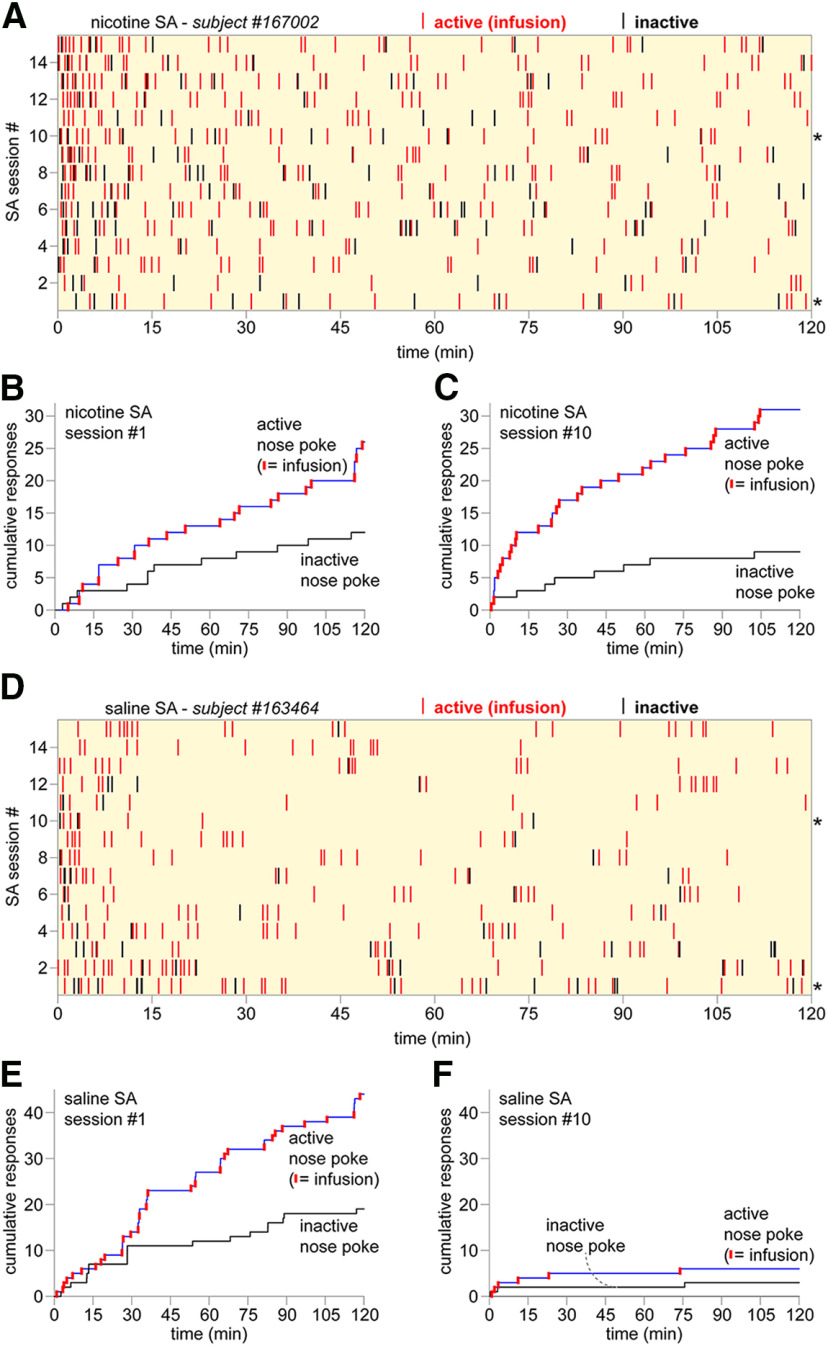
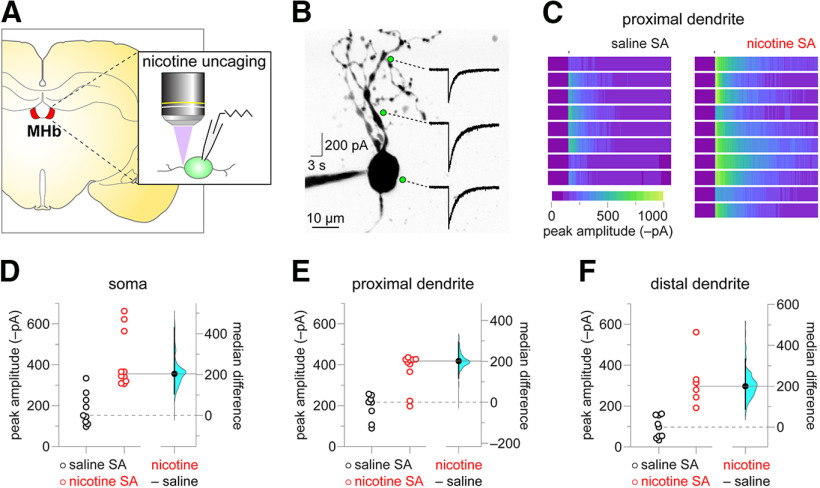
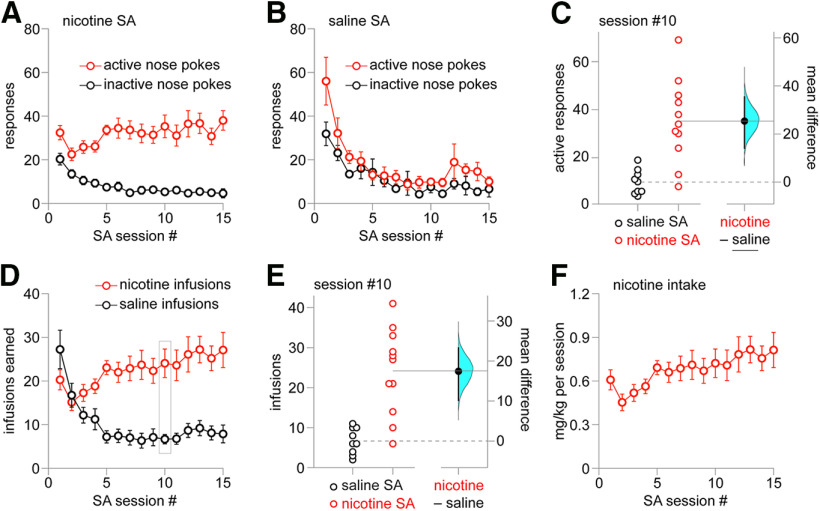
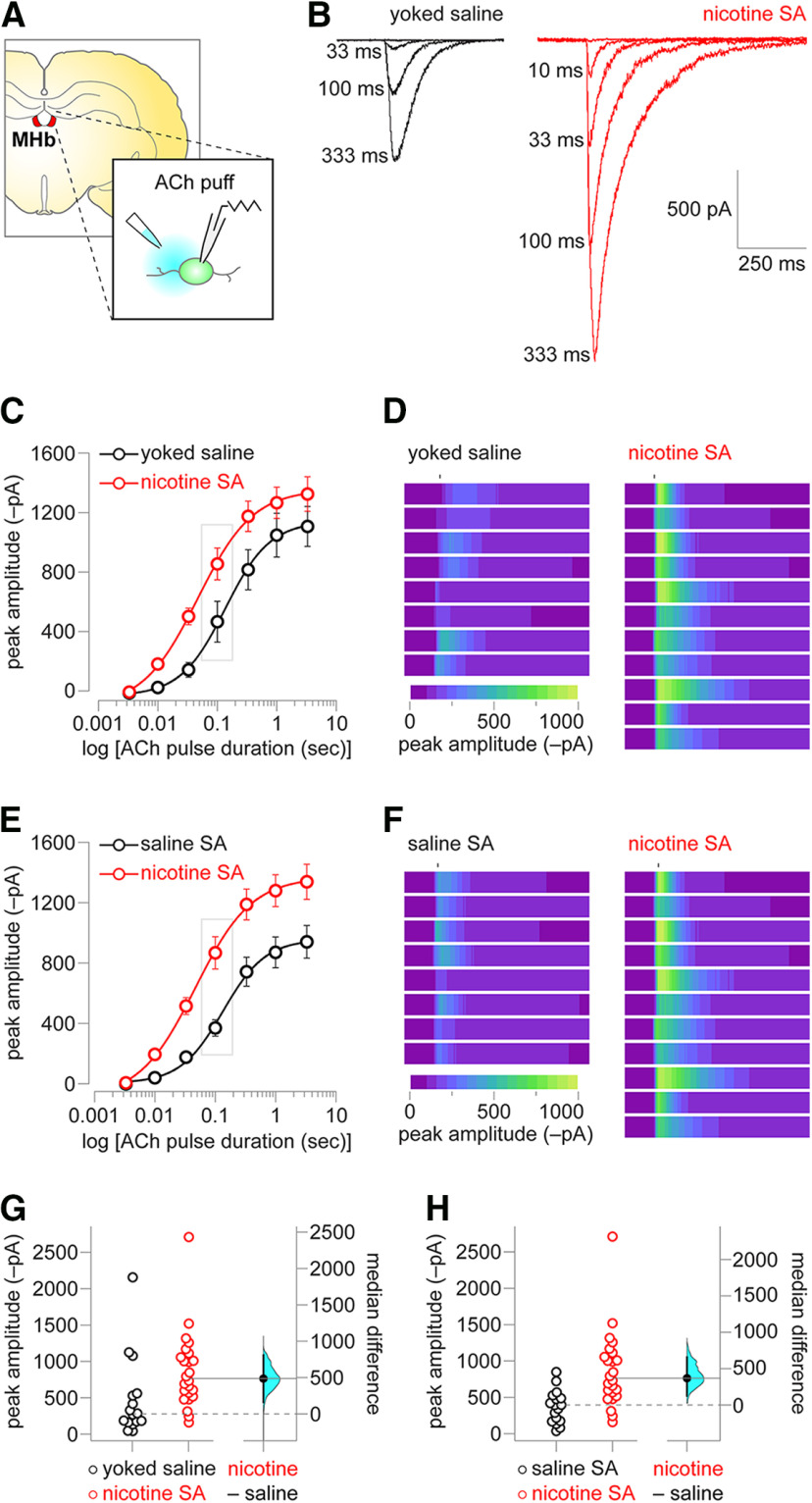
Chronic nicotine upregulates nicotinic acetylcholine receptors (nAChRs) throughout the brain, and reducing their activity may promote somatic and affective states that lead to nicotine seeking. nAChRs are functionally upregulated in animal models using passive nicotine administration, but whether/how it occurs in response to volitional nicotine intake is unknown. The distinction is critical, as drug self-administration (SA) can induce neurotransmission and cellular excitability changes that passive drug administration does not. In this study, we probed the question of whether medial habenula (MHb) nAChRs are functionally augmented by nicotine SA. Male rats were implanted with an indwelling jugular catheter and trained to nose poke for nicotine infusions. A saline SA group controlled for non-specific responding and nicotine-associated visual cues. Using patch-clamp whole-cell recordings and local application of acetylcholine, we observed robust functional enhancement of nAChRs in MHb neurons from rats with a history of nicotine SA. To determine whether upregulated receptors are generally enhanced or directed to specific cellular compartments, we imaged neurons during recordings using two-photon laser scanning microscopy (2PLSM). nAChR activity at the cell soma and on proximal and distal dendrites was examined by local nicotine uncaging using a photoactivatable nicotine (PA-Nic) probe and focal laser flash photolysis. Results from this experiment revealed strong nAChR enhancement at all examined cellular locations. Our study demonstrates nAChR functional enhancement by nicotine SA, confirming that volitional nicotine intake sensitizes cholinergic systems in the brain. This may be a critical plasticity change supporting nicotine addiction.
慢性尼古丁会在整个大脑中上调烟碱型乙酰胆碱受体(nAChRs),而降低其活性可能会促进躯体和情感状态,从而导致尼古丁寻求。在使用被动尼古丁给药的动物模型中,nAChRs 的功能被上调,但对于其是否以及如何对自愿性尼古丁摄入做出反应尚不清楚。这种区别至关重要,因为药物自我给药(SA)可以引起被动药物给药不会引起的神经传递和细胞兴奋性变化。在这项研究中,我们探讨了中脑被盖(MHb)nAChRs 是否通过尼古丁 SA 而功能增强的问题。雄性大鼠被植入留置颈内导管,并接受尼古丁输注的鼻刺训练。盐水 SA 组控制非特异性反应和与尼古丁相关的视觉线索。使用膜片钳全细胞记录和乙酰胆碱局部应用,我们观察到具有尼古丁 SA 史的大鼠 MHb 神经元中 nAChRs 的功能得到了显著增强。为了确定上调的受体是否普遍增强或指向特定的细胞区室,我们在记录过程中使用双光子激光扫描显微镜(2PLSM)对神经元进行成像。通过使用光激活尼古丁(PA-Nic)探针进行局部尼古丁去笼化和聚焦激光闪光光解,在细胞体和近端和远端树突上检查 nAChR 活性。该实验的结果表明,所有检查的细胞位置的 nAChR 增强都很强。我们的研究表明,尼古丁 SA 会增强 nAChR 的功能,证实了自愿性尼古丁摄入会使大脑中的胆碱能系统敏感化。这可能是支持尼古丁成瘾的关键可塑性变化。