Kim Kwanghyun, Jung Sun Jae, Baek Jong Min, Yim Hyeon Woo, Jeong Hyunsuk, Kim Dae Jung, Park Sungha, Youm Yoosik, Kim Hyeon Chang
Department of Preventive Medicine, Yonsei University College of Medicine, Seodaemun-gu, Republic of Korea.
Department of Preventive Medicine, Yonsei University College of Medicine, Seodaemun-gu, Republic of Korea
BMJ Open Diabetes Res Care. 2020 Jul;8(1). doi: 10.1136/bmjdrc-2020-001272.
Social isolation and loneliness are positively associated with metabolic syndrome. However, the mechanisms by which social isolation affects metabolic syndrome are not well understood.
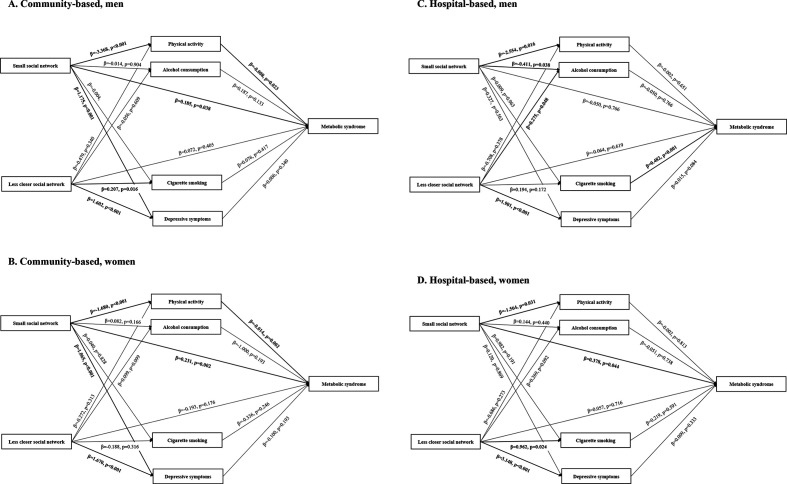
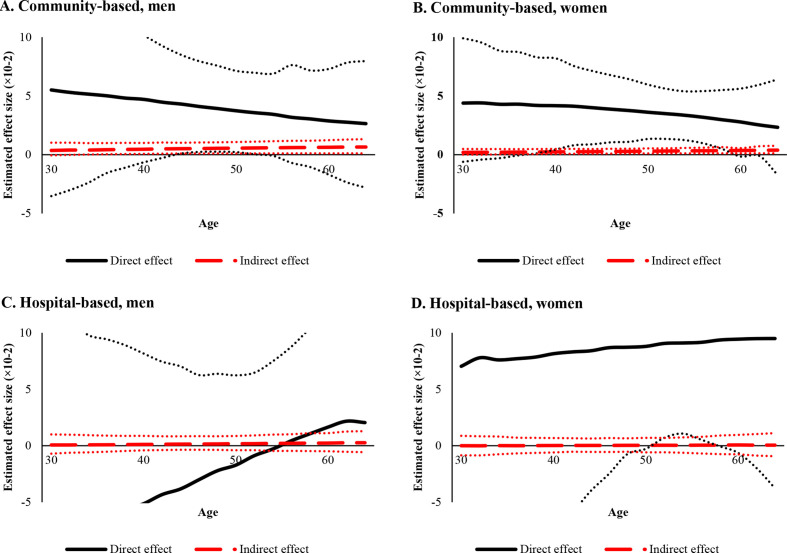
This study was designed as a cross-sectional study of baseline results from the Cardiovascular and Metabolic Diseases Etiology Research Center (CMERC) Cohort. We included 10 103 participants (8097 community-based low-risk participants, 2006 hospital-based high-risk participants) from the CMERC Cohort. Participants aged 65 years or older were excluded. Multiple imputation by chained equations was applied to impute missing variables. The quantitative properties of social networks were assessed by measuring the 'size of social networks'; qualitative properties were assessed by measuring the 'social network closeness'. Metabolic syndrome was defined based on the National Cholesterol Education Program Adult Treatment Panel III criteria. Multivariate logistic regression analyses were conducted to assess association between social network properties and metabolic syndrome. The mediating effects of physical inactiveness, alcohol consumption, cigarette smoking and depressive symptoms were estimated. Age-specific effect sizes were estimated for each subgroup.
A smaller social network was positively associated with higher prevalences of metabolic syndrome in all subgroups, except the high-risk male subgroup. There was no clear association between social network closeness and metabolic syndrome. In community-based participants, an indirect effect through physical activity was detected in both sexes; however, in hospital-based participants, no indirect effects were detected. Cigarette smoking, alcohol consumption and depression did not mediate the association. Age-specific estimates showed that the indirect effect through physical activity had a greater impact in older participants.
A smaller social network is positively associated with metabolic syndrome. This trend could be partially explained by physical inactivity, especially in older individuals.
社会隔离和孤独感与代谢综合征呈正相关。然而,社会隔离影响代谢综合征的机制尚未完全明确。
本研究为横断面研究,分析心血管与代谢疾病病因研究中心(CMERC)队列的基线结果。我们纳入了CMERC队列中的10103名参与者(8097名社区低风险参与者,2006名医院高风险参与者)。排除了65岁及以上的参与者。采用链式方程多重填补法对缺失变量进行填补。通过测量“社交网络规模”评估社交网络的定量特征;通过测量“社交网络亲密度”评估社交网络的定性特征。根据美国国家胆固醇教育计划成人治疗小组第三次报告的标准定义代谢综合征。进行多因素逻辑回归分析以评估社交网络特征与代谢综合征之间的关联。估计了身体活动不足、饮酒、吸烟和抑郁症状的中介作用。对每个亚组估计了年龄特异性效应量。
除高风险男性亚组外,社交网络规模较小与所有亚组中代谢综合征的较高患病率呈正相关。社交网络亲密度与代谢综合征之间无明显关联。在社区参与者中,在男女两性中均检测到通过身体活动产生的间接效应;然而,在医院参与者中,未检测到间接效应。吸烟、饮酒和抑郁并未介导这种关联。年龄特异性估计显示,通过身体活动产生的间接效应在老年参与者中影响更大。
社交网络规模较小与代谢综合征呈正相关。这种趋势可能部分由身体活动不足所解释,尤其是在老年人中。