Sarhan Nasim, Abduljabbar Lulwah, Laperriere Normand, Shultz David, Asha Mohammed, Zadeh Gelareh, Millar Barbara-Ann, Tsang Derek S
Radiation Oncology, Princess Margaret Cancer Center, Toronto, CAN.
Radiation Oncology, King Fahad Specialist Hospital, Dammam, SAU.
Cureus. 2020 Jun 13;12(6):e8604. doi: 10.7759/cureus.8604.
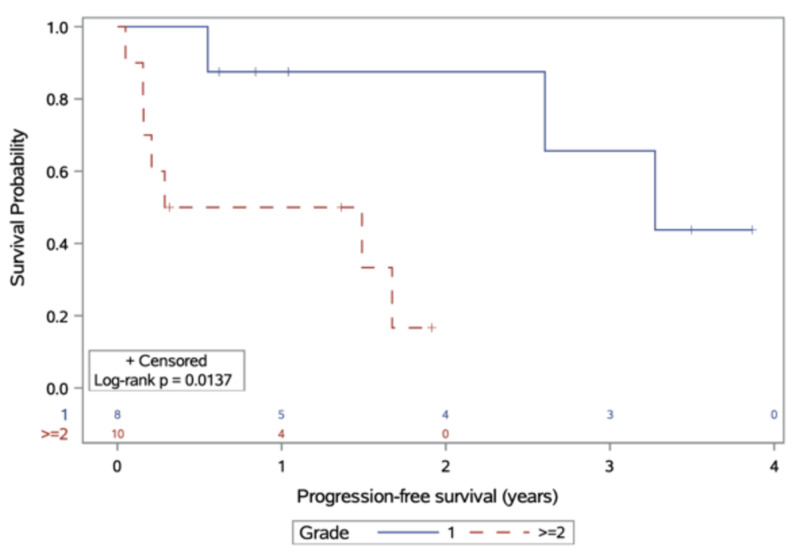
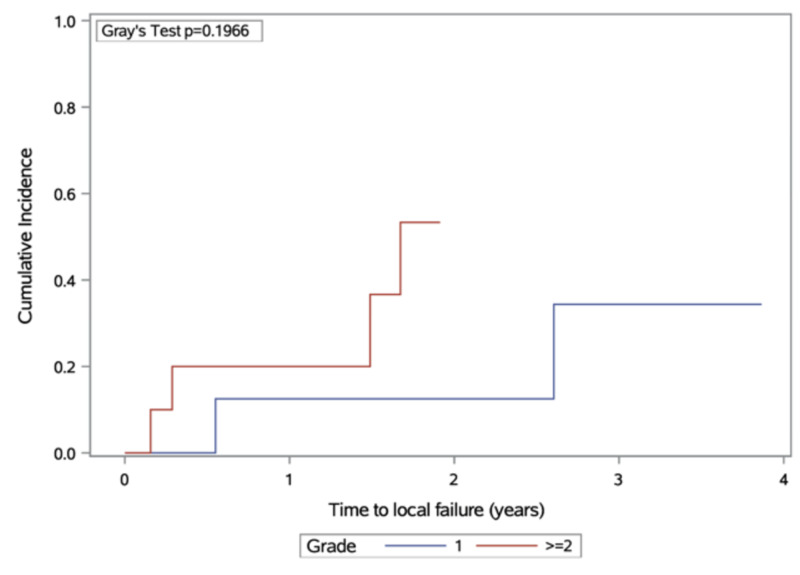
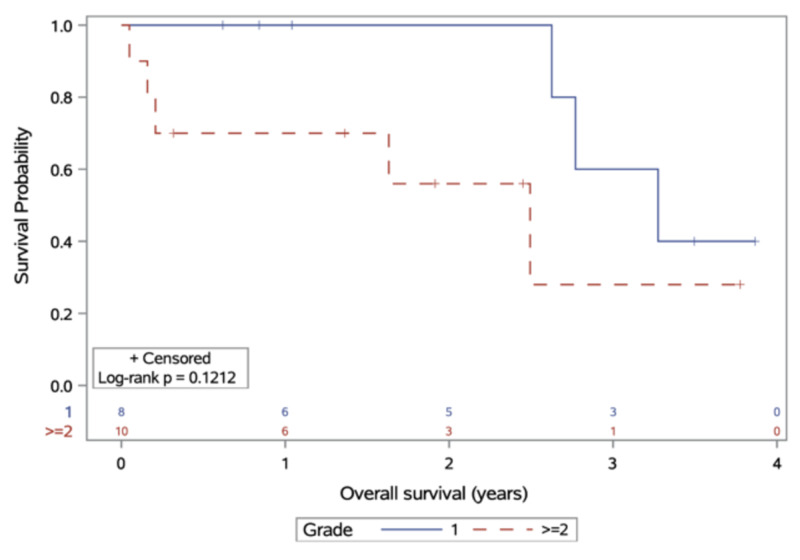
Purpose/Objective(s) The incidence of intracranial meningiomas increases with age. The standard of care treatment is complete surgical excision, followed by radiation therapy (RT) if indicated. However, six weeks of RT can be challenging for elderly or frail patients. The purpose of this study was to determine if short course RT is safe and effective in elderly patients with meningioma. Materials/Methods We performed a retrospective analysis of patients with meningioma treated with short course beam RT (5-15 fractions) at a single institution. Seventeen patients (94%) received 4005 cGy over 15 fractions and one patient (6%) received 2500 cGy over five fractions. Study endpoints were treatment toxicity (edema), progression-free (PFS) and overall survival (OS). Results Eighteen patients with histologically proven (n = 12) or radiologically presumed meningioma (n = 6, presumed grade I) were identified. Median age at treatment was 85 years (66-95 years). There were eight, eight and two patients with grade I, II and III tumours, respectively. Eight patients (44%) had radiologic edema prior to RT. Six (33%) required dexamethasone treatment during RT and the dose was increased during RT for two patients. Fourteen patients had reduced or no edema post-RT and 13 patients had stable or improving symptoms post-RT. Six patients had disease progression (five in-field, one out-of-field). Median PFS was 3.3 and 0.9 years for grade I and II/III tumours, respectively (p = 0.014). Median OS was 3.3 and 2.5 years for grade I and II/III tumours, respectively (p = 0.12). Conclusion Short course RT for elderly patients with meningioma is well-tolerated and can offer disease control for some patients, particularly those with grade I tumours.
目的/目标 颅内脑膜瘤的发病率随年龄增长而增加。标准治疗方法是完整手术切除,如有指征则随后进行放射治疗(RT)。然而,对于老年或体弱患者来说,六周的放疗可能具有挑战性。本研究的目的是确定短程放疗对老年脑膜瘤患者是否安全有效。材料/方法 我们对在单一机构接受短程束流放疗(5 - 15次分割)治疗的脑膜瘤患者进行了回顾性分析。17名患者(94%)接受了15次分割共4005 cGy的放疗,1名患者(6%)接受了5次分割共2500 cGy的放疗。研究终点为治疗毒性(水肿)、无进展生存期(PFS)和总生存期(OS)。结果 确定了18例经组织学证实(n = 12)或放射学推测为脑膜瘤(n = 6,推测为I级)的患者。治疗时的中位年龄为85岁(66 - 95岁)。分别有8例、8例和2例患者的肿瘤为I级、II级和III级。8例患者(44%)在放疗前有放射学水肿。6例(33%)患者在放疗期间需要地塞米松治疗,2例患者在放疗期间增加了剂量。14例患者放疗后水肿减轻或消失,13例患者放疗后症状稳定或改善。6例患者出现疾病进展(5例为野内进展,1例为野外进展)。I级和II/III级肿瘤的中位PFS分别为3.3年和0.9年(p = 0.014)。I级和II/III级肿瘤的中位OS分别为3.3年和2.5年(p = 0.12)。结论 老年脑膜瘤患者的短程放疗耐受性良好,可为部分患者,尤其是I级肿瘤患者提供疾病控制。